A book · London, 1886
Dreams that warned of a death: the 24 cases in “Phantasms of the Living” (Gurney, Myers, and Podmore, 1886)
In 1886, three researchers in London published a book with hundreds of cases. They were people who said they had sensed that someone far away from them was dying. One of the book’s chapters brings together 24 dreams about the death of someone the dreamer knew. Each dream happened less than 12 hours before or after that death. In several of these cases, someone heard about the dream before the news arrived.
The question is: can someone dream of the death of a person they know on the very night that person dies, without knowing anything? The authors believed so, and believed it wasn’t chance. We tell it step by step, with the best cases and with what they lack. If you only want to know what can be checked, skip straight to the results.
Step 1
London, 1882 · The question
Three researchers want to know whether someone can sense from a distance that another person is dying
Edmund Gurney, Frederic Myers, and Frank Podmore were three of the members of the Society for Psychical Research. This society was founded in London in 1882. They noticed a kind of account that came up again and again.
A person dreams of a relative, or sees them, or hears their voice. Days later the news arrives that this relative died that same night, far away.
They wanted to know whether this coincidence was chance. They thought it wasn’t. Their idea was that the mind of a dying person could communicate with the mind of someone still alive. They called this telepathy.
They weren’t looking for spirits. They were looking for communication between two living people, at the moment one of them died.
Step 2
From 1882 to 1885 · The authors’ account
They ask for cases in the newspapers and write to each person

The three researchers placed appeals in newspapers. They asked anyone who had been through something like this to write to them.
Many letters came in. They answered each person with questions. They wanted to know when it happened, whom the person told, and when they learned of the death.
- They asked for the account of the person who experienced it, not that of someone who had heard it secondhand.
- They asked for witnesses: the person who was told before the news arrived.
- They looked for the date of death in documents, such as the death register or the death notices in The Times.
That way they could at least check that the death really happened on that day.
Step 3
1886 · The book
They gather 24 dreams of death that came less than 12 hours from the death

In 1886 they published Phantasms of the Living, in two volumes, with hundreds of cases. One of its chapters is about dreams.
There they drew up a list of 24 dreams that met these conditions:
- The dream was about the death of someone the dreamer knew and was very vivid.
- It happened between 1874 and 1885.
- It came less than 12 hours from the death, before or after.
- The dreamer wasn’t worried about that person. They left out six cases because there was a reason for worry.
According to the dreamers themselves, 20 of the 24 told someone about the dream before they learned of the death.
To know whether 24 was a lot or a little, they needed to know how many dreams like this people have that match nothing.
Step 4
From 1883 · The census of dreams
They ask 5,360 people whether they have ever dreamed of the death of someone they knew
The authors carried out a survey. They called it a census. They asked 5,360 people whether, since 1874, they had had a very vivid dream of the death of someone they knew. It had to be a dream that left them distressed for at least an hour.
- 173 said yes. They removed 7 who were already worried about that person.
- They also counted the people who had had it more than once. That way it came to one person in 26 over 12 years.
- Gurney thought the real figure was lower. People with nothing to report tended not to answer.
With that figure, Gurney worked out how many coincidences chance would produce.
Step 5
1886 · The authors’ calculation
Gurney calculates that chance would produce one coincidence, and they have 24

Gurney knew how many people died each year. With that, he calculated the probability that a dream like this would fall by chance within 12 hours of that person’s death.
This is what he got. If the appeal had reached about 431,000 people, chance would produce a single coincidence. They had 24.
- Gurney believed the appeal had reached far fewer people. He thought it reached 300,000 people at most, and he thought even that was an exaggeration.
- Elsewhere in the book he makes a more precise count. He gets about 72,000 people. He himself says it is a very rough estimate.
For the authors, 24 coincidences were too many to be chance. Let’s look at three of the cases.
Step 6
September 25, 1875 · The case of Annie Harriss
A young woman dreams that her mother has died and tells her friend before the mail arrives
Annie Harriss had been away from home for about six weeks. Her mother’s health had improved a great deal. Two days earlier, Annie had received a letter from her mother. Her mother was well.
One afternoon, on a walk in the country, Annie heard someone call her name several times. It hadn’t been her friend. That night she dreamed that her mother was dying.
In the morning she told her friend, Edith Darwin. An hour later the mail arrived with the news that her mother had died the previous afternoon. Her father wrote the letter that same day. In it he said she died at around 3:45 p.m.
It is one of the three cases on the list with a witness who wasn’t family. The full story is on her page.
Step 7
March 24, 1885 · The case of Gurney’s servant
A servant dreams that a farmer from her old village has died, and writes it down that same week

Mrs. Humphry worked as a servant in Edmund Gurney’s household. She had previously worked for the Jarvis family, in a village in the south of England. One night she dreamed that a milkman who worked for the farmer John Jarvis told her: “He’s gone at last… Mr. John Jarvis is dead.”
The next morning she told another servant, Rose Wade. Five days later the news arrived that John Jarvis had died in the early hours of that morning, at around two. The authors checked it in the death register.
- It is the best-documented case on the list. Her account and Rose Wade’s signed statement were written in the week after the dream.
- It has a weak point. In the dream, someone says “he’s gone at last,” as if the death were expected. The book doesn’t say whether she knew Mr. Jarvis was ill.
The account was written that same week, but probably after the news was already known. The full story is on its own page.
Step 8
February 11, 1882 · The case of the blind boy
A nine-year-old blind boy, a boarder at a school, dreams that his mother has died
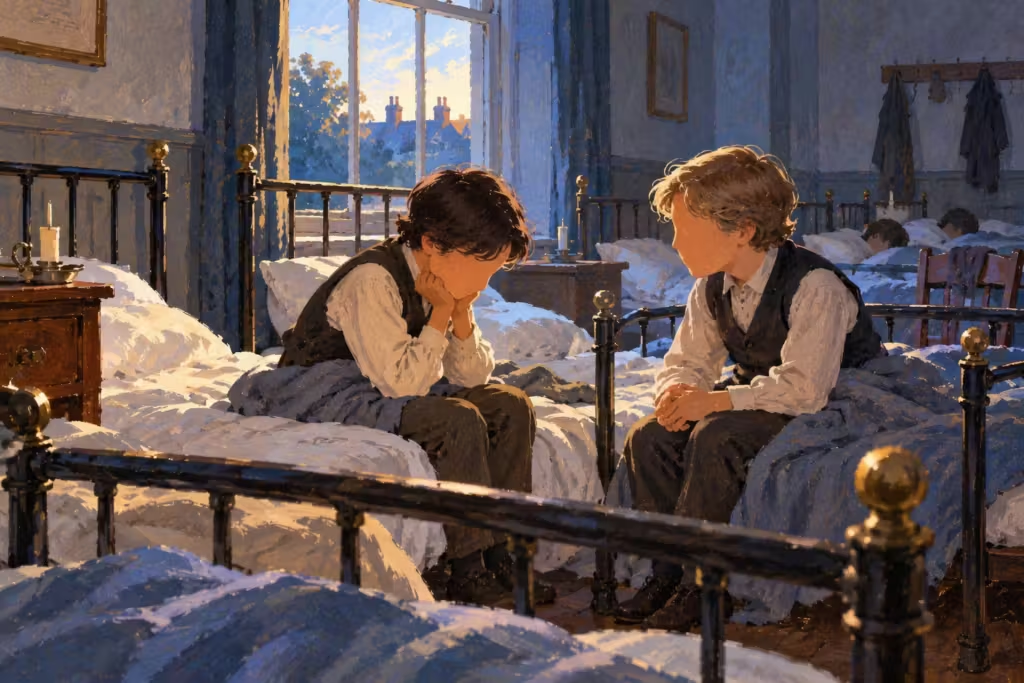
The boy, Tracy, was nine and a boarder at a school for the blind in Worcester. His mother lived in Beccles, more than 250 kilometers away. One Saturday she complained of a headache at 5 p.m. and died at around 8:30.
That night, the boy dreamed that his mother had died. The next morning he told a schoolmate. The letter with the news reached the school on Monday.
- The schoolmate and the headmaster confirm it. Neither was family.
- They wrote it down almost four years later, and their accounts differ. His sister says a teacher found him crying that night, and that in the morning he didn’t talk about it. The schoolmate says the boy told him in the morning.
The Times confirms the date of the death and that it was sudden. The full story is on its own page.
Step 9
The 24 cases · What can be checked
In six cases, someone who heard about the dream before the news confirms it
Not all the cases on the list are worth the same. The best cases have three things. They have a dream with a clear death. They have someone who heard about the dream before the news and confirms it. And they have the date of the death.
- Six cases have all three. Four others are missing one part.
- In three of the six, the person who confirms it isn’t family. They are Annie Harriss’s friend, the other servant, and the blind boy’s schoolmate and headmaster.
- Only 3 of the 24 dreamers clearly knew there was a risk. The risks were a pregnancy, a grandmother who was unwell, and a case of tuberculosis. None of those three is among the best six.
- In 19 of the 24 cases, a document from the time confirms the death. It may be the register, a death notice, or a letter.
What they have is strong. But they all lack the same thing.
Step 10
The 24 cases · What is missing
No one wrote down a dream before the news arrived

To be sure, we would need a piece of paper with the dream written and dated before the news. And someone would have to have seen that paper. There is no paper like that in any of the 24 cases.
- One dreamer wrote it down in a notebook, but no one saw the note until after the news. He himself says: “As evidence, of course, this is worthless.” We tell the whole case in Frederick Wingfield’s story.
- Two others say it was written down in a diary. Those diaries were never produced.
- The witnesses tell it later. Some tell it a few days later and others up to ten years later. All of them tell it when they already know how it ended.
- In six cases there is a document to compare with, and the account doesn’t match it. What doesn’t match is, for example, the month of the death, the day of the dream, or an object in the dream.
One hard question remains. How many coincidences like these would pure chance produce?
Step 11
Today · Chance
Chance depends on two figures no one has measured
Gurney’s calculation used the vivid dreams people remembered years later. But in the best cases, something else matters. What matters is that the dream was told to someone.
To know how many coincidences chance would produce, two figures are needed:
- How many people the appeal reached. Gurney could only make a rough guess, with very little data.
- How often a person tells someone about a dream of the death of someone they know. No study has measured it.
If people rarely tell these dreams, the six best cases are more than chance would produce. If they tell them often, chance might be enough.
There is one clue in the cases themselves. Of the 13 dreamers who mention other dreams of death, 10 say this was the only one like it in their lives.
But the dreamers say this years later, and memory plays a part too.
Step 12
1887 · A critique from the time
An American philosopher criticizes the book’s calculations

In 1887, the philosopher and mathematician Charles S. Peirce published a critique of the book. He focused on the apparitions people said they saw while awake, not on these dreams.
Peirce said the cases didn’t meet the conditions that the calculation itself required. He also wrote about his own dreams. He said they were “largely fabricated after I wake up, in trying to recover and go over in my mind what I had been dreaming.” So he believed the memory of a dream could change with what a person learns afterward.
Gurney replied to him twice, point by point. Gurney died in 1888.
The question from the start remains: is it possible to dream of someone’s death on the night they die, without knowing it? Let’s see what can be said.
From 24 dreams to six clear cases
The table shows how many cases are left at each step.
The four cases “with reservations” have the dream told before the news. But each one is missing one part. It may be the name of the person who died, the order relative to the news, or a dream that is clearly about a death.
| Step | Cases |
|---|---|
| Dreams of death on the list | 24 |
| Told before the news, according to the dreamer | 20 |
| Confirmed by the person who heard it | 16 |
| With a clear death, a prior witness, and a date | 6 |
The six clear cases
The table shows who confirms hearing about the dream before the news, and how long afterward they said so.
| Case | Who confirms it | When |
|---|---|---|
| Annie Harriss: her mother, 1875 | Her friend, from outside the family | 9 years |
| Gurney’s servant: a farmer, 1885 | Another servant, from outside the family | days |
| The blind boy: his mother, 1882 | A schoolmate and the headmaster | almost 4 years |
| A student: an acquaintance, 1875 | His brother | 10 years |
| A 7-year-old girl: a baby, 1882 | Her mother | 1 year |
| A woman: her uncle, 1882 | Her husband | 3 years |
What these figures don’t tell
- How many dreams of death matched nothing. The book only includes the ones that matched.
- Whether the witnesses remembered correctly. The figures count what they said, not whether it was accurate.
Where this page comes from
The book
- Edmund Gurney, Frederic Myers, and Frank Podmore, Phantasms of the Living, vol. 1 (Trübner, London, 1886), in the public domain. The list of 24 dreams and the census, on pages 303-311Read for free
- Edmund Gurney, Frederic Myers, and Frank Podmore, Phantasms of the Living, vol. 2 (Trübner, London, 1886), in the public domain. The calculation of chance, in chapter 13Read for free
Assessments and critiques
- Charles S. Peirce, “Criticism on Phantasms of the Living” and “Mr. Peirce’s rejoinder,” with Edmund Gurney’s replies, Proceedings of the American Society for Psychical Research 1 (1887), pages 150-215 and 286-301, in the public domainRead for free
To understand more
- The census of hallucinations: 17,000 people and the apparitions that coincided with a deathRead
- Annie Harriss: the dream about her mother, one of the six clear casesRead
- J. F. Morse (1897): a dream a doctor wrote down before the news arrivedRead
- John Owen (1892): the dream of his mother’s funeral, written down before the newsRead
- What does science say about near-death experiences?Read
- What is a near-death experience?Read
Our archive
- A full reading of the 24 cases, the census, the chapter on chance, and Peirce’s critique, as of October 21, 2026
More studies

AWARE: the pictures hidden on the shelves
Fifteen hospitals put up pictures that could only be seen from the ceiling, to check whether anyone saw them during a cardiac arrest.

AWARE II: a random picture and the brain on the screen
Above the patient was a tablet with a random picture. Headphones said the names of three fruits. And the doctors measured the brain during resuscitation.

Van Lommel: 344 cardiac arrest survivors in ten hospitals
Ten hospitals asked every cardiac arrest survivor what they remembered. They saw them again after 2 and 8 years.