A study · Murcia and Cartagena (Spain), published in 2026
The Murcia MRI study: what the brain does when recalling a near-death experience
A team of Spanish doctors and researchers put 15 people who had had a near-death experience into an MRI scanner. They asked them to recall that experience while the scanner measured which areas of the brain were working. Areas we use to remember what has happened in our lives became active. The areas that first receive what comes in through the eyes and ears did not. The authors believe the brain stores that memory like the memories of one’s own life, and not like those of something imagined. They themselves call it a preliminary study.
The study’s question is: does the brain store the memory of an NDE like the memories of one’s own life or like those of something imagined? We tell it step by step. If you only want to know what it found, go straight to the results.
Step 1
Before the study · The question
An MRI scan cannot be done during a cardiac arrest, but it can when the experience is recalled

Many researchers believe an NDE is created by the brain when it is in danger, because of the lack of oxygen or chemicals the brain itself produces. Others disagree. The debate remains open.
According to the authors, no test that produces images of the brain can capture the experience while it happens during a cardiac arrest. An MRI scan is one of those tests. What can be watched is what the brain, once recovered, does when the person remembers their NDE. Other studies have measured the brain’s electrical activity during resuscitation. They did it with an electroencephalogram. We describe this in the AWARE II study.
This study looks at the memory, not the experience.
Step 2
The team · As the study tells it
A doctor from Murcia and his team

José Alonso Ruiz is a professor at the Faculty of Medicine of the Catholic University of Murcia. The co-authors are researchers from the same university, from the University of Castilla-La Mancha and from a research center in Murcia.
The scans were done at the Virgen de la Arrixaca Hospital in Murcia and at the Perpetuo Socorro Hospital in Cartagena. The authors write that they did the work in their own time and that it does not speak for their universities.
Step 3
The method · As the study tells it
A machine that shows which areas of the brain are working
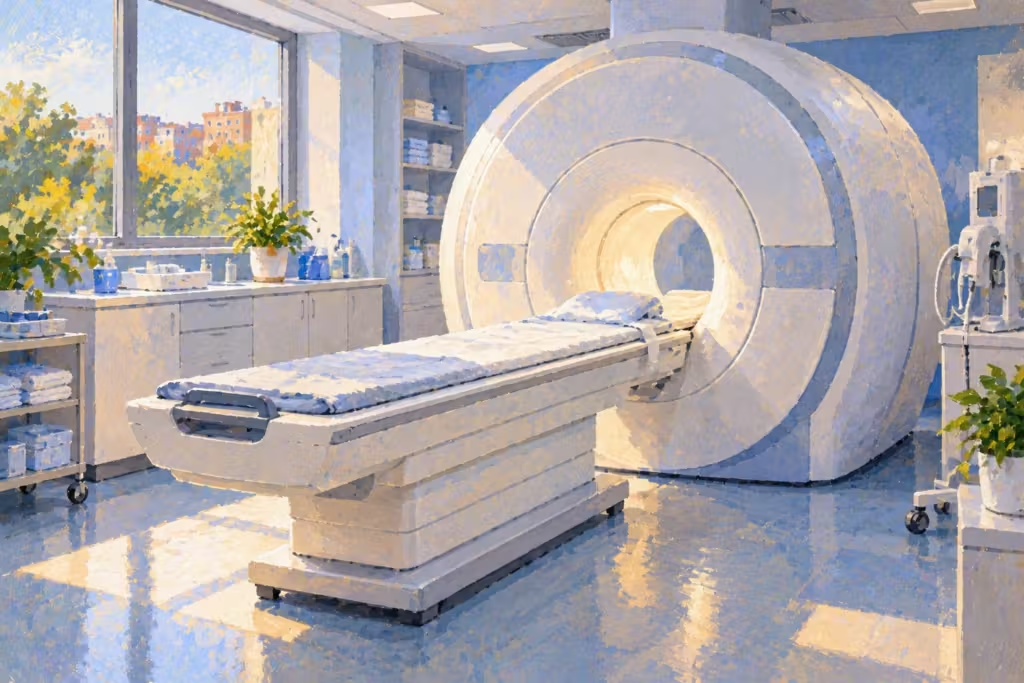
Functional magnetic resonance imaging, or fMRI, is a test in which the person lies inside a large tube. The machine measures which areas of the brain receive more blood at each moment. An area receiving more blood is an area that is working harder.
This makes it possible to compare what the brain does while the person carries out a task and while they rest.
Step 4
The participants · As the study tells it
15 people who nearly died

15 people took part, 7 women and 8 men, aged 18 to 75. All had survived something very serious in which they lost consciousness. 11 had a cardiac arrest. The others had meningitis, a very severe head injury or a very sharp drop in blood sugar.
The team reviewed each person’s medical records at two hospitals. All scored between 12 and 26 points on the Greyson scale, the questionnaire used to decide whether something is an NDE. The scale goes from 0 to 32, and 7 points or more already counts as an NDE.
People with a psychiatric illness or paranoid traits could not take part, nor could people who used drugs. Neither could people with severe cancer or a severe metabolic disease, nor people whose diagnosis was uncertain. And they had to report a vivid and coherent experience.
Step 5
Before the scan · As the study tells it
Training to relive a memory with all the senses

Before entering the scanner, each person did a training session with a psychologist. First they had to relive an important memory from their life other than the NDE. They had to remember it as if living it again, with what they saw, heard and smelled. They were not to judge it or give it a spiritual meaning.
Then they had to recall their NDE in the same way. Only the people who remembered both that important memory and their NDE well, and always in the same way, went into the scanner.
Step 6
Inside the scanner · As the study tells it
Recalling the NDE and emptying the mind, ten times
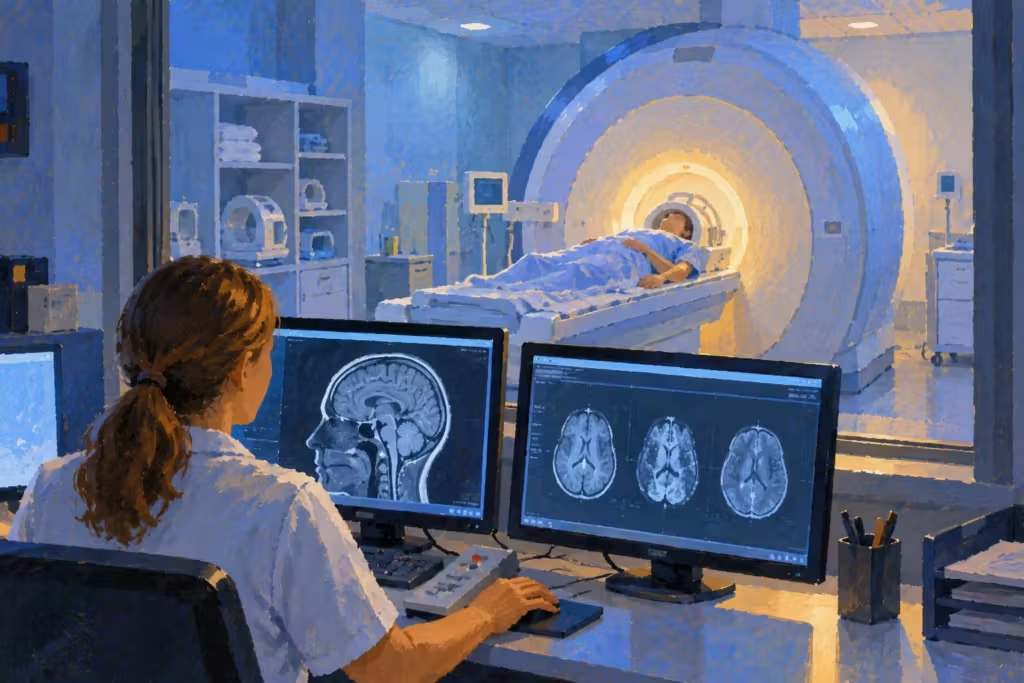
Inside the scanner, each person alternated between two things. For a few seconds they recalled their NDE. Then they emptied their mind. They repeated this ten times.
The team compared what the brain did while recalling the NDE with what it did with the mind empty. There was no other task inside the scanner. Nobody recalled anything else or imagined anything while being measured.
Step 7
The results · As the study tells it
Areas of memory for one’s own life become active
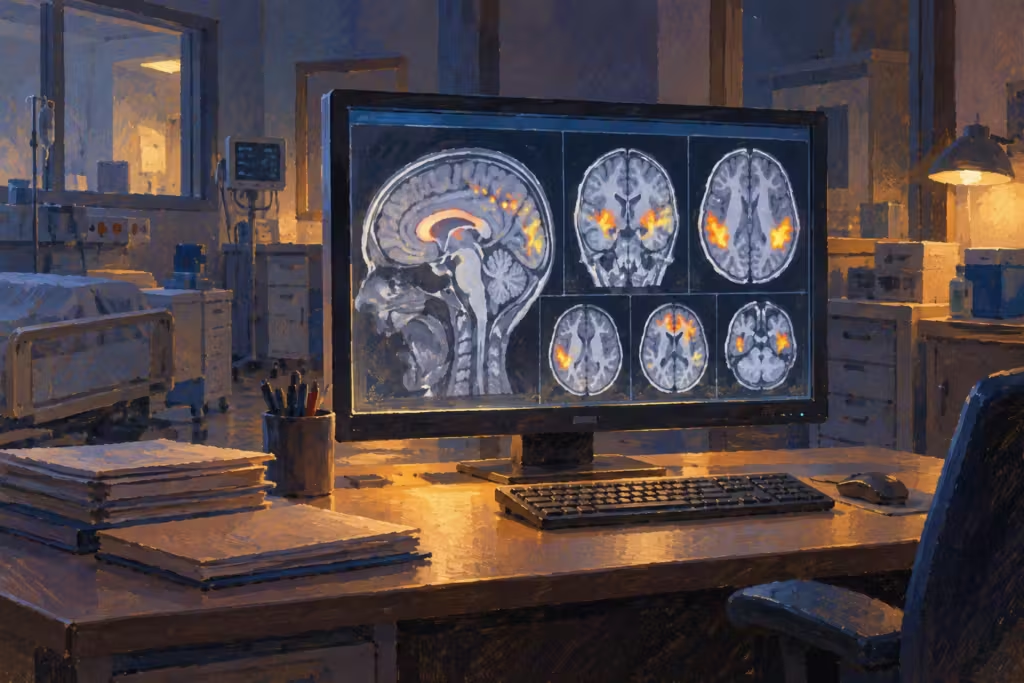
First they searched for activity across the whole brain. According to the authors, only weak signals appeared, not enough to claim anything.
Then they looked only at 9 small areas they had chosen beforehand, based on earlier studies. In 8 of them the activity was clear, higher than with the mind empty. Those 8 areas are used to remember one’s own life, to think about oneself and to see again in the mind what one saw. The hippocampus, an area closely linked to memory, showed some activity, but not enough to be considered certain.
According to the authors, the areas that first receive what comes in from the senses, such as sight and hearing, did not become active. Neither did the areas that send the commands to move the body, nor the limbic areas, which are involved in emotions and memory. Other areas that the authors link to emotions did become active. One helps to control them. Another links them to memories. Most of the activity was on the left side of the brain.
Step 8
In the discussion · As the authors interpret it
For the authors, it resembles the memories of one’s own life

The authors conclude that the pattern fits a vivid memory of one’s own life, generated internally by the brain. They write that this pattern differs from the one other studies describe for imagined experiences or hallucinations.
According to them, hallucinations usually activate the areas that receive what comes in through the senses, and here those areas did not become active.
They also write that their result matches other studies done with questionnaires or with the electroencephalogram, the test that measures the brain’s electrical activity. Those studies found that the NDE is remembered like the events of one’s own life, not like something imagined.
Step 9
2026 · As the authors acknowledge
A preliminary study, with its limits

The authors themselves point out the limits of their study:
- It looks at the memory, not the experience. The brain was healthy and receiving a normal blood supply. They call this “a major and inherent limitation.”
- There are few people. With 15 people, they estimate the study had only a 55% chance of detecting a medium-sized difference, if there was one.
- It does not deal with what is seen during resuscitation. Some patients say they saw what was happening in the room while they were being resuscitated. The authors write that what those patients see “falls outside the scope” of the study.
They call for repeating it with more people, measuring them again after some time and combining the scanner with other tests.
15 people and 8 clear areas out of 9
All 15 recalled their NDE in the scanner.
The activity was clear in 8 of the 9 areas examined.
| Item | Figure |
|---|---|
| People in the scanner | 15 |
| People with a cardiac arrest | 11 |
| Average score on the Greyson scale | 17.3 |
| Brain areas chosen beforehand | 9 |
| Areas with clear activity | 8 |
| Chance of detecting a medium-sized difference, according to the authors | 55% |
What these figures don’t tell
- These are not people chosen at random, so they do not represent everyone who has had an NDE. They were chosen because they remembered their NDE vividly and coherently, and had no psychiatric illness.
- They measure the memory, not the experience. The scan was done afterward, with the brain already recovered.
Frequently asked questions
Does the Murcia MRI study prove that near-death experiences are not hallucinations?
The article does not say that. It concludes that the NDE memory resembles a vivid memory of something from one’s own life. It adds that it differs from what other studies describe for hallucinations. The scanner did not compare it with the memory of a hallucination.
Which areas of the brain become active when recalling a near-death experience?
In a 2026 study with 15 people, recalling the NDE activated areas used to remember one’s own life and to think about oneself. The areas that first receive what comes in from the senses did not become active, nor did the limbic areas, which are involved in emotions. Other areas that the authors link to controlling emotions did. The authors present it as a preliminary study.
Can an MRI scan show what happens in the brain during a near-death experience?
No. Nobody can put someone who is having a cardiac arrest into an MRI scanner. What can be studied is what the brain does when the person, once recovered, remembers their experience.
Where this page comes from
The study
- José Alonso Ruiz, Mayte Rodríguez-González-Moro, Tomás Segura, Víctor M. Serrano del Pueblo and Salvador D. Aznar-Cervantes (2026), “Neural regions associated with memories of Recalled Experiences of Death (REDs; authentic Near-Death Experiences [NDEs]): a preliminary functional MRI study,” Resuscitation Plus 29:101332Read for free
To learn more
- Sans Segarra and supraconsciousness: what he says about this kind of scan, and what the study saysRead
- What does science say about near-death experiences?Read
- Greyson’s study: the same near-death experience, told twice 19 years apartRead
- The Murcia ICU study: 170 patients and 10 near-death experiencesRead
- The AWARE II study: a random image and the brain on screenRead
Our archive
- A full reading of the article and its tables, checked on October 23, 2026
More studies
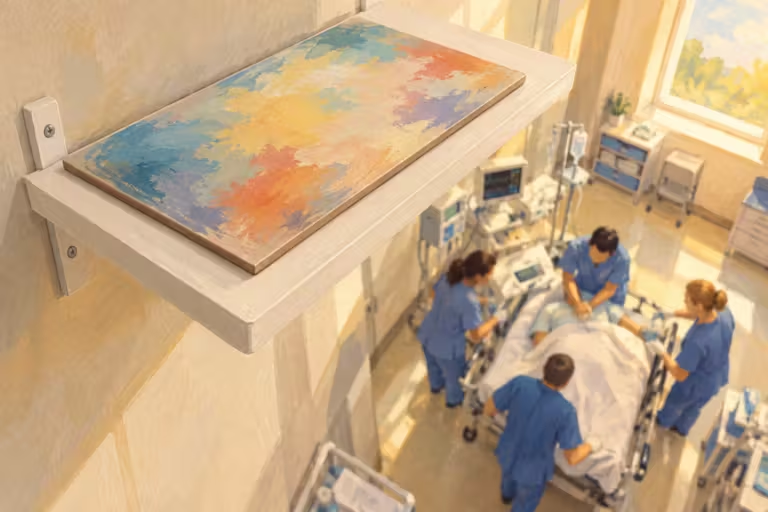
AWARE: the pictures hidden on the shelves
Fifteen hospitals put up pictures that could only be seen from the ceiling, to check whether anyone saw them during a cardiac arrest.
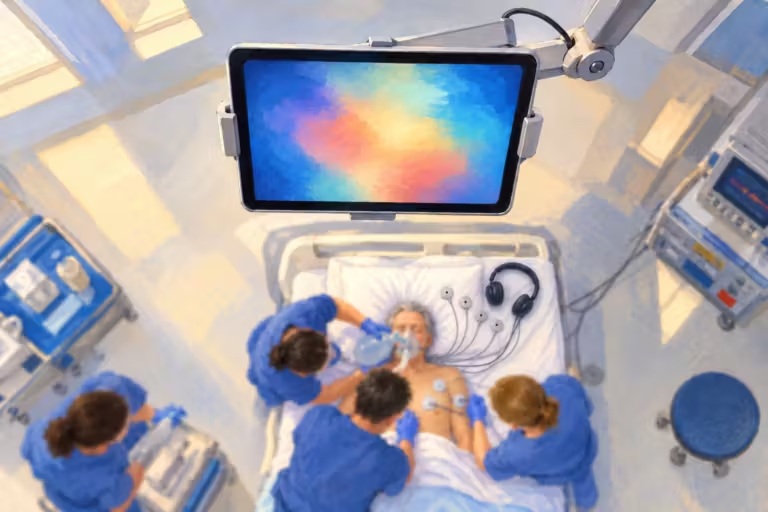
AWARE II: a random picture and the brain on the screen
Above the patient was a tablet with a random picture. Headphones said the names of three fruits. And the doctors measured the brain during resuscitation.
Van Lommel: 344 cardiac arrest survivors in ten hospitals
Ten hospitals asked every cardiac arrest survivor what they remembered. They saw them again after 2 and 8 years.