A study · Murcia (Spain), 2013 to 2015 (published in 2016)
The Murcia ICU study: 170 patients and 10 near-death experiences
A researcher spent two and a half years talking with the patients in the ICU of a hospital in Murcia, Spain. Of 170 patients, 10 described a near-death experience. None of the 10 saw themselves outside their body. The same researcher collected 45 accounts through a Facebook group. There, more than half said they had seen themselves outside their body. The author believes the data gathered in the hospital are more reliable.
The study’s question is: how many patients in a Spanish ICU describe an NDE? And also: are their accounts like those of people who decide to tell their NDE on their own, some time later? We tell it step by step. If you only want to know what it found, go straight to the results.
Step 1
Before the study · The question
The hospital studies had been done outside Spain

The best-known hospital studies of NDEs came from the Netherlands, England and the United States. They mostly asked people who had survived a cardiac arrest.
Cristina Lázaro wanted to know how many patients in a Spanish ICU describe an NDE. She also wanted to know whether what they describe is like what patients in other countries had described.
And she wanted to compare those patients with people who, some time later, decide to tell their experience on their own.
Step 2
2012 to 2013 · As the thesis tells it
A researcher on her own, with no funding and a Facebook group

Cristina Lázaro Pérez is a psychologist and had done a master’s degree in anthropology at the University of Murcia. Her master’s thesis was already about NDEs.
In 2012 she created a Facebook group about near-death experiences. It grew to more than 14,200 members.
She asked several foundations in Spain and abroad for funding, and none of them wanted to pay for the study. She did it on her own and paid for it herself.
The first hospital she asked for permission said no. It told her that these patients were hard to find and that it did not think it appropriate to interview them at the end of their lives. The second hospital, the Reina Sofía in Murcia, did give her permission, after its research and ethics committees reviewed the study. Seven months passed from her first request to the day the second hospital approved it.
Step 3
July 2013 to December 2015 · As the thesis tells it
She talks with every ICU patient she can
Cristina Lázaro went to the ICU of the Reina Sofía hospital from Monday to Friday, in the mornings. She was not looking only for people who had had a cardiac arrest. She talked with every patient she had access to, whatever their illness.
The thesis counts 1,134 admissions to the ICU. She was able to interview 170 patients, about 15 for every 100 admissions. Many were left out:
- those who came into the ICU and left it over a weekend or a public holiday;
- those who died;
- psychiatric patients;
- and those who were confused or too weak to talk.
She saw sedated patients later, once they were able to talk.
Step 4
In the first two days · As the thesis tells it
One single question to start
Cristina Lázaro tried to talk with each patient within the first two days. She introduced herself and asked one single question:
“Do you have any memory of the time of your cardiac arrest or of your time of unconsciousness?” (translated from Spanish)
If the patient said no, she did not go on with the questionnaire. If the patient said yes, she asked them to describe what they had experienced, recorded the conversation and asked the questionnaire’s questions.
The interviews were done in bits and pieces. In the ICU there was always something that cut them short, like a beeping monitor, a medication or the doctor’s visit.
That is why only 3 patients were able to answer the questionnaire used to decide whether something is an NDE. It was created by the psychiatrist Bruce Greyson and is called the Greyson scale.
Step 5
In the ICU interviews · As the thesis tells it
Of 170 patients, 10 describe an NDE
Of the 170 patients, 10 described something they experienced during the problem that brought them to the ICU. That is about 6 in 100.
The drawing has 100 circles. The 6 filled-in ones are, roughly, the share of interviewed patients who described an NDE.
None of the 10 brought it up on their own. All of them described it when she asked.
Another 9 patients described an NDE they had had before, at another time in their lives. Those are not part of the figure of 10.
Step 6
In the ICU interviews · As the patients tell it
A place not of this world, peace and a light
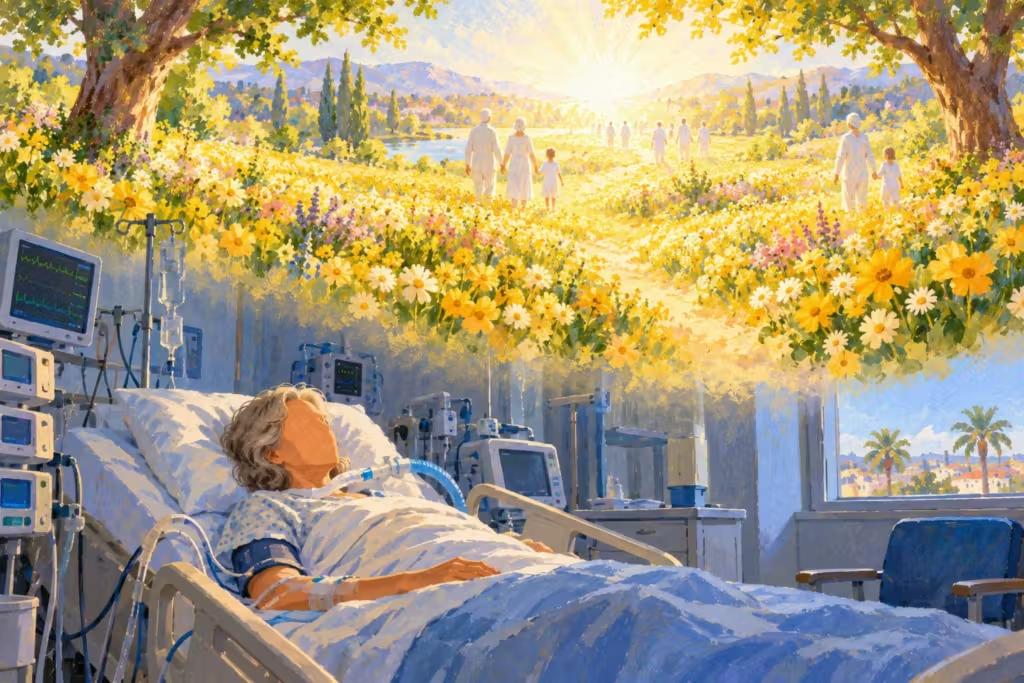
This is what the 10 patients described:
- 7: were in a place that was not of this world.
- 6: felt peace.
- 4: saw a light.
- 4: met other beings.
- 4: heard noises or sounds.
- 2: went through a tunnel.
- 2: saw relatives or friends.
Patient 152, a 67-year-old woman, said she was in a paradise of yellow flowers. There was a tunnel, a light and, in the distance, people dressed in white. Another 67-year-old woman, patient 58, saw her mother and her sister, who had died 20 days earlier.
None of them saw scenes from their life pass by. And none said they saw themselves outside their body. Patient 152 came closest. When she was asked whether she felt separated from her body, she said: “I think I left my body and I felt separated from it.”
Two of the 10 experiences were distressing.
A 20-year-old man had been poisoned by a fumigation product. He felt he was drowning “at the bottom of the sea” or inside a coffin, and that he was shouting without anyone hearing him. A 46-year-old man had, in his words, the most unpleasant nightmares of his life. In one, he was competing with another person and whoever lost died. In the other, he watched a scene of violent, bloody sex.
Step 7
Looking at why they were in the ICU · As the thesis tells it
Three had had a cardiac arrest, and several came from surgery

The 10 patients were in the ICU for different reasons. Four had a heart problem, three came from surgery, two had respiratory failure and one had been poisoned.
At least three had had a cardiac arrest. One of them is patient 152, the one with the fullest experience. Patient 4’s heart stopped six times while she was having a pacemaker fitted. Patient 146 had two cardiac arrests, and only remembers a flash of light, which he links to the defibrillator.
According to the author, only one of the 10 had been given drugs that could have confused their experience. It is the man with the nightmares. But another patient, who came from surgery, thinks what she experienced was due to the anesthesia.
The author also mentions something else. Patients who remembered confused things were not included in the thesis. She thought those memories were due to medication.
Step 8
2012 to 2016 · As the thesis tells it
45 accounts that arrive through Facebook

At the same time, Cristina Lázaro collected NDE accounts through her Facebook group. Anyone who wanted to take part talked with her first. If she felt someone showed “signs of disturbance or psychological disorder,” or that what they had was not an NDE, she did not send them the questionnaire.
The rest received the questionnaire by email and answered it in writing, without an interview. 45 replies came in, about experiences from some time back.
The author herself warns that these data are not rigorous. She does not know how many people in the group had an experience and did not write, and she did not see any medical report.
The thesis also includes other material. There are accounts from 23 people who contacted her outside the hospital. There are visions of patients at the end of life, told by their relatives. And there is a survey of the ICU staff. This page focuses on the ICU patients and on the 45 from Facebook, which are the groups the thesis compares.
Step 9
Comparing the two groups · As the thesis tells it
The Facebook accounts look little like the ICU ones

The author put in a table what the 10 ICU patients and the 45 Facebook respondents described. In almost everything, the Facebook accounts had more:
- Seeing oneself outside the body: none of the 10 in the ICU, and 28 of the 45 people on Facebook. That is 62 in 100.
- Changes in how they see life and death: 2 of the 10 in the ICU, and 91 in 100 on Facebook.
- Seeing a light: 4 of the 10 in the ICU, and 69 in 100 on Facebook.
- Going through a tunnel: 2 of the 10 in the ICU, and 51 in 100 on Facebook.
- Seeing scenes from one’s life pass by: none of the 10 in the ICU, and 36 in 100 on Facebook.
One thing went the other way. 7 of the 10 ICU patients said they were in a place that was not of this world. On Facebook, 29 in 100 said so.
In the ICU, 2 of the 10 experiences were distressing. Of the 45 from Facebook, the author counts 43 as pleasant and does not say what the other 2 were like.
The two groups differ in several ways at once. The Facebook group decided to write in themselves, while she asked the ICU patients. The Facebook group answered in writing, and the ICU patients in person. And the Facebook group told it some time later, while the ICU patients told it within a few days.
Step 10
September 2016 · As the thesis tells it
The author draws four conclusions

Cristina Lázaro defended the thesis at the University of Murcia in September 2016. These are her conclusions:
- NDEs happen in the hospital, but less often than she expected. She estimates that about 6 in 100 ICU patients have them. She believes what they describe is the same as in studies from other countries.
- Hospital studies are more reliable. She says so after comparing the ICU accounts with the Facebook ones. In her view, cases told some time later are less clear. She believes they are muddied by medication or by wanting to believe one has had an NDE.
- Drugs do not cause all NDEs. According to her, medication produced confused memories and the NDEs were clear.
- NDEs remain without a scientific explanation. In her view, they show that consciousness “probably does not reside in a physical organ.” She adds that this is, at least, what those who have had them say.
The author acknowledges several limits. She worked alone, and writes that it would have helped to have other people, skeptics included, double-check the data. She could not follow the patients in the years that followed. And she only gave the Greyson scale to 3 of the 10.
Let’s see what can and can’t be known from these data.
From 1,134 admissions to 10 experiences
The researcher could only talk with some of the ICU patients.
And of those who described an NDE, only 3 answered the scale.
| Group | People |
|---|---|
| ICU admissions counted in the thesis | 1,134 |
| Patients interviewed | 170 |
| Described an NDE during their stay | 10 |
| … of whom answered the Greyson scale | 3 |
| … of whom had a distressing experience | 2 |
| Patients who described an NDE from another time in their lives | 9 |
| Accounts collected through Facebook | 45 |
What these figures don’t tell
- Only patients who could talk were included. The most seriously ill, those who died and those who were confused are missing. More in How many people have an NDE?
- Confused memories were left out. The author put them down to medication.
- The 45 from Facebook do not represent everyone who has had an NDE. Whoever wanted to wrote in, and the author did not send the questionnaire to those whose experience she did not think was an NDE.
Frequently asked questions
How many patients in a Spanish ICU have a near-death experience?
In the ICU of the Reina Sofía hospital in Murcia, 10 of 170 patients interviewed between 2013 and 2015 described an NDE. That is about 6 in 100. Cristina Lázaro measured it in her 2016 doctoral thesis. It is all in “What the Murcia ICU study found.”
Do ICU patients who describe a near-death experience see themselves outside their body?
In the Murcia ICU, none of the 10 patients who described an NDE said they saw themselves outside their body. One patient said she thought she had left it. In contrast, 28 of the 45 people who wrote to the same researcher through Facebook said they saw themselves outside their body.
Are near-death experiences told online different?
In Cristina Lázaro’s thesis, yes. The 45 people who answered through Facebook more often described a tunnel, a light, seeing themselves outside the body and changes in their life. The ICU patients described them much less. It is not known whether that is because they decided to write in themselves, because they answered in writing or because they told it some time later.
Do drugs cause the near-death experiences in the Murcia ICU?
The study’s author believes they do not cause all of them. But patients with confused memories were left out of the thesis, because she put them down to medication. So the study cannot know what role drugs played.
Where this page comes from
The study
- Cristina Lázaro Pérez (2016), La conciencia en el umbral del tránsito: experiencias cercanas a la muerte [Consciousness at the threshold of passing: near-death experiences], doctoral thesis, University of Murcia, in SpanishRead for free
- The thesis record on the University of Murcia research portal, with the defense date and the committeeView
To learn more
- The Murcia MRI study: what the brain does when recalling a near-death experienceRead
- Alejandro Agudo’s summary of the thesis on ecms.es, in SpanishRead
- The Liège ICU study: 126 patients and 19 near-death experiencesRead
- The Greyson study: 1,595 heart patients and 27 near-death experiencesRead
- How many people have an NDE?Read
- Distressing near-death experiencesRead
Our archive
- A full reading of the thesis, except the bibliography and the permission appendices, checked on October 23, 2026
More studies
AWARE: the pictures hidden on the shelves
Fifteen hospitals put up pictures that could only be seen from the ceiling, to check whether anyone saw them during a cardiac arrest.
AWARE II: a random picture and the brain on the screen
Above the patient was a tablet with a random picture. Headphones said the names of three fruits. And the doctors measured the brain during resuscitation.
Van Lommel: 344 cardiac arrest survivors in ten hospitals
Ten hospitals asked every cardiac arrest survivor what they remembered. They saw them again after 2 and 8 years.