Three popular books · Spain, published from 2024 to 2026
Sans Segarra and supraconsciousness: what the studies he relies on say
The surgeon Manuel Sans Segarra argues that consciousness goes on existing after death. He calls that consciousness “supraconciencia,” or supraconsciousness. He sets it out in his books and in talks. He relies on studies of near-death experiences, on a brain scan, and on quantum physics. Here we put each thing he says next to the study it comes from.
The question is: do the studies Sans Segarra cites say what he says they say? We go through it step by step, with what supports him and what doesn’t. This page is not his, and it does not try to convince anyone of anything. If you only want the summary, skip straight to the results.
Step 1
His career · As Manuel Sans Segarra tells it
A surgeon at Bellvitge resuscitates a patient and starts reading about NDEs
Manuel Sans Segarra is a digestive surgeon who specialized in cancer. He trained at the University of Barcelona, where he later became an associate professor. He spent his career at Bellvitge University Hospital, in Barcelona, and was head of its surgery department. In the medical database PubMed, he has 25 articles, all of them on surgery.
He says that one day, while on call in the emergency room, he resuscitated a man who had been in a car accident. He operated on him, and the man recovered. Afterward, the man told him what he had experienced while he was being resuscitated. His books do not give the year or say what that man experienced.
That led him to read the authors who had written about NDEs, such as Elisabeth Kübler-Ross, Raymond Moody, and Melvin Morse. He also consulted neurologists, psychiatrists, and psychologists. He himself says he has never had an NDE.
He waited until he retired to say what he thought.
Step 2
From 2024 to 2026 · His books
Three books in three years, and an idea that fills theaters

Sans Segarra explains his idea in three books from the publisher Planeta:
- La supraconciencia existe. Vida después de la vida [Supraconsciousness exists. Life after life] (2024). He wrote it with the journalist Juan Carlos Cebrián. It came out in English as The Life Beyond. It presents the idea, his cases, and the studies he relies on. The last chapters, written by Cebrián, tell the NDEs of three other people. The most recent editions add an appendix, “Why NDEs are not hallucinations.”
- Ego y supraconciencia. Buscando el sentido de la vida [Ego and supraconsciousness. Searching for the meaning of life] (2025). It has a foreword by the cardiologist Valentín Fuster. It is about the ego, which for him is the part of us that keeps us away from supraconsciousness. It also covers telepathy, premonition, and meditation.
- La humanidad en crisis [Humanity in crisis] (2026). It argues that today’s crisis is one of consciousness, not of money or politics. NDEs carry less weight here.
He gives talks in theaters in Spain and the Americas, and his videos have millions of views. In mid-October 2026, he had about 2.2 million followers on Instagram and 1.8 million on TikTok.
The bibliography of his first book has 77 titles. Seven are scientific articles. The rest are popular books, spiritual books, and self-help books.
To support his idea, he relies on four things. The first is the NDE studies.
Step 3
First support · The NDE studies
NDEs exist and are alike all over the world: here the studies support him

Sans Segarra cites the best-known studies on NDEs. The main ones are by Pim van Lommel, a Dutch cardiologist, and by the psychiatrist Bruce Greyson. On the main points, what he says matches them:
- People of all ages and cultures report NDEs, and the accounts are very much alike.
- People who have an NDE remember it for years in great detail. A study by Greyson asked the same people to tell it twice, 19 years apart. The accounts barely changed.
- Many people change afterward. They fear death less and value other people more.
On two points, he departs from the studies. He says that between 18 and 25 out of every 100 people who are resuscitated have an NDE. The studies that asked survivors of cardiac arrest found between 4 and 23 out of 100, depending on the study. The most cited one, van Lommel’s, found 18. Another, AWARE I, found 9. A third, the Southampton study, in England, found about 6. Sans Segarra keeps only the high end. He also mixes up two of Greyson’s scales. He starts by talking about the questionnaire used to decide whether someone had an NDE. Then he describes another one, the kundalini scale, which does have 19 questions. The NDE scale has 16. In his interviews and in his second book, he does say 16.
The second support is what the brain does during cardiac arrest.
Step 4
Second support · The brain during cardiac arrest
Sans Segarra says the brain is switched off during the NDE, and that has not been measured
His central argument is this. If the brain is switched off and the person experiences something orderly and remembers it, that experience was not created by the brain.
The first part has a basis. When the heart stops, the brain’s electrical activity fades out in about 10 to 20 seconds. This is measured with an electroencephalogram, the test that records that activity.
What has not been measured is that the brain is still switched off at the very moment the person has the NDE. Sans Segarra does not give any case in which that was recorded. The most recent study, AWARE II, from 2023, measured the brain during resuscitation. In some pauses in resuscitation, it found nearly normal brain waves, even at 35 and 60 minutes.
In his 2024 book, Sans Segarra writes about brain activity up to an hour after resuscitation. The closest thing is what AWARE II found, although that was during resuscitation, not after. He says the figure comes from a 2023 study by the University of Michigan. That study did not resuscitate anyone. It measured four people in a coma who were taken off the ventilator, and none of them survived.
Some brain activity during resuscitation does not prove that the brain creates the NDE. Nor does it prove the opposite. It only means the brain is not always switched off.
From the same AWARE II study, Sans Segarra cites a figure that needs its context.
Step 5
2023 · The AWARE II study
AWARE II’s “20%” is 6 people out of 28
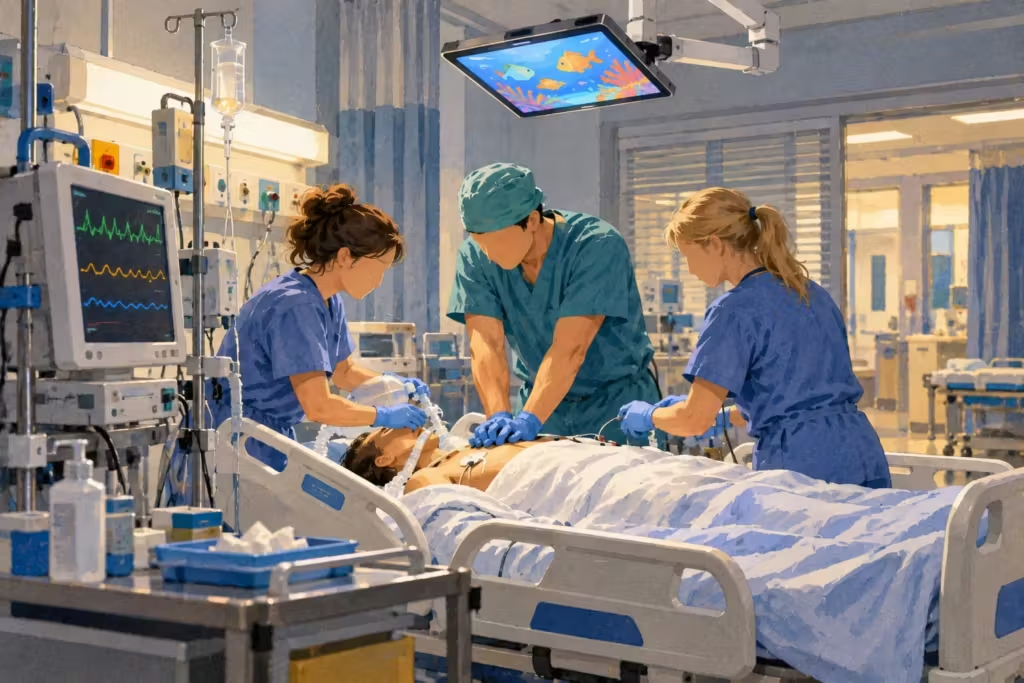
Sans Segarra writes that the AWARE II study followed 567 cardiac arrests. According to him, 20 out of every 100 people who survive resuscitation report a lucid experience of death.
These are the study’s figures. Of the 567 cardiac arrests, 53 people survived. Only 28 of them did the interview, and 6 reported an NDE. Those 6 are 21 out of every 100 people interviewed. Out of the 53 survivors, they are 11 out of every 100.
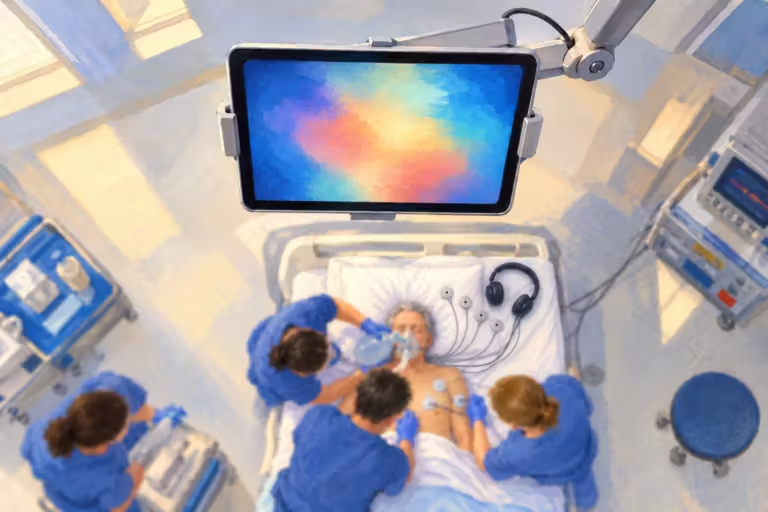
The study placed a randomly chosen image on a tablet above each patient. No one remembered seeing the image. Its first part, AWARE I, had placed images hidden on high shelves, and no one recognized those either. Neither of those two results appears in Sans Segarra’s book.
The third support is a brain scan.
Step 6
Third support · The brain scan and meditation
Sans Segarra says a brain scan proves the patient “really saw the object,” and the study does not say that
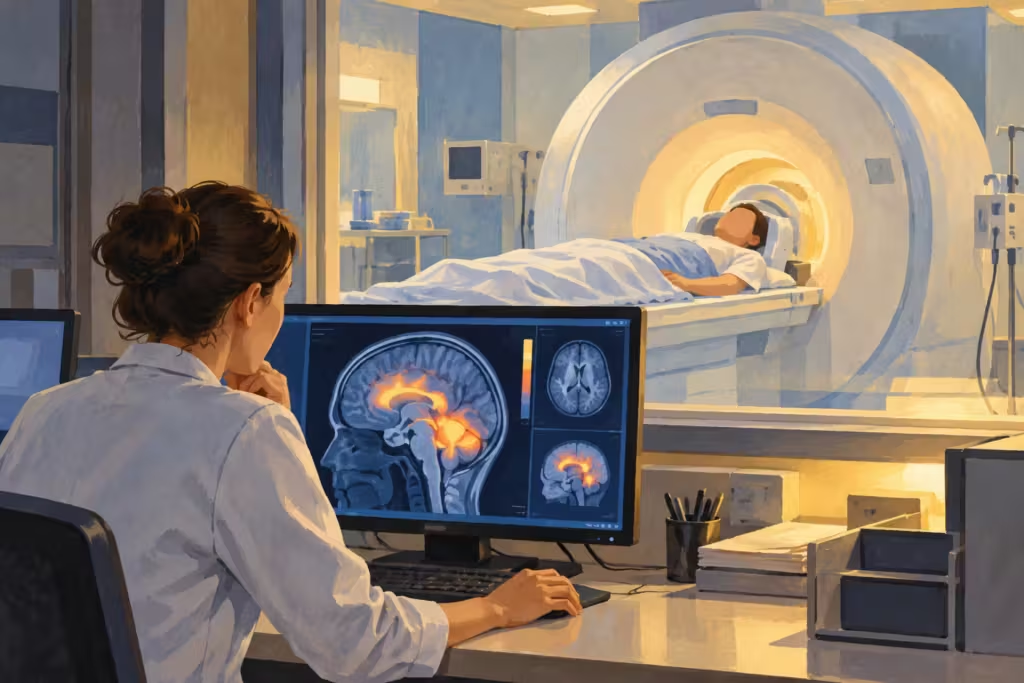
In his 2024 book, Sans Segarra describes a test with magnetic resonance imaging, or MRI. The test was done on people while they recalled the NDE they had had. According to him, they recalled an object they had seen in their NDE. As they did, the part of the brain that handles what we see lit up. From this he draws this conclusion:
“The patient really saw the object in question, that is, he is not lying” (translated from Spanish).
The book does not say who did that test, or where, or when. The only published study of this kind is José Alonso Ruiz’s, from the Catholic University of Murcia. It came out in April 2026, a year and a half after the book. Sans Segarra presented that study with Alonso on his YouTube channel.
Alonso’s study scanned 15 people while they recalled their NDE. Its authors conclude that the brain treats that memory as a vivid memory from the person’s own life. The areas of the brain that directly receive what we see and hear did not become active. The study did not analyze any object. Nor did it compare the memory of the NDE with the memory of something imagined or a hallucination. And it says nothing about what happened during the cardiac arrest.
A brain scan done years later shows how the NDE is remembered. It does not show whether what the person says they saw was there. In its conclusions, the book goes further. It says the patient saw images that were far from his body while he was being resuscitated.
On meditation, Sans Segarra cites a study with Buddhist monks. That study found very fast brain waves, called gamma waves, in their brains while they meditated. He adds that those waves show a connection with supraconsciousness. That is his addition. The study does not say so.
The fourth support, quantum physics, is the most disputed.
Step 7
Fourth support · Quantum physics
Sans Segarra sees a likeness between quantum physics and NDEs, and the physicists who have looked at it say it does not prove it
Quantum physics studies the smallest particles, such as electrons. Things happen there that we don’t see in daily life. Two particles can stay linked even when they are far apart, and that is called entanglement. A particle can pass through a barrier, and that is called tunneling. Sans Segarra sees in these things a likeness to what people with an NDE describe. They say they know things that are happening far away, or that they pass through walls.
He also cites Roger Penrose, winner of the Nobel Prize in Physics, and the anesthesiologist Stuart Hameroff. The two propose that consciousness arises from quantum processes inside neurons. It is a hypothesis that has not been confirmed, and many scientists dispute it. In a 2024 interview, Sans Segarra said that Penrose and Hameroff showed that the brain works like a television set that receives supraconsciousness. Neither of them has shown that, and their hypothesis does not say it. Hameroff has said that consciousness could carry on after death. Penrose does not back that.
Javier Santaolalla is a science communicator with a PhD in particle physics. In 2025 he published a video about the book that has more than a million views. He pointed out physics errors, such as the date and place in which the Higgs boson was proposed. He argues that no explanation in quantum physics requires a supraconsciousness. His video is only about the physics, not about NDEs. In the 2025 Portuguese edition of the book, several of those errors have already been corrected.
Sans Segarra has qualified this part. In 2025 he talked with the neuroscientist Álex Gómez-Marín. In that conversation, he acknowledged that it cannot be said that quantum physics explains NDEs, “for now.” He now speaks of a likeness, not of proof.
That leaves his own patients.
Step 8
His cases · As Manuel Sans Segarra tells it
His patients report NDEs, but his cases come without dates or documents
Sans Segarra tells the NDEs of several of his patients. The case he repeats most is that of a health worker at his hospital. According to him, she later told him who had resuscitated her and what was going on in other emergency rooms, and he checked it. He gives no year, no time, and no document, either in his books or in his interviews. She worked at that hospital and knew the team that treated her, so she could have known or worked out part of what she said.
In his book he tells another case, that of a patient who went into cardiac arrest in the operating room. The patient said he saw Sans Segarra from above while he was doing heart massage on him. He was under general anesthesia, and the book gives no further details.
His cases may be true. Without dates, without records, and without other witnesses, no one can check them. Some accounts of this kind have been studied with documents from the time. A team from the University of Virginia gathered 14 of those cases.
With all this, what is left of each of his supports?
What Sans Segarra says and what the study says
Some figures and facts from his books, next to what the study they come from says.
| What | Sans Segarra | The study |
|---|---|---|
| Resuscitated people who report an NDE | 18 to 25 out of 100 | 4 to 23 out of 100, depending on the study |
| NDEs in AWARE II | “20%” | 6 of 28 people interviewed, out of 567 cardiac arrests |
| Questions on Greyson’s NDE scale | 19, which belong to another of his scales, the kundalini scale | 16 |
| People in the brain scan study | not given | 15 |
| Hidden images that anyone recognized in AWARE | does not mention it | none |
What these figures don’t tell
- They don’t say whether his idea is true. A figure cited wrongly does not make an idea false, and a figure cited correctly does not make it true.
- The figures in the studies change depending on who is asked. Some studies asked people who had a cardiac arrest, and others asked heart patients in general. More figures in How many people have a near-death experience?
- His books make many more claims. Here are the ones that have to do with NDEs and with the studies he cites.
Frequently asked questions
Who is Dr. Manuel Sans Segarra?
Manuel Sans Segarra is a digestive surgeon. He worked at Bellvitge University Hospital, in Barcelona, and was head of its surgery department. Now retired, he argues in books and talks that consciousness carries on after death. He calls it “supraconciencia,” or supraconsciousness.
What is supraconsciousness, according to Sans Segarra?
For Manuel Sans Segarra, supraconsciousness is a consciousness that does not depend on the brain, that exists before birth, and that carries on after death. He sets it apart from the consciousness that neurons produce. No study has measured it.
What books has Sans Segarra written, and in what order?
Manuel Sans Segarra has published three books with the publisher Planeta. The first is La supraconciencia existe (2024), written with Juan Carlos Cebrián, which came out in English as The Life Beyond. Then came Ego y supraconciencia (2025) and La humanidad en crisis (2026). The first one says the most about NDEs.
Has Sans Segarra’s supraconsciousness been proven?
No. The studies Manuel Sans Segarra cites show that NDEs exist and are alike all over the world. They do not show that consciousness carries on without the brain. Nor have they shown the opposite. The cause of NDEs remains unresolved.
What do scientists criticize about Sans Segarra?
Physicists, such as the science communicator Javier Santaolalla, mainly criticize his use of quantum physics. They say it contains errors and that this physics does not support the idea of a supraconsciousness. In 2025, talking with the neuroscientist Álex Gómez-Marín, Sans Segarra himself acknowledged that quantum physics does not explain NDEs, “for now.”
Has Sans Segarra published any study on NDEs?
No. In the medical database PubMed, Manuel Sans Segarra has 25 articles, all of them on surgery. His books on supraconsciousness are written for the general public. They are not scientific studies.
Where this page comes from
His books
- Manuel Sans Segarra and Juan Carlos Cebrián, La supraconciencia existe. Vida después de la vida [Supraconsciousness exists. Life after life] (Planeta, 2024), in Spanish. Read in the e-book edition updated in 2026, with the appendix. It came out in English as The Life BeyondBuy the book
- Manuel Sans Segarra, Ego y supraconciencia. Buscando el sentido de la vida [Ego and supraconsciousness. Searching for the meaning of life] (Planeta, 2025), in Spanish, with a foreword by Valentín FusterBuy the book
- Manuel Sans Segarra, La humanidad en crisis [Humanity in crisis] (Planeta, 2026), in SpanishBuy the book
The studies he cites
- The van Lommel study: 344 cardiac arrest survivors in ten hospitals (2001)Read our page
- The AWARE II study: a random image and the brain on screen (2023)Read our page
- The AWARE study: the images hidden on the shelves (2014)Read our page
- The Murcia MRI study: what the brain does when recalling a near-death experience (2026)Read our page
- Gamma waves in the dying brain, from the University of Michigan (2013 and 2023)Read our page
- “Life After Life,” by Raymond Moody (1975)Read our page
- Stuart Hameroff and Roger Penrose, “Consciousness in the universe: a review of the ‘Orch OR’ theory,” Physics of Life Reviews (2014)View the source
Assessments and criticism
- Javier Santaolalla, “La supraconciencia cuántica no existe” [Quantum supraconsciousness does not exist], video on the Date un Vlog channel (2025), in SpanishWatch on YouTube
- Elio Quiroga, “La supraconciencia y la mecánica cuántica: un análisis crítico de las tesis del Dr. Manuel Sans Segarra” [Supraconsciousness and quantum mechanics: a critical analysis of Dr. Manuel Sans Segarra’s theses], an article not reviewed by other scientists (2025), in SpanishView the source
- María Paulina Ortiz, “El cirujano que plantea que la supraconciencia existe” [The surgeon who proposes that supraconsciousness exists], Ethic (2025), in Spanish, with the opinion of Kevin NelsonView the source
- Ángel Vivas, review of his first two books, Nueva Revista (2025), in SpanishView the source
His conversations
- With José Alonso Ruiz, “ECM: no son alucinaciones” [NDEs: they are not hallucinations], on his channel (2026), in SpanishWatch on YouTube
- With Bruce Greyson, on his channel (2025)Watch on YouTube
- With Álex Gómez-Marín (2025), in SpanishWatch on YouTube
- Interview on Roca Project (2024), in SpanishWatch on YouTube
To understand more
- What is a near-death experience?Read
- What does science say about near-death experiences?Read
- The near-death experience of Eben Alexander, a neurosurgeon whom Sans Segarra citesRead
Our archive
- A full reading of La supraconciencia existe, Ego y supraconciencia, and the Portuguese edition, and of six of his interviews, as of October 29, 2026
More studies
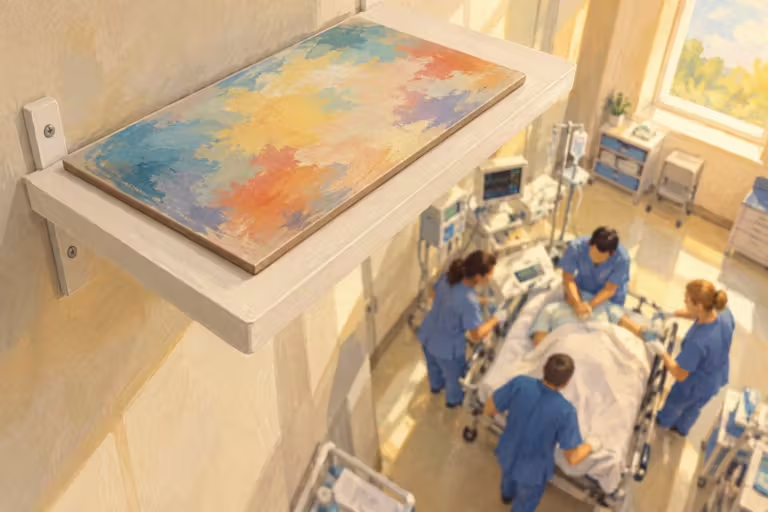
AWARE: the pictures hidden on the shelves
Fifteen hospitals put up pictures that could only be seen from the ceiling, to check whether anyone saw them during a cardiac arrest.
AWARE II: a random picture and the brain on the screen
Above the patient was a tablet with a random picture. Headphones said the names of three fruits. And the doctors measured the brain during resuscitation.
Van Lommel: 344 cardiac arrest survivors in ten hospitals
Ten hospitals asked every cardiac arrest survivor what they remembered. They saw them again after 2 and 8 years.