A study · online survey in English, French, and Spanish, 2018 and 2019, published in 2021
Elsaesser’s study: 991 people who say they sensed a loved one after that person died
An after-death communication is when someone feels that a loved one who has died is getting in touch with them. They may see or hear the person, feel a touch, smell their perfume, or feel them close by. In 2018, the Swiss researcher Evelyn Elsaesser and three British colleagues put a survey online for people who had been through it. It was answered by 991 people. For most, it happened during sleep, and most found it comforting. One in four says they received information they hadn’t known. The authors acknowledge that nothing the participants describe could be checked.
The study’s question is: what are these experiences like, and what effect do they have on the people who have them? We tell it step by step: how the survey was done, what people answered, and what could be checked. If you only want to know what it found, go straight to the results.
Step 1
1971 · The question
A doctor in Wales finds that almost half of the widowed people he interviews have sensed their dead spouse
Dewi Rees was a family doctor in central Wales. He interviewed 293 of the 363 widowed people in his area, 227 women and 66 men. He had left out 52 because a serious physical or mental illness kept them from being interviewed. He wanted to know what helped people get over the death of their spouse.
He was surprised. Almost half told him they had seen or heard their spouse, or felt them nearby, after the death. The most common experience was feeling that the spouse was there. Of those who had been through it, only 28 in 100 had told anyone before. Some were afraid of being laughed at.
Rees published his results in 1971 in the British Medical Journal, one of the most widely read medical journals. He concluded that these experiences were normal in widowhood and that they helped most people.
Almost fifty years later, a team set out to study them with many more people.
Step 2
2018 · The authors
A Swiss researcher and three British colleagues prepare a survey in three languages
Evelyn Elsaesser has spent years collecting accounts from people who say they have had contact with someone who died. She prepared the survey in 2018 with David Lorimer and with the psychologists Chris Roe and Callum Cooper, of the University of Northampton.
The work was paid for by a foundation in Geneva, on the condition that its name not be given. The authors write that the foundation played no part in how the study was done or analyzed.
Before they began, they wrote down what they planned to do in a study registry at the University of Edinburgh. That way, what they had planned can later be compared with what they published.
The questionnaire was long.
Step 3
August 2018 to April 2019 · How it was done · As the study tells it
They put a 194-question survey online and announce it at talks and in forums about these experiences

The questionnaire had 194 questions, in English, French, and Spanish. First, it asked people to describe the experience in their own words. That way, the questions that followed couldn’t shape the account. Then it asked about what was seen, heard, or felt, and when it happened. It also asked who the deceased was and what changed afterward.
It was anonymous. Because of that, the authors couldn’t go back to anyone to ask more.
They announced it at talks and in online groups devoted to these experiences. Anyone who wished could answer, and those who answered already believed they had had one. Most had had several. The questionnaire asked them to answer about the one that seemed most important to them.
In eight months, more than a thousand responses came in.
Step 4
2019 · Who answered · As the study tells it
991 people answer, almost all of them women, and one in four was not grieving
In all, 1,004 questionnaires came in. The authors removed 13 that were incomplete or filled in incorrectly, which left 991. Of these, 412 people answered in English, 434 in French, and 145 in Spanish.
Women made up 85 in 100. The average age was 51. Almost half had a university education.
Almost 9 in 10 said they were in good health. One in six said they had depression. The authors recall Rees’s study. In it, depression was just as common among the widowed people who had sensed their spouse as among those who hadn’t. For the authors, this suggests that being depressed doesn’t make a person more likely to sense the deceased.
There is one figure the authors stress. Out of every 100 people, 27 said they were not grieving for that person, or had already gotten over it, when they sensed them.
What remained was to find out how they had experienced it.
Step 5
What the participants describe · As the study tells it
For most, it happened during sleep, and almost half say they felt the deceased touch them
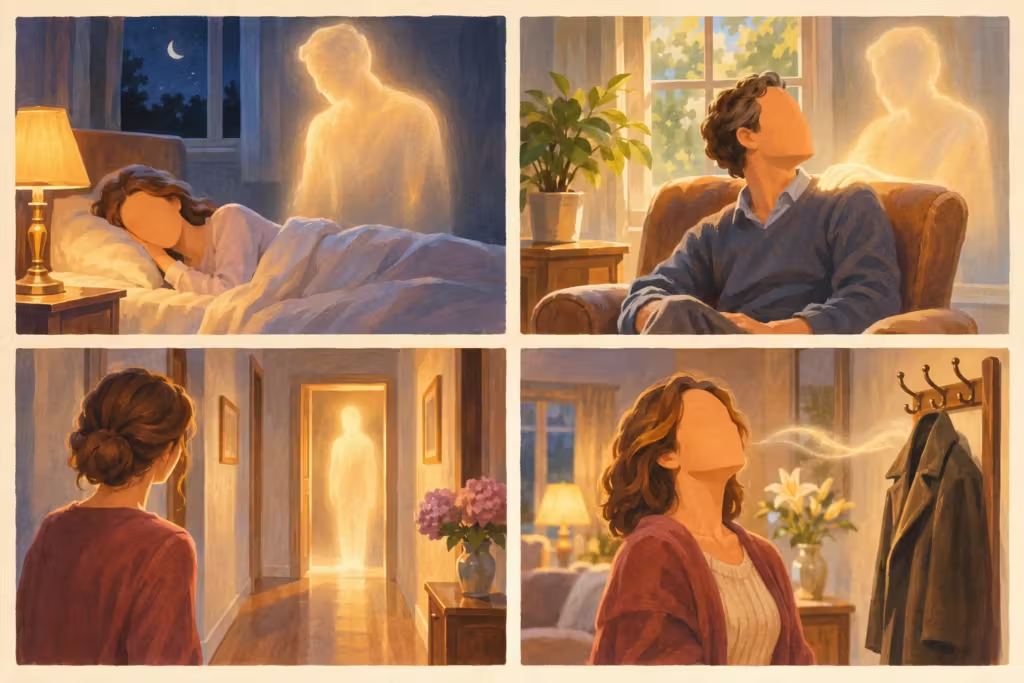
Each person could tick several forms of contact. The most common was during sleep, for 62 in 100. Next came feeling the deceased touch them, seeing them, hearing them, feeling they were there without seeing or hearing them, and smelling them.
The authors asked whether it had been just a dream, and 37% said no. The article doesn’t make clear whether that is 37% of everyone or of those who experienced it while asleep. Many say it was different from dreaming about the deceased, and that they felt it as something coming from outside.
In Rees’s survey, the most common experience was sensing a presence. Here, only a third described it. The authors think the difference lies in how each group was gathered. Rees spoke with eight in ten of the widowed people in his area. This survey drew people who wanted to share something, and many chose their most striking experience.
A little over half of the experiences happened in the evening or at night. The forms of contact varied with the language of the survey. For example, 61 in 100 of those who answered in Spanish saw the deceased, compared with 42 in 100 of those who answered in French. For the authors, this suggests that culture shapes how these experiences are lived.
Some people described things that could be checked.
Step 6
What the participants describe · As told by the study and a 2021 article by the same authors
One in four people say they received information they hadn’t known, and no one has checked it
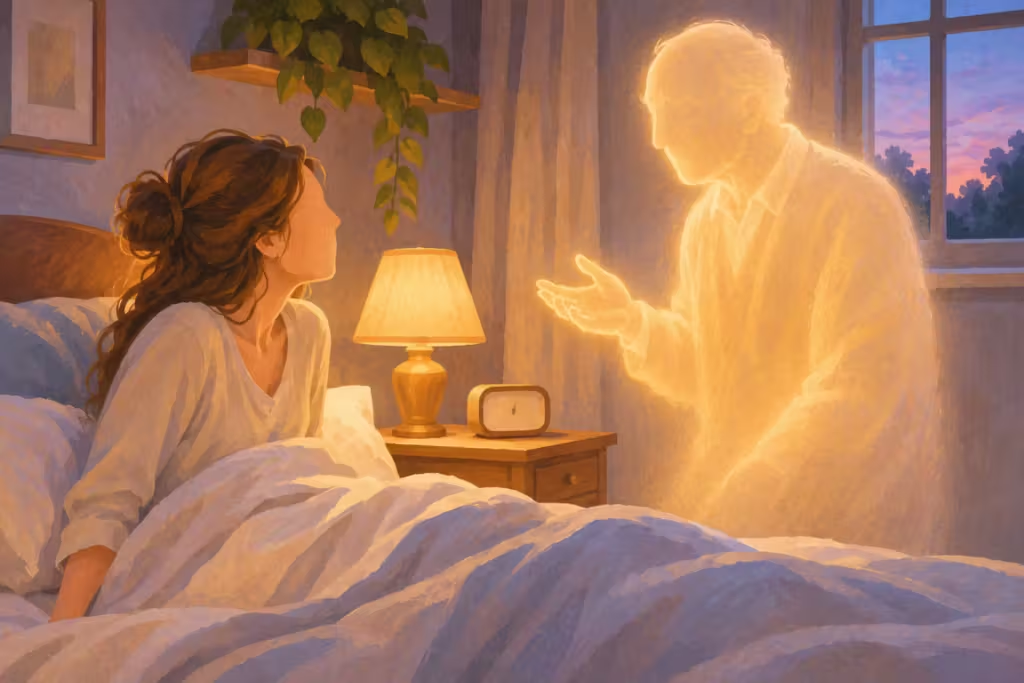
Out of every 100 people, 36 said they were not alone when it happened. Of those, one in five says that the person with them noticed it too.
Out of every 100, 24 said they had received information they hadn’t known before. It was often about how the person had died. In all, 236 people said so. The same authors analyzed this in another 2021 article, also signed by the neuroscientist Marjorie Woollacott.
That article gives some examples. A woman says she woke up and saw her grandfather beside the bed, and he told her he was leaving. She looked at the clock, and it was six in the morning. Later, a phone call told her that her grandfather had died. According to her, the death certificate gave the approximate time as six. Other people say the deceased told them where to find a key, some documents, or a ring that no one could find.
None of this has been checked. The participants say it was confirmed afterward. The authors write that they have not checked it against other sources. Because the survey was anonymous, they also couldn’t ask for the certificate or speak with the witnesses.
The authors also measured what changed in these people’s lives.
Step 7
2021 · The conclusion · As the study tells it
Most found it comforting, and the authors ask therapists not to treat these experiences as an illness

Out of every 100 people, 71 said the experience was a treasure to them, and another 21 said they were very glad to have had it. About 73 in 100 said it had brought them comfort. Only 12 in 100 said it had made the absence of the person who died more painful.
About 60 in 100 said their fear of death had decreased or disappeared. Before the experience, 69 in 100 believed in life after death. After the experience, 93 did. People said they felt more spiritual, but not more religious.
According to the authors, these experiences are common, come unexpectedly, and don’t depend on any illness or on the person needing to sense the deceased. They write that the people who have them feel them as real, whatever their origin. They ask psychologists and psychiatrists to listen to those who describe them, without playing them down or treating them as a symptom.
They also acknowledge the limits. The accounts are given long afterward and can’t be checked. And almost all the participants lived in wealthy countries, with similar ideas about these experiences.
The team kept working with the same questionnaires.
Step 8
2021 to 2026 · What came next
The same team finds that some experiences resemble sleep paralysis
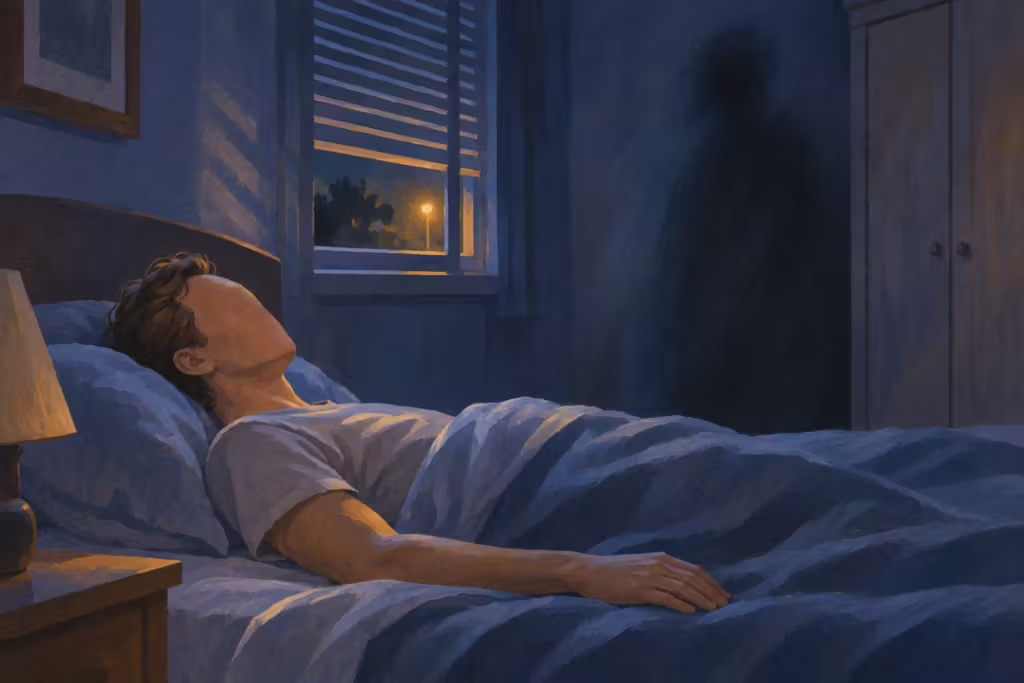
By 2026, the team had drawn seven more articles from the survey. It also opened the survey in other languages, such as German. There are now 1,311 questionnaires in six languages.
Some experiences were frightening. In 2021, the French psychologist Renaud Evrard studied them with the team. There were 108 accounts in English and French. In 20 of them, there was no deceased person they knew, only an unidentified presence. It almost always went along with sleep paralysis. Sleep paralysis is when a person wakes up and can’t move for a few seconds or minutes. Sometimes they also sense a presence in the room.
In 2025, the team published how many participants had been partly paralyzed during the contact. It was 10 in 100 in the German survey and 12 in 100 in the other three. Elsaesser describes this paralysis as one more part of these experiences, and doesn’t compare it with sleep paralysis.
In that 2025 article, most say that, shortly after the experience, they had no doubt at all that it had been real. It was 73 in 100 in the German survey and 77 in 100 in the other three. Only 1 or 2 in 100 thought it was an illusion created by grief.
The question from the beginning remains: what are these experiences like, and what effect do they have? Let’s look at what is known and what isn’t.
How the 991 people sensed the deceased
Each person could tick more than one form. The figures are per 100 people.
| Form of contact | Out of 100 |
|---|---|
| During sleep | 62 |
| Felt their touch | 48 |
| Saw them | 46 |
| Heard them | 43 |
| Felt they were there, without seeing or hearing them | 34 |
| Smelled them | 28 |
What these figures don’t tell
- They don’t say how many people experience it. Only people who already believed they had experienced it answered. The population surveys the authors cite give figures between 10 and 31 in 100, depending on the country and the question.
- Each person described only one experience. Most had had several and chose the one that seemed most important to them.
- Everything is what each person remembers. Some described it many years later.
Frequently asked questions
What is an after-death communication?
An after-death communication is when someone feels that a loved one who has died is getting in touch with them. They may see or hear the person, feel a touch, smell their perfume, or feel them close by. They may also dream about the person in a way that feels different from an ordinary dream. In Evelyn Elsaesser’s 2021 survey, the most common form was during sleep.
Is it normal to sense the presence of a loved one who has died?
Yes, it is common. The Welsh doctor Dewi Rees spoke with eight in ten of the widowed people in his area. In 1971, he published that almost half had seen, heard, or sensed their dead spouse. A 2020 review of studies on grief concludes that it is almost always harmless. Most people who experience it say it comforted them.
Has it ever been checked that a deceased person gave information no one knew?
Not in Elsaesser’s survey. Of 991 people, 236 say they received information they hadn’t known, but the survey was anonymous and the authors acknowledge that they didn’t check any of it. To find out, someone would have to write down what the person says before they know anything, and then compare it with documents and witnesses.
Are after-death communications hallucinations?
No one knows what causes them. The study’s authors use the word “hallucination” without assuming that they are an illness or that there is nothing real. Some psychologists think they arise because, during grief, the person keeps searching, without meaning to, for the one they have lost. Other researchers think they may be real contact. Neither view has been checked.
What do these experiences have to do with sleep paralysis?
Some resemble it. In 2021, Elsaesser’s team studied 108 frightening experiences. In 20, there was an unidentified presence, almost always during sleep paralysis. In 2025, the team published that between 10 and 12 in 100 participants were partly paralyzed during the contact.
Where this page comes from
The study
- Evelyn Elsaesser, Chris A. Roe, Callum E. Cooper, and David Lorimer, “The phenomenology and impact of hallucinations concerning the deceased,” BJPsych Open 7(5):e148 (2021)Read for free
- The study’s questionnaire, on the University of Northampton websiteRead for free
What came next, with the same data
- Marjorie Woollacott, Chris A. Roe, Callum E. Cooper, David Lorimer, and Evelyn Elsaesser, “Perceptual phenomena associated with spontaneous experiences of after-death communication,” Explore 17(3) (2021)Read for free
- Renaud Evrard et al., “Expériences exceptionnelles nécrophaniques et deuil paradoxal,” L’Évolution Psychiatrique 86(4):799–824 (2021), in FrenchRead for free
- Tuba Kalelioglu et al., “Factors moderating the impact of after death communications on beliefs and spirituality,” Omega 87(3):884–901 (2023)Read for free
- Evelyn Elsaesser et al., “What the deceased communicate, what we learn about their state of mind, and how this impacts grief,” Journal of Anomalistics 25(2):242–281 (2025)Read for free
Assessments and other studies
- W. Dewi Rees, “The hallucinations of widowhood,” British Medical Journal 4:37–41 (1971)View in the journal
- K. S. Kamp et al., “Sensory and quasi-sensory experiences of the deceased in bereavement: An interdisciplinary and integrative review,” Schizophrenia Bulletin 46(6):1367–1381 (2020)Read for free
- K. S. Kamp, A. Moskowitz, H. Due, and H. Spindler, “Are sensory experiences of one’s deceased spouse associated with bereavement-related distress?” Omega 89(3):895–915 (2024, online in 2022)View in the journal (paywalled)
To understand more
- What does science say about near-death experiences?Read
Our archive
- A full reading of the 2021 article and of the parts of the later articles used on this page, compared page by page, as of November 1, 2026
More studies
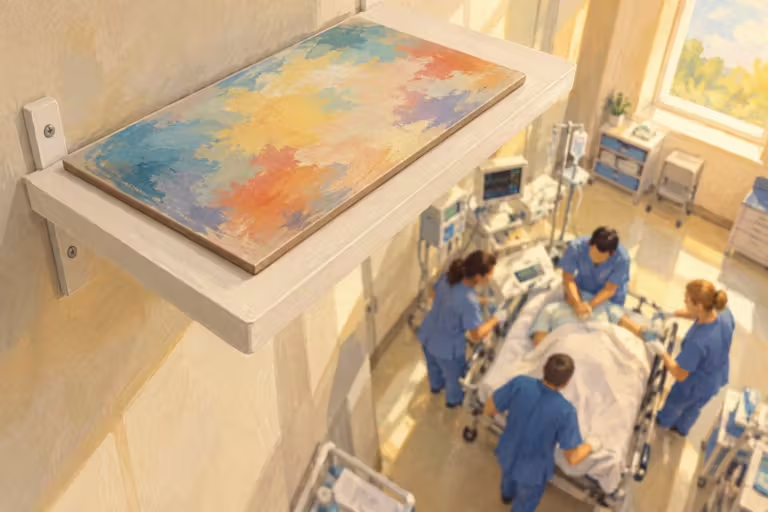
AWARE: the pictures hidden on the shelves
Fifteen hospitals put up pictures that could only be seen from the ceiling, to check whether anyone saw them during a cardiac arrest.
AWARE II: a random picture and the brain on the screen
Above the patient was a tablet with a random picture. Headphones said the names of three fruits. And the doctors measured the brain during resuscitation.

Van Lommel: 344 cardiac arrest survivors in ten hospitals
Ten hospitals asked every cardiac arrest survivor what they remembered. They saw them again after 2 and 8 years.