
A study · online survey in 35 countries, published in 2019
The Kondziella survey: 106 of 1,034 people described an NDE
A near-death experience, or NDE, is a very intense experience that some people have when they are about to die. In 2019, the neurologist Daniel Kondziella and two colleagues asked 1,034 people in 35 countries online whether they had ever had one. 289 said yes. Of these, 106 reached 7 points on the questionnaire researchers use to decide whether an experience is an NDE. That is 10 in 100 of everyone who responded. According to the authors, the figure didn’t change with age, sex, or country. And almost half of these experiences happened without any real danger of death. They also found that people who described an NDE said more often that they have visions or paralysis as they fall asleep or wake up.
The study’s question is: how many people say they have had an NDE? We tell it step by step: whom they asked, how they did it, and what came out. If you only want to know what is known, skip straight to the results.
Step 1
Before 2019 · The question
Two earlier surveys had found between 4 and 8 in 100 people
Studies done in hospitals measure how many people resuscitated after a cardiac arrest describe an NDE. They find between 4 and 23 in 100, depending on the study. We cover this in How many people have a near-death experience?
Those studies don’t say how many people in the general population have had an NDE. That takes surveys. Before 2019, two had been done. A 2001 survey in Germany found about 4 in 100 people. Another, in Australia in 2005, found 8 in 100.
Neither of them used the Greyson scale. It is a 16-question questionnaire that researchers use to decide whether an experience is an NDE. It was created in 1983 by the psychiatrist Bruce Greyson.
A neurologist in Copenhagen wanted to measure how many people have had an NDE, with that scale and with many more people.
Step 2
2019 · Copenhagen · As the study tells it
Daniel Kondziella wants to count how many people say they have had an NDE, and to test an idea about sleep

Daniel Kondziella is a neurologist at Rigshospitalet, the University of Copenhagen’s hospital, in Denmark. He did the study with the neurologist Jens Dreier, from the Charité hospital in Berlin, and with Markus Harboe Olsen, from the anesthesia department of his own hospital.
The study had two goals. The first was to count how many people say they have had an NDE. The second was to test an idea from the neurologist Kevin Nelson. In 2006, Nelson found that people with an NDE said more often that things typical of sleep happened to them while they were awake. For example, seeing things as they fell asleep, or waking up unable to move. Nelson compared these people with staff at his own hospital. Critics said their medical training might influence how they answered. We cover this in Kevin Nelson’s study.
Before starting, the team wrote down on a public website what it was going to measure and how. That way it couldn’t change the question after seeing the answers.
To reach a lot of people, they looked outside the hospital.
Step 3
January 2019 · The survey · As the study tells it
In three and a half hours, 1,034 people in 35 countries respond

The team used Prolific, a website where people from many countries sign up to answer surveys for money. The only requirements were being 18 or older and reading English. The quota of 1,034 people filled up in three and a half hours.
The survey was advertised as a survey on NDEs and similar experiences. Before starting, everyone was told they would be paid the same whether or not they described an NDE.
First, each person answered the four sleep questions Nelson had used. The fourth is about something that happens a lot in narcolepsy, a sleep disorder:
- Have you ever, just before falling asleep or just after waking up, seen things or people that others can’t see?
- Have you ever, at those moments, heard voices, music, or sounds that others can’t hear?
- Have you ever woken up unable to move?
- Have your legs ever suddenly given way? Or has your face suddenly lost its strength, or your head dropped?
Next, the survey explained what an NDE is. It said these are exceptional experiences that people can have when dying or when feeling that they are dying. And it asked whether the person had had one, whether they had been in real danger of death or it only felt that way.
Those who said no stopped there. Those who said yes answered the 16 questions of the Greyson scale. For example, whether time seemed to speed up or slow down, whether they saw a very bright light, or whether they felt separated from their body. Each question scores 0, 1, or 2 points. With 7 points or more, researchers count the experience as an NDE. The survey also asked what situation it happened in, whether it was pleasant or unpleasant, and whether the person had had more than one.
Almost three in ten people said they had had an NDE.
Step 4
2019 · The results · As the study tells it
289 people say yes, and 106 reach 7 points on the scale

Of the 1,034 people, 289 said they had had an NDE. That is 28 in 100. With the Greyson scale, the figure drops. Of those 289 people, 106 reached 7 points or more.
So 106 of the 1,034 people described an experience that researchers count as an NDE. That is 10 in 100. Given the size of the survey, the authors calculate a margin. With that margin, the figure would be between 8.5 and 12 in 100.
The people who responded were 33 years old on average, and six in ten were women. They came from 35 countries, but almost all of them lived in Europe: 938 of the 1,034.
According to the authors, having an NDE didn’t depend on age, sex, occupation, or continent.
The situations in which these experiences happened were very different from one another.
Step 5
2019 · The experiences · As the study tells it
Almost half were in no real danger of death, and almost half found it unpleasant
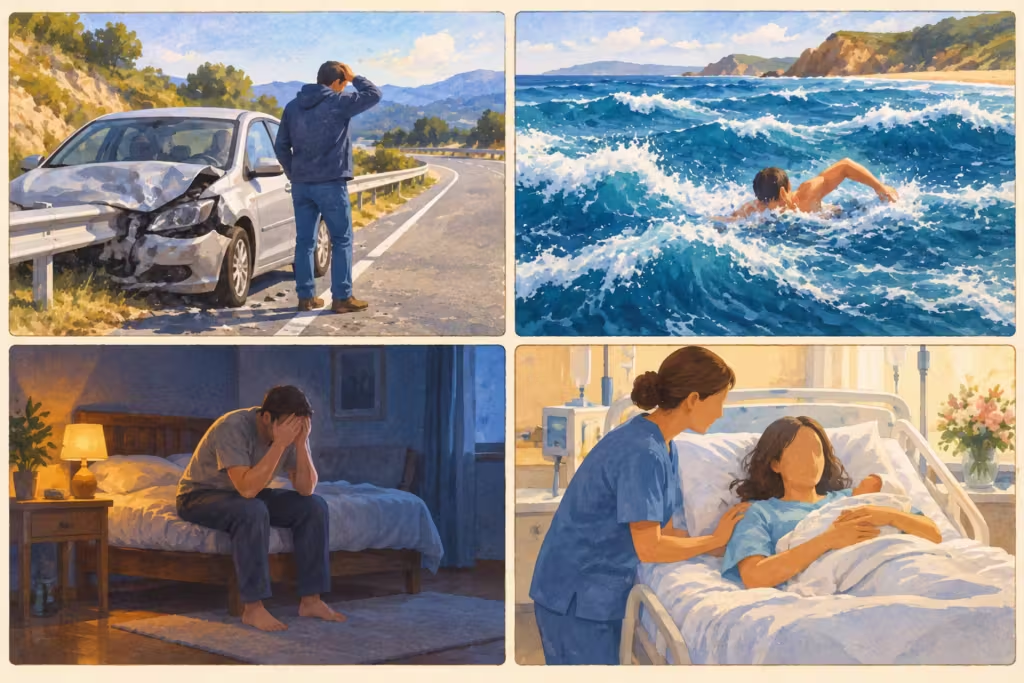
The survey asked whether the person had really been in danger of death. Of the 106 people with an NDE, 55 said yes and 51 said it only felt that way. Another 183 people said they had had an NDE but didn’t reach 7 points. Among them, too, roughly half said the danger had been real.
The study lists the situations for the 289 people who said they had had an NDE. It doesn’t give them separately for the 106. The most common was a traffic accident, for 77 people. Next came nearly drowning, for 56, and very deep grief or anxiety, for 51. After that came drugs or alcohol, violence, serious illness, and childbirth with complications. A cardiac arrest or a heart attack appears for 16 of the 289 people.
What they described most often was that time sped up or slowed down. 252 of the 289 people said so. Next came thinking faster than usual, having sharper senses, and feeling separated from the body.
The Greyson scale only asks about pleasant feelings, such as peace or joy. This survey also asked whether the experience was unpleasant. Of the 106 people with an NDE, 77 chose between pleasant and unpleasant. The other 29 said it was neither. Of the 77, 41 said it was pleasant and 36 said it was unpleasant.
The authors write that in earlier studies almost all NDEs were pleasant. They think the difference comes from two things. They asked about unpleasant feelings, and they also counted experiences without any real danger of death.
Next, the team looked at the answers about sleep.
Step 6
2019 · Sleep · As the study tells it
People who describe an NDE say more often that they have visions or paralysis as they fall asleep or wake up
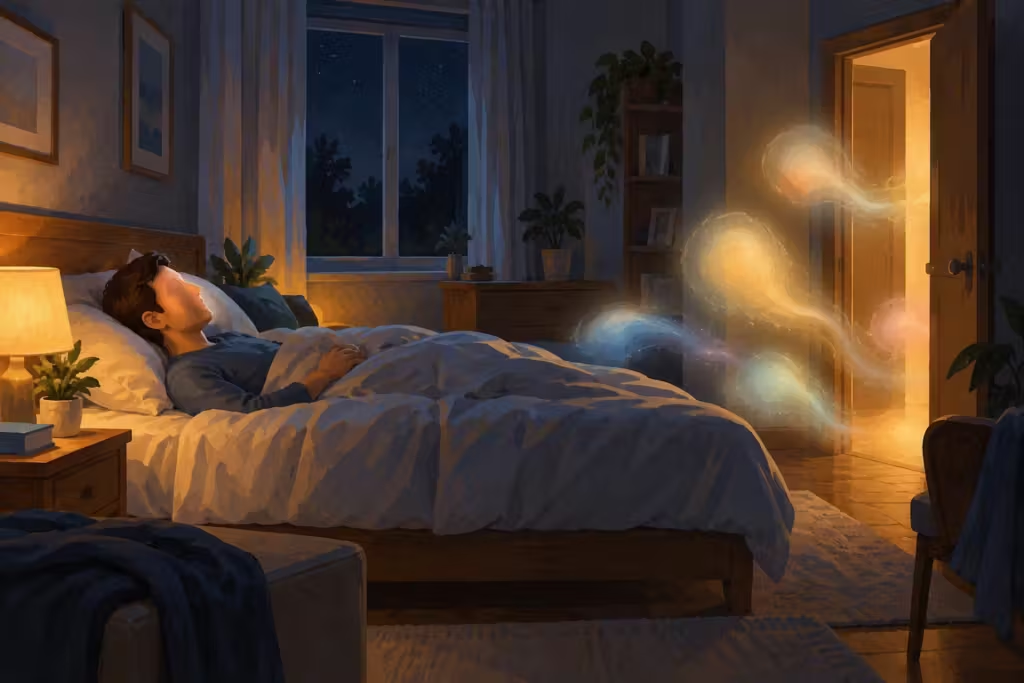
The team counted the people who said yes to three or more of the four sleep questions. 50 of the 106 people with an NDE did. That is 47 in 100. Among the 744 people who described no similar experience, 14 in 100 said yes to three or more questions. And among the 183 people whose experience didn’t reach 7 points, 26 in 100.
The team checked whether the difference could come from age, sex, occupation, continent, or real danger. It didn’t. Of everything the team looked at, the only thing linked to having an NDE was those visions or that paralysis when falling asleep or waking up.
As in Nelson’s study, no one measured sleep in a laboratory. These are yes-or-no answers, from memory, about the person’s whole life. And the survey didn’t ask what came first, the NDE or those visions. We cover the debate about this idea in Kevin Nelson’s study.
With all this, the authors drew their conclusions.
Step 7
August 2019 · The conclusion · As the study tells it
The authors conclude that one in ten people describes an NDE, and warn that the figure may be somewhat inflated

The authors conclude that about 10 in 100 people describe an NDE. That is somewhat more than in the surveys from Germany and Australia. They write that age, sex, country, occupation, and how real the danger was don’t seem to change that figure.
They also note something else. They compared the people with an NDE with those who didn’t reach 7 points, and both groups rated their situation as equally dangerous. For the authors, this means that people who have an NDE don’t dramatize more than others. And, in their view, it supports the idea that NDEs are really experienced and don’t simply come from a tendency to fantasize.
On sleep, they write that their survey repeats the link Nelson found, and they call it “a possible relation.” They add that a link between two things doesn’t mean that one causes the other.
They also acknowledge limits. People knew the survey was about NDEs, and that may have drawn in more people who had had one. In that case, the figure in the general population would be lower than 10 in 100. They didn’t ask about religion, illnesses, medication, alcohol, or drugs. And almost a third of those who said they had had an NDE described two or more. It isn’t known which one they had in mind when they answered the scale.
Two weeks after the first survey, the team did another one with different people.
Step 8
February 2019 · The second survey · As another study by the same team tells it
With another 1,037 people, the figure comes out at 8 in 100
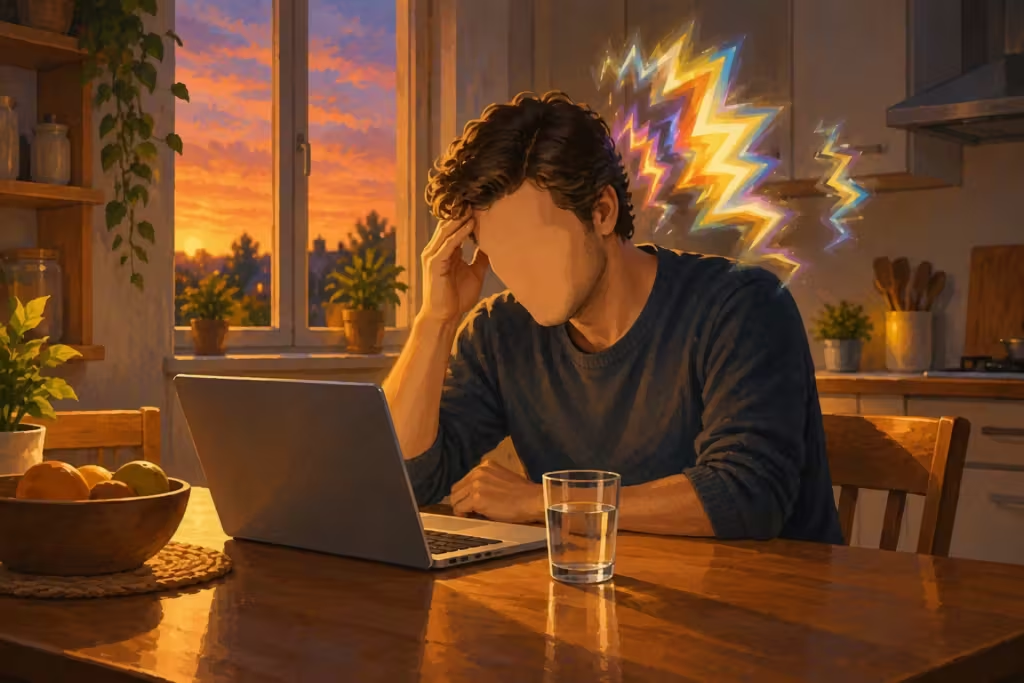
On February 4, 2019, the team ran another survey on the same website. It left out everyone who had answered the first one. This time it advertised it as a survey on NDEs and headache. 1,037 people in 35 countries responded.
Again, 28 in 100 people said they had had an NDE. With the Greyson scale, 81 reached 7 points. That is 8 in 100. Again, it didn’t depend on age or sex.
This time the team was looking for a link with migraine. Some people with migraine see lights or spots before the headache, and doctors call this an aura. 13 in 100 people with aura had had an NDE, and 6 in 100 people without it. This second study was published in December 2019, in the same journal.
The question from the beginning remains: how many people have an NDE? Let’s look at what is known and what isn’t.
The Kondziella team’s two surveys
How many people answered each survey, how many said they had had an NDE, and how many reached 7 points on the Greyson scale.
| Survey | Responded | Said yes | Reached 7 points |
|---|---|---|---|
| January 2019, on NDEs and sleep | 1,034 | 289 | 106, about 10 in 100 |
| February 2019, on NDEs and headache | 1,037 | 286 | 81, about 8 in 100 |
What these figures don’t tell
- They are volunteers from the same survey website. The second survey repeats the first with different people, but the team and the website are the same.
- Almost all the people lived in Europe. In the first survey, 938 of the 1,034 people lived in Europe, and only 36 in the Americas.
- What situation each NDE happened in. The study gives the situations for the 289 people who said yes, but not for the 106 who reached 7 points.
Frequently asked questions
How many people have had a near-death experience?
No one knows exactly. The neurologist Daniel Kondziella ran a survey in 2019. In it, 106 of 1,034 people described an NDE that reached 7 points on the Greyson scale, about 10 in 100. Another survey by the same team found 8 in 100. The Greyson scale is a 16-question questionnaire that researchers use to decide whether an experience is an NDE. The people were volunteers from a survey website, not a sample of the whole population.
Do you have to be about to die to have a near-death experience?
Not always. In the neurologist Daniel Kondziella’s 2019 survey, 106 people had an NDE. Of these, 51 said it only felt as if they were in danger of death. No one checked what each person said.
Are near-death experiences always pleasant?
No. In the neurologist Daniel Kondziella’s 2019 survey, 77 people with an NDE said whether it was pleasant or unpleasant. Of these, 36 said it was unpleasant. The authors of the survey think other studies find fewer unpleasant NDEs for two reasons. The Greyson scale only asks about pleasant feelings, and some of those studies only counted experiences with a real danger of death.
What link did Kondziella find between NDEs and REM sleep?
Kondziella asked four questions about visions or paralysis when falling asleep or waking up. Doctors link these things to the REM stage, the stage of sleep in which we dream. 47 in 100 people with an NDE said yes to three or more. Among people with no similar experience, 14 in 100 did. Kondziella writes that he didn’t ask what came first, so he doesn’t know whether sleep leads to the NDE or the other way around. The debate is in Kevin Nelson’s study.
Where this page comes from
The study
- Daniel Kondziella, Jens Dreier, and Markus Harboe Olsen, “Prevalence of near-death experiences in people with and without REM sleep intrusion,” PeerJ 7:e7585 (2019)Read for free
- The second survey: Daniel Kondziella, Markus Harboe Olsen, Coline L. Lemale, and Jens Dreier, “Migraine aura, a predictor of near-death experiences in a crowdsourced study,” PeerJ 7:e8202 (2019)Read for free
Assessments and critiques
- Jeffrey Long and Janice Miner Holden, “Does the arousal system contribute to near-death and out-of-body experiences? A summary and response,” Journal of Near-Death Studies 25(3):135–169 (2007)Read for free
- Charlotte Martial et al., “A neuroscientific model of near-death experiences,” Nature Reviews Neurology 21:297–311 (2025)View in the journal (paywalled)
- Bruce Greyson and Marieta Pehlivanova, “A neuroscientific model of near-death experiences reconsidered,” Psychology of Consciousness (2025)Read for free
To understand more
- How many people have a near-death experience?Read
- Kevin Nelson’s study of near-death experiences and sleepRead
- The NEPTUNE model, co-authored by Kondziella and NelsonRead
Our archive
- A full reading of the article by Kondziella, Dreier, and Olsen, and of the method and results of the second survey, compared page by page, as of October 30, 2026
More studies
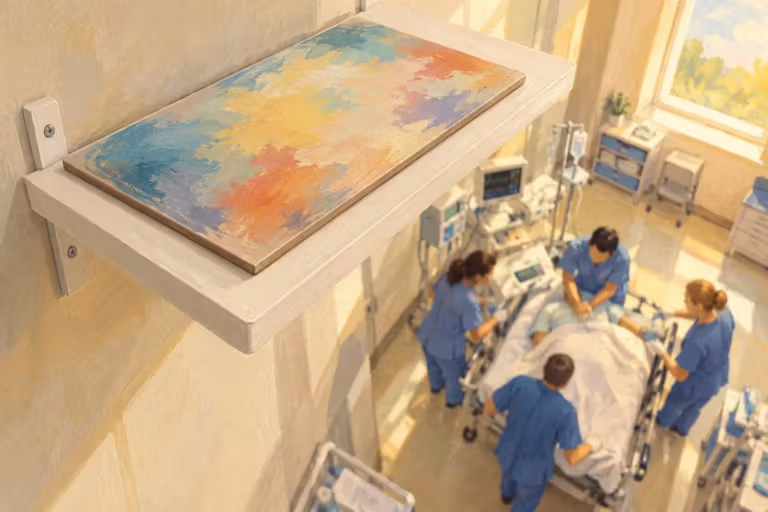
AWARE: the pictures hidden on the shelves
Fifteen hospitals put up pictures that could only be seen from the ceiling, to check whether anyone saw them during a cardiac arrest.
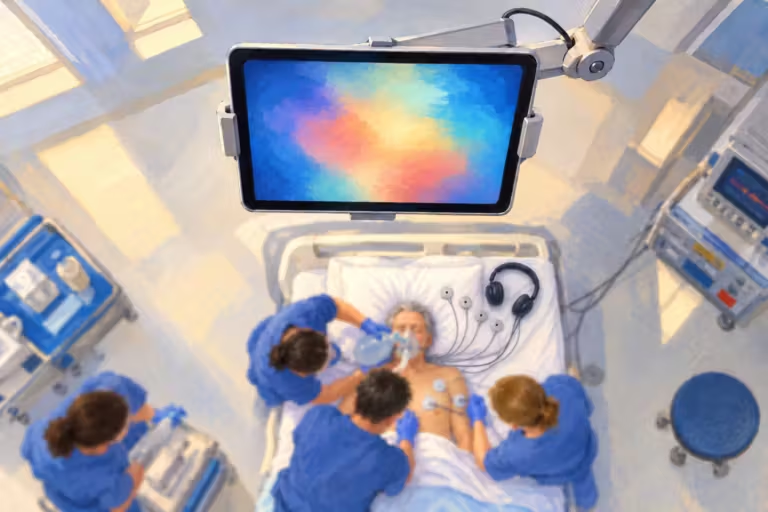
AWARE II: a random picture and the brain on the screen
Above the patient was a tablet with a random picture. Headphones said the names of three fruits. And the doctors measured the brain during resuscitation.
Van Lommel: 344 cardiac arrest survivors in ten hospitals
Ten hospitals asked every cardiac arrest survivor what they remembered. They saw them again after 2 and 8 years.