A study · Liège (Belgium), published in 2014
Charland-Verville’s study: do you have to be close to death to have an NDE?
A near-death experience, or NDE, is a very intense experience that some people have when they are about to die. But some people describe something very similar without having been in any danger. In 2014, a team from the University of Liège compared two groups. One was made up of 140 people who reported an NDE after a coma. The other was made up of 50 people who had had one while sleeping, while fainting, while meditating, or in other situations with no danger. The study found no clear differences between the two groups, either in how intense the experience was or in its features. The authors conclude that the NDE cannot be explained only by being close to death.
The study’s question is: does the experience change if the person really was about to die? We explain who they asked, how they measured it, and what they found. Then we look at the studies that did find some difference between the two groups. If you only want to know what is known, skip straight to the results.
Step 1
Before 2014 · The question
Many people who report an NDE were not in danger of dying
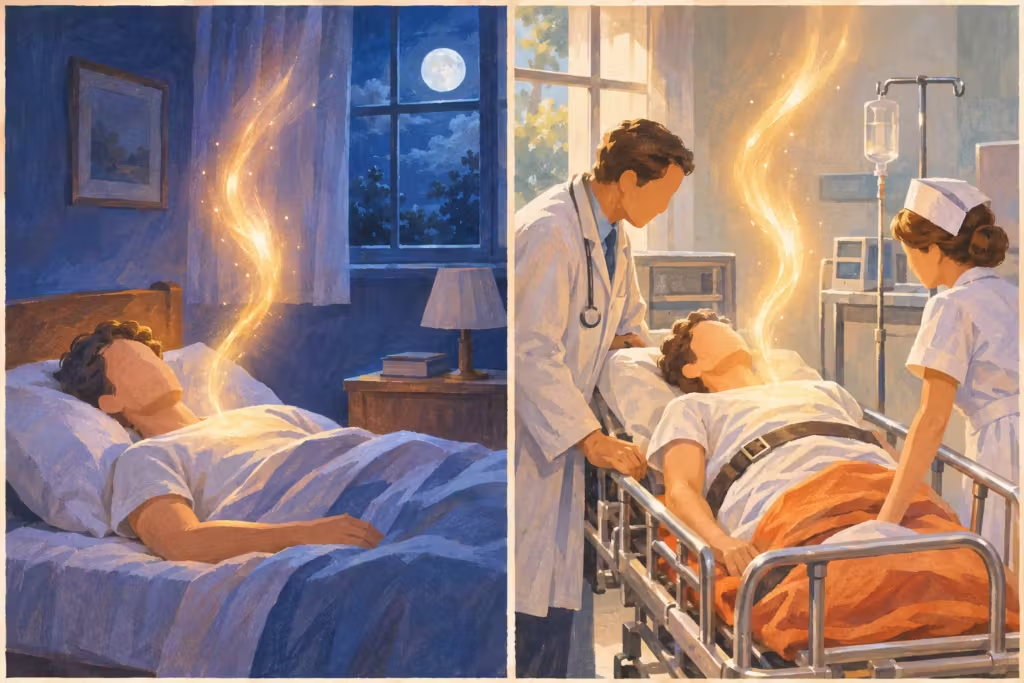
Since the 1980s, it had been known that some people report an NDE without having been about to die. It happens to them while sleeping, while fainting, while meditating, or when they believe they are going to die even though they are not.
In 1990, a team from the University of Virginia, in the United States, checked this with medical records. They brought together 58 cases of people who reported an NDE and read their medical records. According to those records, 30 of the 58 had not been in danger of dying. Most of those 30 believed they were dying. Even so, they described experiences similar to those of the other 28.
Similar, but not the same. A very intense light came up in 21 of the 28 who had been close to death, and in only 12 of the 30 who had not. The people who had been close to death also said more often than the others that they had thought more clearly than usual.
A team in Liège wanted to repeat the comparison with many more people.
Step 2
Before 2014 · University of Liège · As the study tells it
An anonymous survey of 190 people who reported an NDE

The Liège group looked for volunteers with the help of the associations of people who have had NDEs in France and in Flanders, in Belgium. People heard about it through the associations’ websites, their magazines, and their appearances in the local press. They answered an anonymous questionnaire, in writing or by phone.
The questionnaire asked them whether their life had been in danger, whether they had been in a coma for more than an hour, and why. And it included the Greyson scale, created by the psychiatrist Bruce Greyson. It is a set of 16 questions that researchers use to decide whether an experience is an NDE. They ask, for example, whether the person felt peace, left their body, or saw a light. Each answer is worth 0, 1, or 2 points, up to a maximum of 32, and from 7 points up the experience counts as an NDE.
215 people responded. Those who did not reach 7 points were left out. In the end, 190 people remained.
On average, they had had their experience 24 years before answering.
The team divided those 190 people into two groups.
Step 3
Before 2014 · As the study tells it
140 people had it in a coma and 50 with no danger at all

The groups were formed from what each person reported:
- 140 people who had it in a coma. In 45, the coma came from a lack of oxygen, for example during cardiac arrest or after nearly drowning. In 30, from a blow. In the other 65, from an illness or from a complication during surgery or childbirth. The authors call this a “real NDE.”
- 50 people who had it with no danger at all to their life. 13 had it while sleeping, 11 while fainting, 5 while meditating, and 3 after taking drugs or alcohol. The other 18 had it in other situations with no danger. The authors call this an “NDE-like” experience.
No one checked medical records to see who had been in a coma or in danger. What is known about each person is what that person answered.
Then they compared what the two groups reported.
Step 4
2014 · The results · As the study tells it
No clear differences between the two groups

The intensity of the experience came out very similar in both groups, with no clear difference. On average, the people who had not been in danger scored 17 points on the Greyson scale, and those who had been in a coma scored 16.
The team also compared the 16 features on the scale, one by one. In none of them was the difference large enough to rule out chance. These are the five that were reported most often:
50 people with no danger and 140 in a coma. All 16 features are in the table further down.
Seeing relatives who had died or religious figures was less common in both groups. It was reported by 34 out of 100 people with no danger and by 39 out of 100 in a coma. That difference is not larger than what chance can produce either.
Most of the experiences were pleasant. But 18 of the 190 people felt neither peace nor joy. Of these, 2 described a distressing experience, and both had been in danger.
The team also looked at whether the cause of the coma mattered.
Step 5
2014 · The results · As the study tells it
No clear differences by cause of coma either

The team compared the 140 people who had been in a coma according to its cause. Some had gone without oxygen, others had suffered a blow, and others had an illness or a complication. Neither the intensity nor any feature came out with a clear difference between the three groups.
The closest was seeing relatives who had died or religious figures. It was reported by 51 out of 100 people in a coma from an illness or a complication. Among those who had gone without oxygen, it was 27 out of 100, and among those who had suffered a blow, 30. The difference came very close to the threshold scientists use to rule out chance, but it did not reach it.
The team made a third comparison. It set the 45 people who had gone without oxygen beside 42 similar cases from three earlier studies. In those studies, patients were asked in the hospital, a few days after their cardiac arrest. Here clear differences did appear. The Liège participants more often said that time changed, that they felt in harmony with everything, or that they suddenly understood everything. On the other hand, seeing people who had died or religious figures came up in 27 out of 100 people from Liège and in 57 out of 100 in the other studies.
These are groups from different studies, asked in different ways and years apart. So it is not known what causes the difference. But it shows that what people describe can change depending on how and when they are asked.
With all this, the authors drew their conclusion.
Step 6
May 2014 · The conclusion · As the study tells it
The authors conclude that the NDE cannot be explained only by being close to death

The authors write that NDEs cannot be explained solely by closeness to death or by the cause that triggers them. Some people think the NDE is brought on by believing you are going to die. The authors reply that someone who has one while sleeping or meditating does not believe they are going to die.
They do not say where the experience comes from. They write that it is still a matter of debate whether brain activity fully explains its extraordinary features.
They themselves point out three limitations. The people volunteered and probably knew more about NDEs than average. No one checked their medical condition. And they answered many years after the experience.
They also cite the studies that found differences, such as the 1990 Virginia study. They point out that those studies did not use a scale.
Other studies, before and after, found some difference.
Step 7
From 2001 to 2026 · What other studies say
Other studies find one difference: seeing relatives who had died

In 2001, the researcher Emily Williams Kelly, from the University of Virginia, who in 1990 published as Emily Williams Cook, studied more than 500 NDE accounts. She looked at the cases with medical records. The people who had been close to death saw people who had died almost three times as often as the rest. 22 out of 100 in the first group saw them, and 8 out of 100 in the second. Most of those people who had died were relatives.
In 2015, Robert and Suzanne Mays, two American NDE researchers, commented on the Liège study in a specialist journal. They consider it more reliable than the 1990 Virginia study, because it has more people and uses a scale. They think that if the experience is the same with danger and without it, all NDEs have a common cause. And they argue that this cause could be that consciousness separates from the body.
Later, the Liège group took part in two more comparisons. In them, too, the groups were formed from what each person reported, without checking it. In 2023, it found no differences on the Greyson scale between 63 people with an NDE and 31 with an “NDE-like” experience. In 2026, in a study with Hangzhou University, in China, the two groups scored about the same on another NDE scale. But in the accounts of 23 people who said they had been in danger, real or as they believed, 8 mentioned loved ones who had died or spiritual beings. In those of 25 who reported no danger, none did.
The question from the beginning remains: do you have to be close to death to have an NDE? Let’s see what is known and what isn’t.
The 16 features, in the two groups
How many people out of 100 reported each feature of the Greyson scale, depending on whether they had been in danger or not.
| Feature | No danger (50 people) | In a coma (140 people) |
|---|---|---|
| Peace | 90% | 91% |
| Leaving the body | 74% | 79% |
| A bright light | 84% | 76% |
| Time changes | 82% | 75% |
| Being in another world | 70% | 72% |
| Joy | 74% | 70% |
| Feeling in harmony with everything | 78% | 69% |
| Reaching a border | 62% | 61% |
| Senses more vivid | 68% | 60% |
| Suddenly understanding everything | 50% | 54% |
| A being, a presence, or a voice | 58% | 51% |
| Thinking faster | 40% | 44% |
| Seeing relatives who had died or religious figures | 34% | 39% |
| Knowing what is happening somewhere else | 28% | 34% |
| Scenes from the past | 18% | 26% |
| Scenes from the future | 18% | 19% |
What these figures don’t show
- They are volunteers from NDE associations. They are not a sample of everyone who has had one.
- These are memories from many years ago. On average, 24 years between the experience and the survey.
- Each person decides their own group. No one checked documents to see who had been in a coma or in danger.
Frequently asked questions
Can you have a near-death experience without being about to die?
Yes. Some people describe a near-death experience after fainting, while sleeping, or while meditating. A 2014 study from the University of Liège looked at this. It found no clear differences between the 50 people who had not been in danger and the 140 who had been in a coma.
What is an “NDE-like” experience?
It is the name some researchers give to a near-death experience that happens with no danger to life. For example, while sleeping, while fainting, or while meditating. According to the 2014 Liège study, it does not clearly differ from an NDE after a coma.
Does Charland-Verville’s study show that NDEs are produced by the brain?
No. It shows no clear differences with danger and without it, but it did not measure the brain. The authors themselves write that it is still a matter of debate whether the brain fully explains it. Other researchers read it as a sign of a cause that is not physical.
Does a near-death experience change if the person really was about to die?
No clear difference has been found in intensity or in the features of the questionnaire used to measure NDEs. Some studies find more encounters with people who had died, mostly relatives, among those who were close to death or said they had been. A 2001 study from the University of Virginia and another carried out in China in 2026 found this.
Where this page comes from
The study
- Vanessa Charland-Verville, Jean-Pierre Jourdan, Marie Thonnard, Didier Ledoux, Anne-Françoise Donneau, Etienne Quertemont, and Steven Laureys, “Near-death experiences in non-life-threatening events and coma of different etiologies,” Frontiers in Human Neuroscience 8:203 (2014)Read for free
Assessments and other studies
- Robert G. Mays and Suzanne B. Mays, “Explaining near-death experiences: physical or non-physical causation?,” Journal of Near-Death Studies 33(3):125–149 (2015)
- Justine Owens, Emily Williams Cook, and Ian Stevenson, “Features of ‘near-death experience’ in relation to whether or not patients were near death,” The Lancet 336:1175–1177 (1990)View in the journal (paywalled)
- Emily Williams Kelly, “Near-death experiences with reports of meeting deceased people,” Death Studies 25:229–249 (2001)
- Bicego and others, “Personality traits and pattern of beliefs of near-death(-like) experiencers,” Frontiers in Human Neuroscience 17:1124739 (2023)Read for free
- Xue and others, study of near-death experiences in China, Frontiers in Psychology (2026)Read for free
To understand more
- Are all near-death experiences the same?Read
- What is a near-death experience?Read
- What does science say about near-death experiences?Read
Our archive
- A full reading of Charland-Verville’s study, with its three tables, and of the studies by Owens, Kelly, Bicego, Xue, and Mays, as of November 18, 2026
More studies

AWARE: the pictures hidden on the shelves
Fifteen hospitals put up pictures that could only be seen from the ceiling, to check whether anyone saw them during a cardiac arrest.
AWARE II: a random picture and the brain on the screen
Above the patient was a tablet with a random picture. Headphones said the names of three fruits. And the doctors measured the brain during resuscitation.

Van Lommel: 344 cardiac arrest survivors in ten hospitals
Ten hospitals asked every cardiac arrest survivor what they remembered. They saw them again after 2 and 8 years.