Are near-death experiences real?
It’s a question many people ask. People who have had an NDE truly live through it. Many even say their memories of the other side are more real than those of the physical world.
Some patients describe things that happened in the operating room or the ICU while they were unconscious. Some say they watched the operation from outside their body, and others describe what was going on in the rooms next door.
Doctors or documents have confirmed part of what they said. No one has been able to fully explain how they found out.
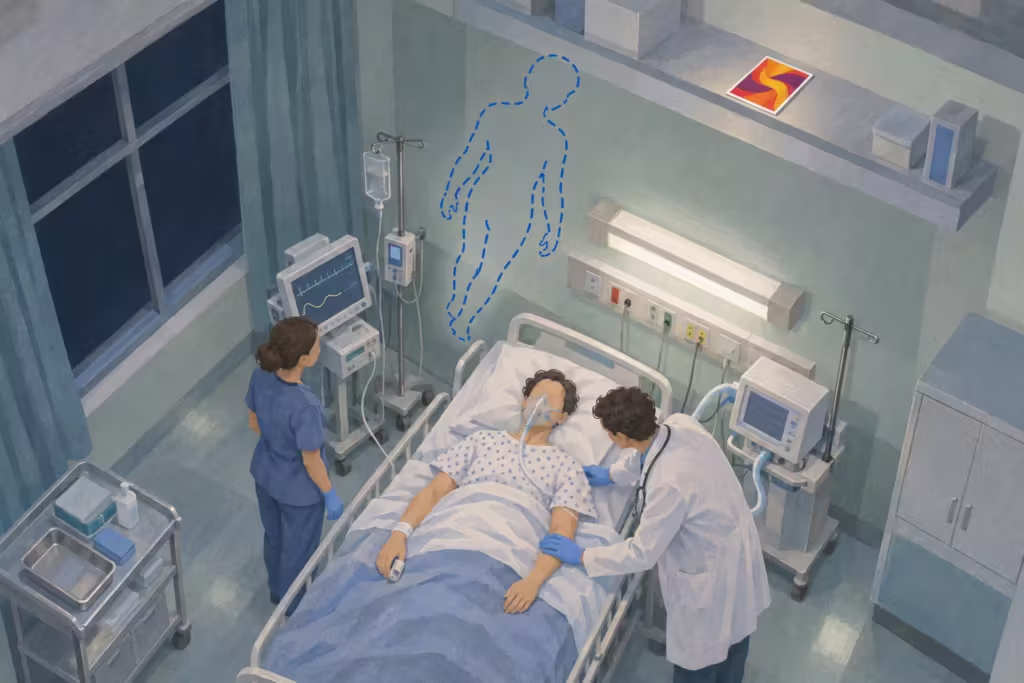
- Are they really experienced?
- Yes. People who have one say it was “more real than real,” and their memory of it is more vivid than their memories of things they lived through while awake.
- Are they hallucinations?
- No one knows. Some researchers think the brain creates them and others don’t. Neither idea has been proven.
- Did what they say they saw really happen?
- In some cases, doctors or documents confirm details they described. The closest ones pass four of the five checks it would take to consider them proven.
- Do they prove there is life after death?
- They don’t prove it, and they don’t prove the opposite either. The question is still open.
“More real than real”
A near-death experience, or NDE, is a very intense experience that some people have when they are about to die. They say they felt peace, saw a light, or left their body. Many say it was “more real than real.”
What that phrase describes has been measured. In 2013, a team at the University of Liège, in Belgium, compared people’s memory of an NDE with their other memories. The study included eight people who had had an NDE. They remembered it with more detail, more clarity, and more emotion than things they had lived through while awake. The authors conclude that it is not an imagined memory. They believe the experience was produced by the brain, but that the person truly lived through it. We cover this in the Liège study of NDE memories.
The memory doesn’t grow over the years either. The American psychiatrist Bruce Greyson asked 72 people to fill out the same questionnaire about their NDE twice, about 19 years apart. Their answers barely changed. We compared 138 interviews with eight other people who have been telling the story of their NDE for years, plus one book by each of them. In all of them, the same experience can be recognized from the first interview to the last. We cover this in “Does the story of an NDE change over the years?”.
On this point, researchers who think the brain creates the experience agree with those who think it doesn’t. People who have an NDE don’t make it up. What is in dispute is where it comes from.
Did what they say they saw really happen?
Many people say that, while they were unconscious, they left their body and saw what was going on around them. Some describe the doctors, a tool, or a conversation. This can be checked, because what happened in the room is sometimes written down.
In some cases, doctors or documents confirm what people described. Here are three:
- Al Sullivan. He had heart surgery in 1988 in the United States. He said he saw his surgeon from above, flapping his elbows as if he wanted to fly. The surgeon confirmed it was a habit of his, although he couldn’t confirm he had done it during that operation. Sullivan’s cardiologist says he never saw another surgeon do it. Years later, the surgeon said on television that he couldn’t explain how Sullivan saw it.
- Patient 10. That is what the study called him, to keep his name private. He was unconscious for hours in an ICU in Wales. He said he saw a doctor look into one of his eyes and the physiotherapist peek out from behind a curtain. His nurse, Penny Sartori, was running a study and had seen what happened. When he woke up, she wrote down what he described.
- Pam Reynolds. In 1991 she had brain surgery in the United States. She was under anesthesia, with her eyes taped shut and earpieces in her ears that gave off very loud clicks. She said she saw the saw they used and heard talk about the arteries in her groin. The surgical report records that the doctors discussed that the artery in her right groin was too narrow. And the saw she described resembles the one they used in its main features.
No one has been able to fully explain how these three people found out what they described. Nor has it been proven that they saw it from outside their body. To be considered proven, a case would have to pass five checks. For example, what the person said would have to be written down before anyone explained anything to them, or someone outside the family would have to confirm it. The hardest one is ruling out that the person heard it or was told about it.
Our archive holds 189 cases in which someone says they saw, heard, or knew something that could be checked. The staircase shows how far they get.
- Al Sullivan and Patient 10 reach the fourth step.
- Pam Reynolds is among the 6 that reach the third.
- No case has reached the fifth yet.
Each step is one more check passed. To count as proven, a case would have to reach the fifth. Our archive, as of November 19, 2026.
If a case passes none of the checks, that doesn’t mean the person lied. Often there is data in its favor, but a document confirming what they said is missing. You can see the ten best-checked cases, with what each one is missing.
Are they hallucinations?
This is the most common question, and the honest answer is that no one knows.
Some researchers think the brain creates the experience when it lacks oxygen or is about to shut down. They point out that some features of NDEs also appear with certain drugs, during fainting, or when some areas of the brain are stimulated. Other researchers think consciousness can carry on for a while without the brain. In their view, some people describe what happened around them at a moment when their brain should not have been able to form memories.
Both ideas have data in their favor, and both have gaps. We cover them with the same care in “What does science say about near-death experiences?”.
What about blind people?
It is one of the questions that comes up most often in forums. In the mid-1990s, two American researchers looked for blind people who had had an NDE. They also looked for blind people who said they had left their body. They found 31, and 25 said they had seen something during the experience. Among the 14 who were blind from birth, 9 said so.
When they were asked more questions, that “seeing” was sometimes closer to knowing or touching. And few details turned up that another person could confirm. We cover this in the study of blind people and in the story of Vicki Umipeg, who was blind from birth.
The experiments with hidden pictures
There is a way to keep the patient from finding out what is happening by ordinary means, for example by hearing it. A picture or an image is hidden where it can only be seen from above, near the ceiling. If someone says they left their body and says what was there, they couldn’t have heard it or worked it out. This has been tried in at least seven studies with people who were critically ill in the hospital. The table shows four.
| Study | What they hid | What happened |
|---|---|---|
| Southampton, England, published in 2001 | Boards with pictures hung from the ceiling | Of the 63 survivors, none said they had left their body. No one had a chance to look at the pictures. |
| An ICU in Wales, five years starting in 1998 | Cards on top of the monitors | 8 patients said they had left their body. None of them saw the cards, and none remembered looking toward the monitors. |
| AWARE, 15 hospitals, from 2008 to 2012 | About a thousand high shelves, with an image on top of each one | 2 people said they saw their resuscitation. Both were in rooms with no shelf. Only 22 out of every 100 cardiac arrests happened in a room with a shelf. |
| AWARE II, 25 hospitals, from 2017 to 2020 | A random image on a tablet above the patient, and the names of three fruits played through headphones | Out of 567 cardiac arrests, only 28 people did the interview. None remembered the image or hearing the fruits. When asked to name any three fruits, one person named exactly the ones from the headphones. |
What the studies themselves published. Each one has its own page on our website.
In all seven studies, no one saw any of the pictures. That doesn’t mean the test failed. Almost no one had a chance to see them. In Southampton, no one said they had left their body. In AWARE, the two people who said they saw their resuscitation were in rooms with no shelf. In AWARE II, only 28 people were able to do the interview. And in the Welsh study, according to its author, the 8 patients were focused on their own body and didn’t look toward the monitors. The other three studies, in Illinois, Connecticut and Virginia, had the same problem: almost no one had an NDE.
There is a curious detail in AWARE II. No one remembered hearing the fruits. But when they were asked to name any three fruits, one person named exactly the three that had played in their earphones. With just one person, there is no way to know whether it was chance.
So the test says nothing either for or against. For it to say something, it would take many more hospitals and many more years.
Do they prove there is life after death?
They don’t prove it, and they don’t prove there isn’t one either. If the brain produces these experiences, no one has yet explained in full detail how it does so. If consciousness carries on without the brain, no one has yet proven it. That is why the question is still open.
Many people also ask whether NDEs prove that God exists. They don’t prove that either. Many people say they met a being of light or a presence full of love. When they give that being a name, it is almost always the name from their own religion. We cover this in “Are near-death experiences the same in other cultures?”.
Two things could settle the question. One is a case that passes all five checks. The other is a person who says what was in a hidden picture. If, after many more attempts, neither ever shows up, the brain-based explanation would come out stronger. If either one shows up, it would be very hard to explain without consciousness carrying on without the brain. To this day, neither has happened.
In short
To this day, neither science nor anyone else has been able to prove that what people go through in a near-death experience is false or real. No one disputes that people truly live through it. What remains unproven is whether it comes from the brain or from something beyond it.
Frequently asked questions
Is there any near-death experience case that has been fully checked?
No. Of the 189 cases we have gathered, none passes all five checks it would take, as of November 19, 2026. One of them is that what the person said was written down before anyone explained anything to them. The two that come closest, Al Sullivan and Patient 10, meet four. They are in “Top 10 best-checked NDEs”.
Has anyone identified a hidden picture during a near-death experience?
No. At least seven studies hid pictures or images that could only be seen from above, and no one saw any of them. Almost no one had a chance to see them, so the result says nothing either for or against.
Do near-death experiences get exaggerated over the years?
From what has been measured, they don’t. A study by Bruce Greyson gave the same questionnaire to 72 people 19 years apart, and the answers barely changed. We cover this in Greyson’s study.
Were people who have a near-death experience dead?
Not in the sense of final death, because they came back. In many of them, the heart had stopped for minutes. That is why we call them “near”-death experiences.
Keep reading
- See the best-checked casesThe ten best-checked cases, with their five checks and what each one is missing.
- Read Al Sullivan’s storyThe surgeon who flapped his elbows, and why it is one of the two cases that come closest.
- Read what science saysThe two explanations, what supports them, and what they lack.
Where these figures come from
- Our archive: 189 cases in which a person says they saw, heard, or knew something that could be checked. Each one has its five checks, as of November 19, 2026.
- Our study: “Does the story of an NDE change over the years?”, 138 interviews and eight books.
- Thonnard et al. (2013), how an NDE is remembered, PLoS ONE 8(3):e57620. Read for free
- Greyson (2007), the same accounts about 19 years apart, Resuscitation 73(3):407-411. View the article
- Ring and Cooper (1997), blind people, Journal of Near-Death Studies 16(2):101-147. Read for free
- Parnia et al. (2001), the Southampton study, Resuscitation 48(2):149-156. View the article
- Sartori (2008), The Near-Death Experiences of Hospitalized Intensive Care Patients: A Five Year Clinical Study, a book published by Edwin Mellen Press.
- Parnia et al. (2014), the AWARE study, Resuscitation 85(12):1799-1805. View the article
- Parnia et al. (2023), the AWARE II study, Resuscitation 191:109903. View the article
- Holden (2014), apparently non-physical veridical perception, in Hagan (2017), The Science of Near-Death Experiences, University of Missouri Press, pp. 83-85. The seven studies with hidden targets.
- The three cases: Cook, Greyson, and Stevenson (1998), Journal of Scientific Exploration 12(3):377-406, on Al Sullivan. Sartori, Badham, and Fenwick (2006), Journal of Near-Death Studies 25(2):69-84, on Patient 10. Michael Sabom (1998), Light & Death, a book published by Zondervan, on Pam Reynolds.