Are all near-death experiences the same?
No. Near-death experiences are very much alike in broad terms. But there is nothing that everyone describes, and there is no fixed order of stages. And what people go through changes very little depending on how they came close to death.
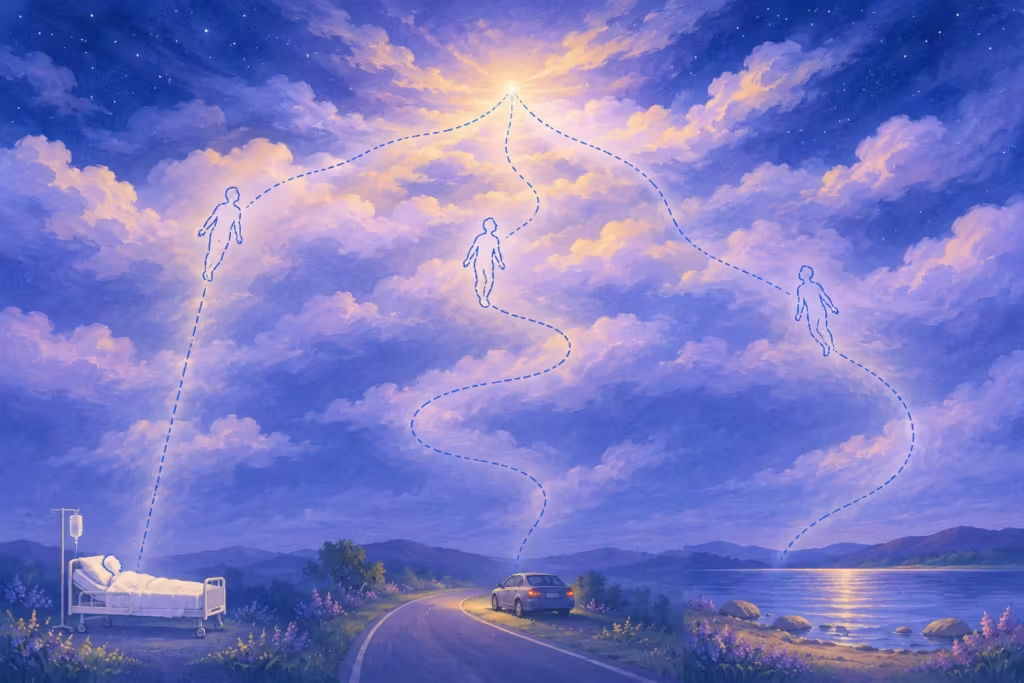
- What they share
- Peace, a light, beings or presences, and leaving the body come up again and again in many accounts.
- What they don’t all have
- No element appears in every experience. Not even peace, which is the most common one.
- The order
- There is no fixed order. The thing people most often describe first is leaving the body, and at the end, going back into it.
- How they came close to death
- What people go through changes little between an accident, surgery, or cardiac arrest.
What they share
A near-death experience, or NDE, is a very intense experience that some people have when they come close to death. People who describe one often speak of peace, a very bright light, beings or presences, and leaving their body. That is why anyone who reads several accounts gets the impression that they all tell the same story.
In “What is a near-death experience?” we explain how many people describe each thing. Here we answer a different question: are they all the same?
No element appears in all of them
In 2017, a team at the University of Liège, in Belgium, read the written accounts of 154 people who had had an NDE. The team looked in each account for elements such as peace, light, or leaving the body. They counted eleven clear elements like these. Each account had between 1 and 9, and the average was 4. If five other, less specific ones are added, the average was 6.
The most common element was peace, described by 80 out of 100 people. The rest did not mention it. Of every 100 people, 69 described seeing a light and 53 described leaving the body. Only 16 out of 100 described seeing their life pass by.
The authors conclude that no NDE element is universal. The same is true of the accounts we have gathered in our archive. Not even the most common element is described by everyone.
Are there stages? Do they happen in order?
In 1980, the American psychologist Kenneth Ring proposed that an NDE has five stages, one after another:
- Peace and the absence of pain.
- Separating from the body.
- Entering darkness or a tunnel.
- Seeing a bright, warm light.
- Entering that light.
The Liège team wanted to check whether the accounts really follow an order. To do this, they looked at what each person described first, what came next, and what came last.
154 accounts written in French, from a University of Liège study published in 2017. Each of the other elements comes first in fewer than 2 out of 100.
There are some clear trends:
- The beginning and the end. Many accounts begin with leaving the body. And what comes up most often at the end is going back into the body, in 36 out of 100 accounts.
- The beings come later. Of the 47 people who described leaving the body and meeting beings, 43 described leaving the body first.
- Light and peace go together. Of the 88 people who describe both light and peace, 49 describe the light first and 39 describe peace first. The authors think it may be hard to tell them apart, because many people describe the light as something that brings peace.
What does not appear is an order that everyone follows. The team looked for the most common sequence of four elements. It was leaving the body, then the tunnel, then the light, and finally peace. Of the 27 people who described those four elements, only 6 described them in that order. The other 21 described them in other orders. The team also found 33 other different sequences of four elements. Each one came up in only 2 to 5 accounts.
The authors conclude that each person may describe their own order. They point out a limitation. What they measure is the order in which a person writes their account, years later. They cannot know whether it is exactly the order in which the person went through it.
Two stories on our site show this. Pam Reynolds says she left her body during surgery and that she later saw a light and relatives who had died. Howard Storm also says he left his body. But then he says he went through a darkness where beings attacked him. The light came later.
Does it change depending on how the person came close to death?
Very little. There are two ways to check, and both give the same result.
Some people describe an experience like this without having been in any danger. The first way to check is a 2014 study by the same Liège group. It compared 140 people who said they had an NDE during a coma with 50 people who said they had one without any threat to their life. No one checked this against their medical records. Those 50 had it while sleeping, during a fainting spell, while meditating, after taking drugs or alcohol, or in other situations with no danger. The study found no clear differences between the two groups, either in how intense the experience was or in its elements. Nor did it find any depending on the cause of the coma. That does not prove they are the same: with 50 people, a small difference can go unnoticed.
The second way is our archive. As of November 15, 2026, we have analyzed 268 accounts one by one. We sorted them by what happened to each person. For example, an accident, cardiac arrest, surgery, an illness, drowning, or an overdose. Then we looked at whether each element came up more often with some causes than with others. We made 72 comparisons. Only 3 showed a difference. With that many comparisons, you would expect 3 or 4 to show a difference by pure chance. And none of the 3 held up under the test used when there are so many comparisons, so as not to mistake chance for a real difference.
The table does not show those 3 differences. For four elements, it shows the cause in which the fewest people describe them and the cause in which the most do.
| What they describe | Cause where it is described least | Cause where it is described most |
|---|---|---|
| A light | 11 of 15, in poisonings and overdoses | Everyone: 8 of 8 in fainting spells and 6 of 6 with lightning or an electric shock |
| Beings or presences | 5 of 8, with lightning or an electric shock | Everyone: 17 of 17 in poisonings and overdoses and 9 of 9 in fainting spells |
| Leaving the body | 3 of 8, in fainting spells | 15 of 16, in poisonings and overdoses |
| A tunnel | 2 of 17, in poisonings and overdoses | 3 of 8 in fainting spells, and another 3 of 8 with lightning or an electric shock |
Our archive, as of November 15, 2026. We only count people who say clearly whether or not they experienced that thing. Those who don’t mention it are left out. The smallest groups, of 6 to 9 people, give figures that are not very reliable.
With groups this small, differences like these can come up by chance. Everyone described the light in two groups, and everyone described the beings in two groups as well. In the remaining groups, some people did not describe them.
The tunnel is a good example. A well-known idea says that the tunnel is caused by a lack of oxygen in the eyes. If that were so, you would expect more tunnels in cardiac arrests, where oxygen is lower. In our archive, the tunnel comes up just as often in cardiac arrests as overall: 29 out of 100.
This similarity across different causes does not prove that the experience comes from outside the brain. It may also be that the brain responds in a similar way when facing death, whatever the cause. Nor does it prove that the brain produces it. We cover both explanations in “What does science say?”.
Our archive has a limitation. These are people who choose to tell their experience in public, in books or interviews. They are not a random sample. And with groups this small, only large differences would show up. A small difference could exist without our seeing it.
What does change: who appears, and their names
Where experiences differ most is in who appears and what they are called. In villages in India, for example, many people say that messengers came to fetch them, and almost no one mentions a tunnel. When someone gives a being a name, it is almost always a name from their own religion. We cover this in “Are near-death experiences the same in other cultures?”.
Frequently asked questions
Do all near-death experiences have a tunnel?
No. In a University of Liège study of 154 accounts, 47 out of 100 people described a tunnel. In the accounts in our archive, fewer than a third describe one. More in “What is a near-death experience?”.
Does everyone who has an NDE see relatives who have died?
No. In the accounts in our archive, roughly 1 in 3 people say they saw relatives or friends who had died. It is more common in cardiac arrests, but the difference may be due to chance.
Why are near-death experiences so alike?
No one knows. Some researchers think the brain reacts in a similar way when it is close to death. Others think the person goes through something real that does not depend on the brain. Neither idea has been proven. We cover this in “What does science say?”.
Keep reading
- What is a near-death experience?What people go through, how often it happens, and what changes afterward.
- NDEs in other culturesWhat recurs all over the world, and what changes.
- Howard Storm’s storyAn art professor who did not believe in God says he went through darkness before he saw the light.
Where these figures come from
- Martial et al. (2017), the order of the elements in 154 accounts, Frontiers in Human Neuroscience 11:311. Read for free
- Charland-Verville et al. (2014), experiences with and without a threat to life, Frontiers in Human Neuroscience 8:203. Read for free
- Kenneth Ring (1980), Life at Death, a book published by Coward, McCann & Geoghegan. The five stages, as summarized by Martial et al. (2017).
- Our archive: 268 accounts, each with its record, sorted by the cause of the episode, as of November 15, 2026.