
A real-life story · Southern Iraq, 2007
Natalie Sudman’s near-death experience
Natalie Sudman is an American archaeologist who worked in Iraq for the U.S. Army. In November 2007, a bomb exploded under the truck she was riding in. She later said that, in the seconds of the explosion, she appeared before thousands of beings, as if in a stadium. She says that there she decided to come back and chose which injuries she would have.
Military documents from the time confirm the attack, and the Army gave her a medal for her injuries. Natalie doesn’t say she died. She says everything she experienced fit into less than five seconds, with the truck still moving. We tell her story step by step in her own words and then look at what can be checked. If you only want the evidence, skip straight to what can be checked. How can so much fit into five seconds?
Step 1
From August 2006 to November 2007 · In Iraq
An archaeologist oversees construction for the Army in Iraq

Natalie Sudman grew up near Minneapolis, in the United States. She studied art and worked as an archaeologist. In August 2006 she arrived in Iraq as a civilian employee of the U.S. Army Corps of Engineers. She wasn’t a soldier. Her job was to oversee the projects being paid for to rebuild the country, such as water treatment plants and roads.
To get to the sites, she traveled in convoys with armed security guards.
Natalie says she had had unusual experiences since she was a child. She says she would leave her body and that she gave her friends psychic readings, like a fortune-teller’s.
On November 24, 2007, she went out to visit sites, as she did on so many days.
Step 2
November 24, 2007 · In the truck · Natalie’s account
A bomb explodes under her armored truck

It was the end of a long day. The convoy of four vehicles was coming back from visiting sites and was a few minutes from the base. Natalie was in the back seat of an armored SUV, next to a coworker. The driver and a security guard sat up front. In her book she calls the coworker in the back Ben, the driver Ian, and the guard Mark. Those aren’t their real names.
Natalie was very tired. She was half asleep, with her head resting on her hand and her elbow on the door handle.
Then a bomb hidden by the road exploded under the truck. She says she only heard a “pop,” like a champagne bottle being opened far away.
Natalie says that in that instant she was no longer in the truck.
Step 3
In the instant of the explosion · Natalie’s account
Natalie says she appeared before thousands of beings, as if in a stadium
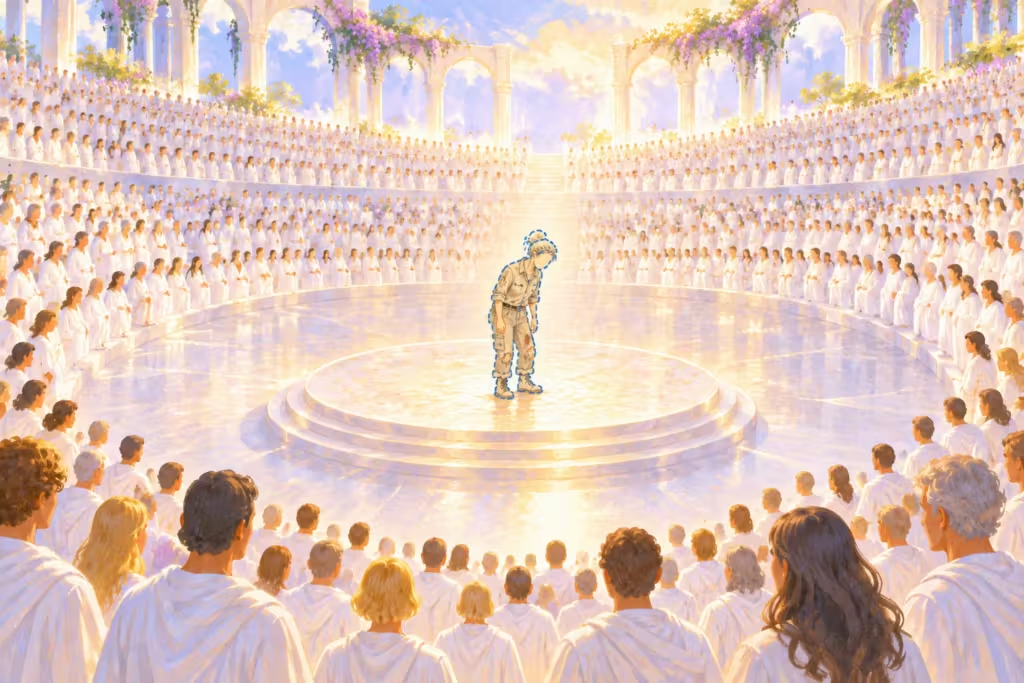
Natalie says that, all at once, she was standing on a round platform at the center of something like a huge stadium. Around her were thousands of beings dressed in white. She was wearing her work clothes, torn and stained with blood. She says she knew most of them, although they weren’t relatives or friends from this life.
The first thing she told them, without words, was that she was tired and didn’t want to go back. She says the decision was hers.
Then, she says, she passed them a huge amount of information all at once about life on Earth, above all about culture and politics. They took it in within seconds. They asked her to go back to her body to finish a job. Natalie agreed, but she asked them to help her for the rest of her life.
Before going back, she says, she needed to rest.
Step 4
In the same instant · Natalie’s account
Natalie says she rested in a darkness that held all light within it

Natalie says she moved to another place, a boundless darkness that, she says, held all light. There she had no shape. Other beings helped her regain her strength while she rested. She says that rest lasted what would be centuries, in less than a moment.
While she rested, she went over her life. It wasn’t a judgment. Years later, in an interview, she described it as “kind of a leisurely stroll through my life.” She paid attention to what had surprised her and to where she had had fun, including when she was working hard.
Then, she says, she went to look at her body.
Step 5
In the same instant · Natalie’s account
Natalie says she saw her body in the truck and chose her injuries
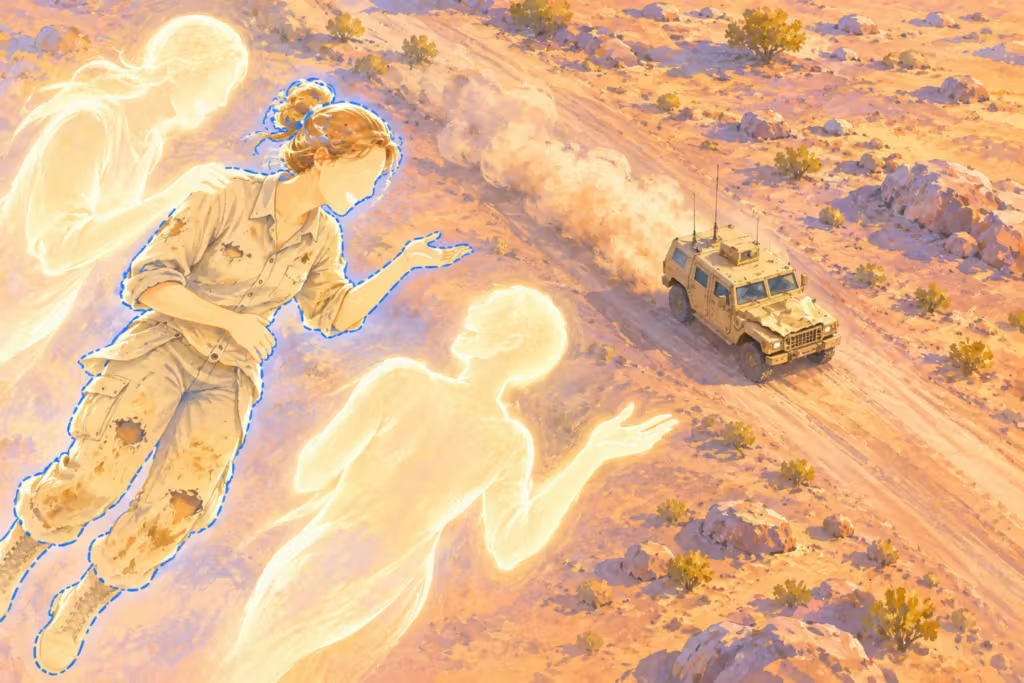
Natalie says that, from somewhere else, she could see her body in the truck. It was just as she had left it, with her head in her right hand and her elbow on the handle. She says she could also see her injuries. Her right wrist was broken, and so were her right foot and ankle. She had a wound in her side and a large hole in her head. She was missing an eye and part of her brain.
She says that she and other beings healed some of her body’s injuries, but not all of them. They tried out other injuries, such as going completely blind, losing her right hand, or having shrapnel in her brain. With each one, they looked at what her life would be like. She says she chose which injuries she would come back with and that they joked as they worked.
Years later, in an interview from around 2018, she added that she saw it all from above, from “one hundred feet or something.” Her book doesn’t say this.
Then, she says, she thanked them.
Step 6
November 24, 2007, seconds after the explosion · Natalie’s account
She returns to her body, and the truck is still rolling
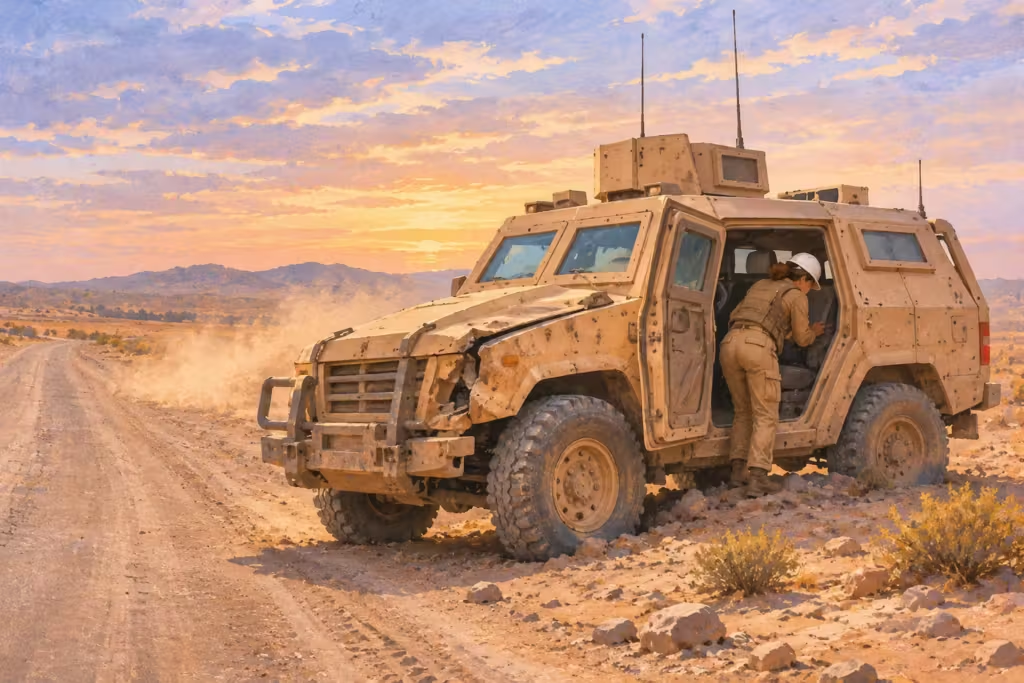
Natalie says that, before going back, she talked with other beings about what she had agreed to do. Then she took a deep breath and returned to her body, with a “pop” in her head. She opened her eyes and the truck was still rolling down the road. She estimates that it had all happened in less than five seconds.
The truck went on for about 200 meters, turned on its own, and stopped. Natalie tried to reach the first-aid kit at Mark’s feet, but Mark’s legs were in the way. She looked at the others to see if any of them was bleeding badly. She unbuckled the driver’s seat belt.
A Corps of Engineers newsletter from February 2008 quoted her. She said she was conscious from the explosion until they were loaded onto the helicopters.
A few minutes later, she heard the radio.
Step 7
November 24, 2007, minutes later · In the desert · Natalie’s account
She hears on the radio that one critical casualty is left and says she knew Mark had died
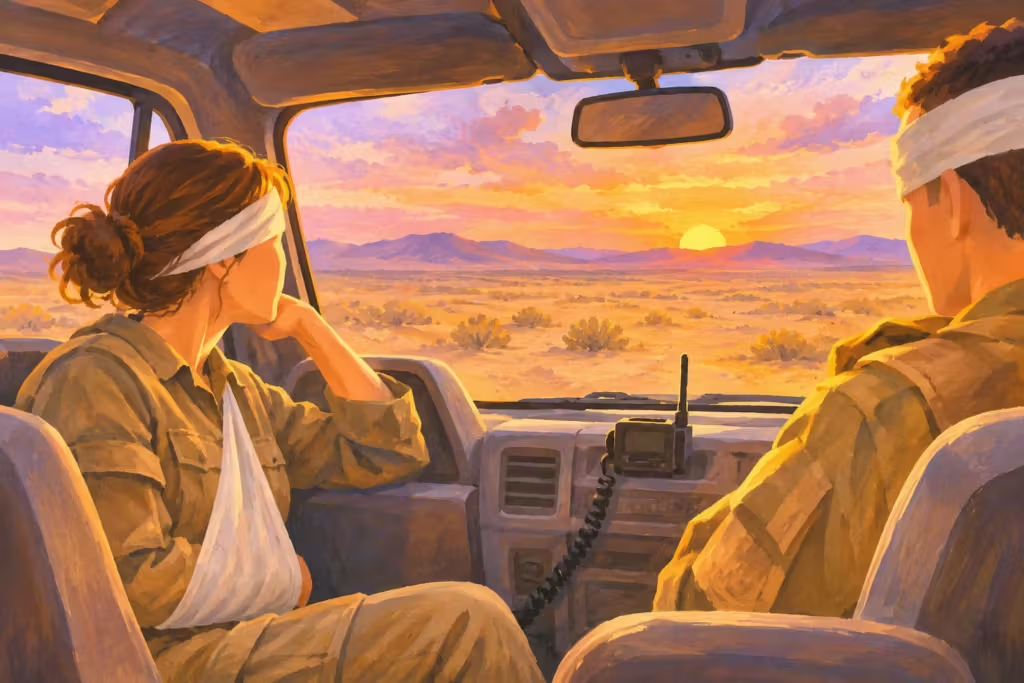
The guards got her out of the truck and sat her in another SUV, next to the driver. Natalie says the radio was on and that she heard someone report two superficial and two critical casualties. She thought the two critical ones were Ben and Mark.
Almost right away, the same voice corrected itself: two superficial, one critical. Years later, Natalie wrote that this was the moment she knew Mark had died.
She says she doesn’t know how she knew it was Mark. It could have been Ben, who had a very serious leg wound.
Then came the evacuation by helicopter.
Step 8
From November 2007 to February 2008 · In the hospitals and in Washington
A month in the hospital and a medal at the Pentagon
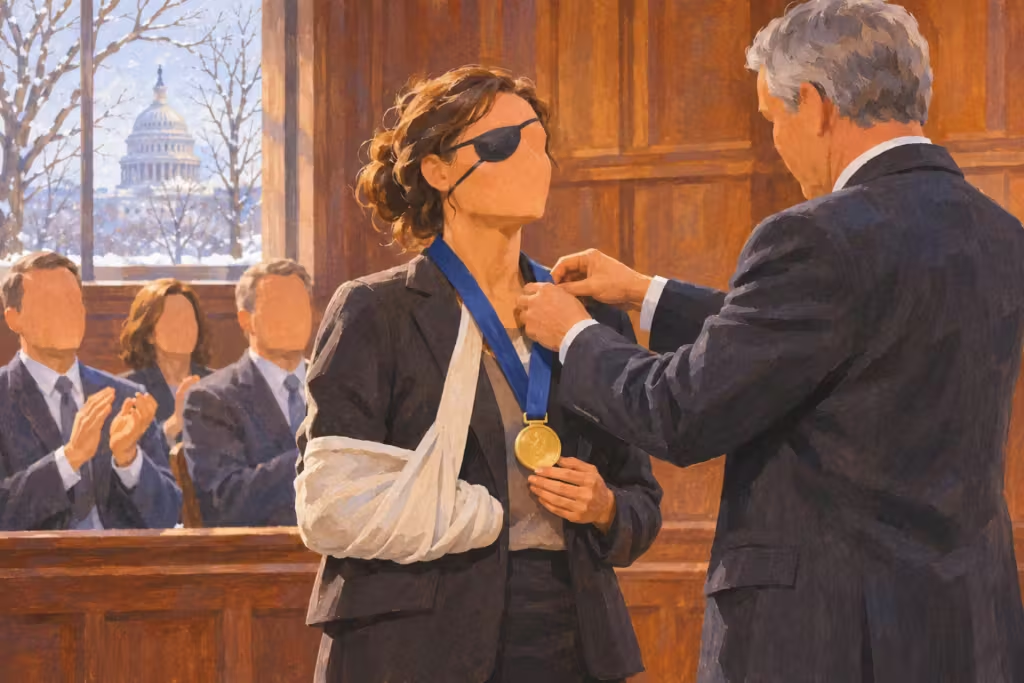
Natalie says she spent a month at Walter Reed, the military hospital near Washington. Her skull and the bones on the right side of her face were broken, and she had shrapnel in her eyes. Her wrist and forearm were shattered, and her heel was broken. She lost part of the sight in her right eye. Doctors put titanium plates in her skull.
In January 2008 she was given the Defense of Freedom Medal. It is the medal awarded to civilian employees of the Department of Defense who are wounded in the line of duty. The Corps of Engineers newsletter reported it in February 2008, with the date and her injuries. That article also names a colleague who was wounded with her, Jarrod Bonnick, whose main thigh artery had been cut. Because of that leg wound, Jarrod Bonnick is most likely the colleague the book calls Ben.
On February 26, 2008, she received another medal at the Pentagon, for her service in the war on terrorism. She was among the first civilians to receive it. None of those news reports mentions anyone killed in the attack.
It took Natalie years to tell the story of her experience.
Step 9
From 2008 to 2012 · Natalie’s account
Four years later, she tells the story in a book

Natalie says that in the hospital, or soon after, she wrote down what had happened in the truck, in as much detail as she remembered. She wanted to use that text in a book about her work in Iraq. Her 2012 book says she left the experience out on purpose, and that it now surprises her that she did. In an interview from around 2018, she told it differently. She said the memories came back months after she left the hospital, while she was meditating.
The earliest interview about her experience that we have found is from March 2012. That same year she published her book, “Application of Impossible Things.”
Today Natalie is an artist and works as a professional psychic reader. She says the experience didn’t change her all at once. She says it was one more step on a path she had already started on as a child.
What can be checked in Natalie Sudman’s account?
How many people have an NDE?
Natalie Sudman is not a one-off. The most reliable figures come from people who survive a cardiac arrest. For more than thirty years, several teams of doctors have asked them what they remember. They do it in the hospital, a few days afterward.
Picture 100 of those people:
Each dot is a person. The 18 filled-in dots are the ones who described a near-death experience. That is what the largest study found. It was done in the Netherlands in 2001, with 344 people.
The other 82 didn’t describe one. Many remember nothing of their cardiac arrest.
| Where and when | People interviewed | Described an NDE |
|---|---|---|
| England, 2001 | 63 | 6% |
| Netherlands, 2001 | 344 | 18% |
| United States, 2002 | 30 | 23% |
| United States, 2003 | 116 | 10% |
| United Kingdom, United States, and Austria, 2014 | 101 | 9% |
| Vienna, Austria, 2023 | 126 | 4% |
| United States and United Kingdom, 2023 | 28 | 21% |
What these figures don’t tell you
- Only some people are asked. In the 2014 study, 330 people survived, but only 140 could be interviewed, and 101 reached the second interview. The rest died later, were too ill, or didn’t respond.
- Most cardiac arrests are never counted. These studies run in a few hospitals for a limited time. Outside them, no one keeps track. Also, the 2003 study interviewed 1,595 cardiology patients, not just the 116 with cardiac arrest in the table, and 81 of them described an NDE from an earlier occasion. The study did not count them, because it only counted those from that hospital stay.
- Some people keep quiet. In the accounts in our archive, at least 13 people say they kept their experience to themselves for a while. They kept quiet because they weren’t believed or because they were afraid of how others would react.
- It depends on how you count. If you count any memory of the cardiac arrest, the numbers go up. If you use a strict scale, they go down. In England in 2001, 7 of 63 people remembered something. But on the scale, only the memories of 4 people qualified as an NDE.
That’s why no one knows the real figure. But every study shows that it isn’t rare. Between 4 and 23 of every 100 survivors who are asked describe an NDE. Natalie Sudman doesn’t describe a cardiac arrest. She had her experience in the seconds of an explosion.
Frequently asked questions
Who is Natalie Sudman?
Natalie Sudman is an American archaeologist and artist. She worked in Iraq as a civilian employee of the U.S. Army Corps of Engineers. In November 2007, a bomb exploded under her truck. In 2012 she described her near-death experience in the book “Application of Impossible Things.”
Did Natalie Sudman die in the explosion?
No. Natalie Sudman doesn’t say her heart stopped or that she died. She says she left her body in the instant of the explosion. She says she came back in less than five seconds, with the truck still moving. She was badly wounded in the head, the face, an arm, and a foot.
What did Natalie Sudman see in her near-death experience?
Natalie Sudman says she appeared before thousands of beings dressed in white, as if in a stadium, and that she decided to go back to her body. She says she rested in a darkness full of light and went over her life. Then, looking at her body in the truck, she chose which injuries she would come back with.
Where this story comes from
Her book
- Natalie Sudman, Application of Impossible Things (Ozark Mountain Publishing, 2012). It has a Spanish edition, “La aplicación de cosas imposibles”Buy the book
Interviews
Documents from the time
- Engineer Update, the newsletter of the U.S. Army Corps of Engineers, February 2008, page 4Read
- The Department of Defense news story about the medals of February 26, 2008, saved by the University of North TexasRead
- The Washington Post, February 27, 2008
Learn more
- What is a near-death experience?Read
Our archive
- Our reading of her book, two interviews, and the 2008 documents, and the scoring against our five criteria, as of November 18, 2026
Keep reading

Austin, 1977
Gary Wimmer
In 1977, a car hit Gary Wimmer and he got up without a scratch. Gary says he saw the future, and that in 2001 he recognized the attack on the Twin Towers on television.
Charleston, South Carolina, United States, 1991
Mary Helen Hensley
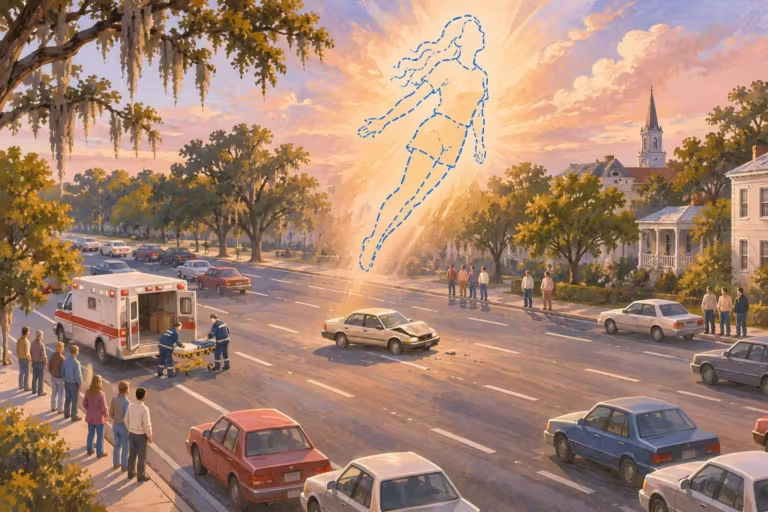
In 1991, a car ran a red light and slammed into Mary Helen Hensley’s. She says she left her body before the impact, that from above she saw a man turn off the engine and a woman leave a note on the seat, and that two beings showed her her whole life.
Seattle, United States, 1973
Vicki Umipeg
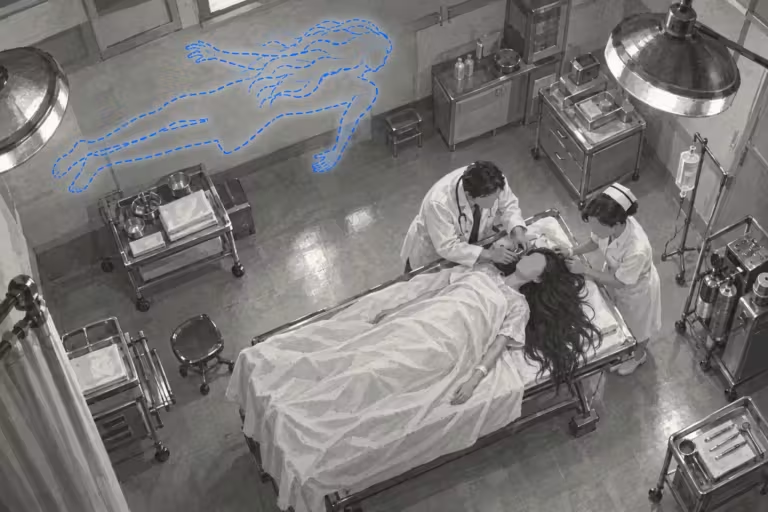
She was blind from birth and was in a very serious car accident. She later said she saw herself from the ceiling of the emergency room. She said she recognized her hair and her rings.

Reincarnation: The top 5 people who remember past lives
We asked them the same five questions as this story. A 32-page PDF, free in your inbox.
Check your email
We have sent you an email. Open it and press the button to confirm. If you cannot see it, check your spam folder.