Skip to content
portalecm Search

Top 10 best-checked reincarnation cases

Assessed against the published evidence and documentation

A reincarnation case is when a person, almost always a young child, talks about another life and gives details about someone who has already died. Here are the cases on our site, ranked from best checked to least checked. None of them is fully checked.

What matters most is whether someone wrote down what the child said before the other family was found. If it was written down afterward, the memories of both families can shift without anyone meaning to, and fit what they already know about the person who died.

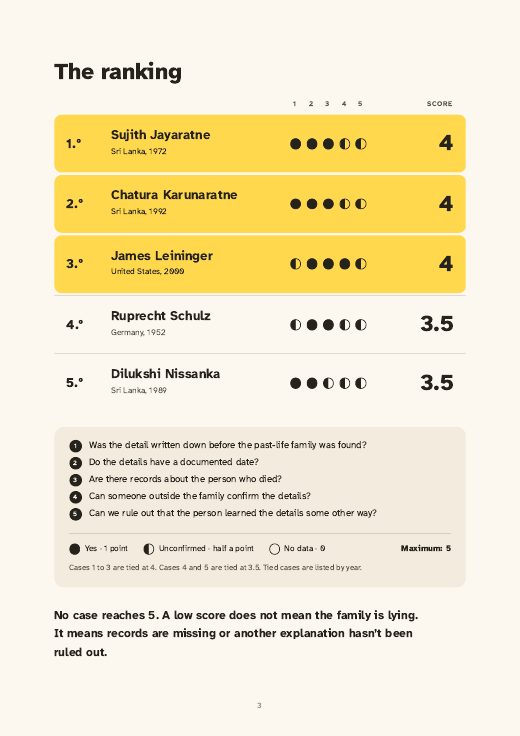
We ask every case the same five questions. Each answer is marked with a dot:

  • Yes1 point
  • Unconfirmed½ point
  • No0 points
  • No data0 points
  • Does not apply0 points

A low score doesn’t mean the family lied. It means the documents needed to check the account are missing.

How we score

#1: 3 stories tied with 4 out of 5

Number 1

Sujith Jayaratne

Sri Lanka, 1972

4 out of 5

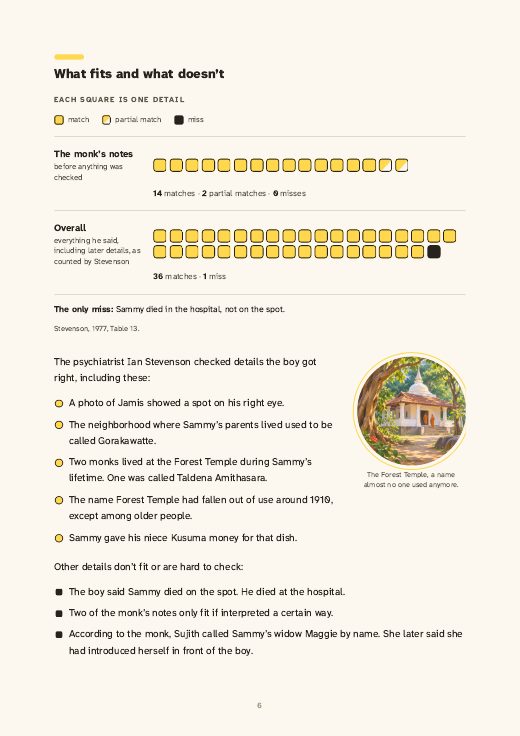
Sujith Jayaratne was about two years old when he began saying that he was called “Gorakana Sammy” and that a lorry had run him over. A Buddhist monk wrote down what he said before checking it. In Gorakana he found the family of Sammy Fernando, who died that way in 1969.

  1. Was what the child said written down before the other family was found? Yes.
  2. Do we know when it was written? Yes.
  3. Are there documents of the other person’s death? Yes.
  4. Does an outsider confirm it? Unconfirmed.
  5. Could the child have learned it some other way? Unconfirmed.
What document would raise the score Who the monk spoke to in Gorakana when he checked what he had noted down. And something more than the neighbors’ word to rule out that Sujith heard talk of Sammy Fernando, because a friend of Sammy’s lived less than 100 meters from his house.
Read the full story

Number 2

Chatura Karunaratne

Sri Lanka, 1992

4 out of 5

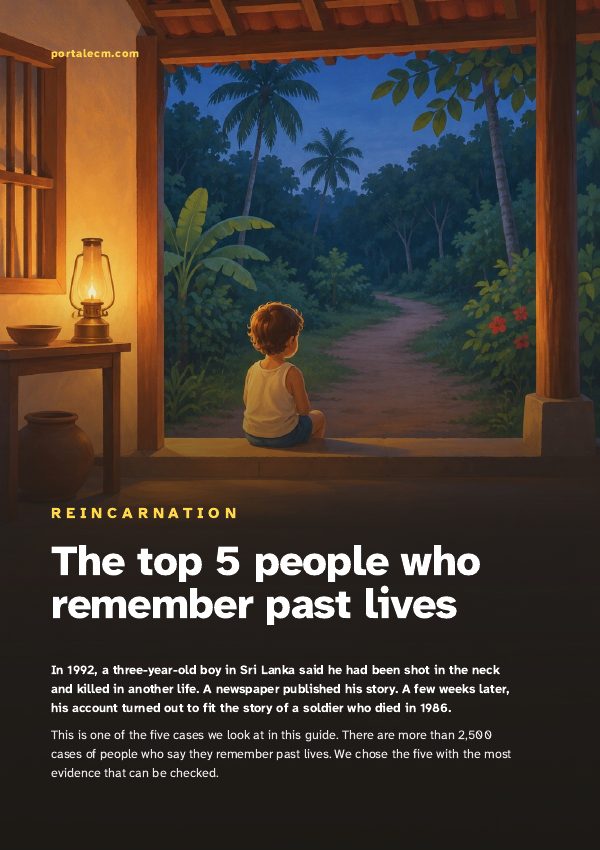
Chatura Karunaratne was three years old when he began saying that in another life he was a soldier who was attacked in a truck. A national newspaper published what he said in June 1992. Then the father of a soldier who died in 1986 read the article and recognized his son.

  1. Was what the child said written down before the other family was found? Yes.
  2. Do we know when it was written? Yes.
  3. Are there documents of the other person’s death? Yes.
  4. Does an outsider confirm it? Unconfirmed.
  5. Could the child have learned it some other way? Unconfirmed.
What document would raise the score Someone from outside the family who confirms what Chatura said about the life of Dayananda, the soldier who died in 1986. Chatura talked about some turtles, a shop, and a house. Today only Dayananda’s family confirms this, and they came to the case after reading about it in the newspaper.
Read the full story

Number 3

James Leininger

Louisiana, United States, 2000

4 out of 5

James Leininger was two years old when he began screaming in his sleep that a plane was going down in flames. His parents say he talked about a ship called “Natoma” and a pilot named Jack Larsen. In 2002 his father found a pilot who fit, James Huston, who died in 1945.

  1. Was what the child said written down before the other family was found? Unconfirmed.
  2. Do we know when it was written? Yes.
  3. Are there documents of the other person’s death? Yes.
  4. Does an outsider confirm it? Yes.
  5. Could the child have learned it some other way? Unconfirmed.
What document would raise the score The emails James Leininger’s family wrote to Carol Bowman, an author of books about children who remember another life. They would say what the boy said and when. They would also say whether he talked about the ship Natoma Bay and the pilot Jack Larsen before his father looked them up on the internet. Those emails have not been published.
Read the full story

#4: 5 stories tied with 3.5 out of 5

Number 4

Iranga Jayakody

Sri Lanka, 1985

3.5 out of 5

Iranga Jayakody was three or four when she began to talk about another life in Elpitiya, as the daughter of a banana seller. Part of it was written down before anyone looked. In Elpitiya, one family had lost a 13-year-old daughter in 1950.

  1. Was what the child said written down before the other family was found? Yes.
  2. Do we know when it was written? Yes.
  3. Are there documents of the other person’s death? Unconfirmed.
  4. Does an outsider confirm it? Unconfirmed.
  5. Could the child have learned it some other way? Unconfirmed.
Read the full story

Number 5

Kemal Atasoy

Turkey, 1997

3.5 out of 5

Kemal Atasoy was six years old when he told a psychologist that in another life he was Karakas, a rich Armenian from Istanbul. The psychologist wrote it down before looking for anyone. Then he found the house, and a local historian who remembered Karakas.

  1. Was what the child said written down before the other family was found? Yes.
  2. Do we know when it was written? Yes.
  3. Are there documents of the other person’s death? Unconfirmed.
  4. Does an outsider confirm it? Unconfirmed.
  5. Could the child have learned it some other way? Unconfirmed.
What document would raise the score Any document about the life and death of Karakas, the rich Armenian from Istanbul that Kemal talked about. The Armenian church records burned in 1957. Today only a neighborhood historian and some elderly neighbors remember Karakas.
Read the full story

Number 6

Gnanatilleka

Sri Lanka, 1960

3.5 out of 5

Gnanatilleka Baddewithana talked from a young age about other parents in Talawakele, in Sri Lanka. In 1960, a journalist wrote down 57 things she said before identifying anyone. Then a truck driver who read the story pointed to the family of a boy who died in 1954.

  1. Was what the child said written down before the other family was found? Yes.
  2. Do we know when it was written? Yes.
  3. Are there documents of the other person’s death? Unconfirmed.
  4. Does an outsider confirm it? Unconfirmed.
  5. Could the child have learned it some other way? Unconfirmed.
What document would raise the score A document that explains why the death certificate of Tillekeratne, the boy who died in 1954, doesn’t match what Tillekeratne’s family says. Three things don’t match: the age, the parents, and the burial place. The certificate lists the parents as unknown.
Read the full story

Number 7

Dilukshi Nissanka

Sri Lanka, 1989

3.5 out of 5

Dilukshi Nissanka was not yet two years old when she began saying that in another life she had drowned near Dambulla. A letter and a newspaper recorded what she said in 1989. Days later, the father of a girl who drowned in 1983 wrote to Dilukshi’s family.

  1. Was what the child said written down before the other family was found? Yes.
  2. Do we know when it was written? Yes.
  3. Are there documents of the other person’s death? Unconfirmed.
  4. Does an outsider confirm it? Unconfirmed.
  5. Could the child have learned it some other way? Unconfirmed.
What document would raise the score The death certificate of Shiromi, the girl who drowned near Dambulla in 1983. Today her death is told only by her father and her aunt, in a letter.
Read the full story

Number 8

Ruprecht Schulz

Germany, 1952

3.5 out of 5

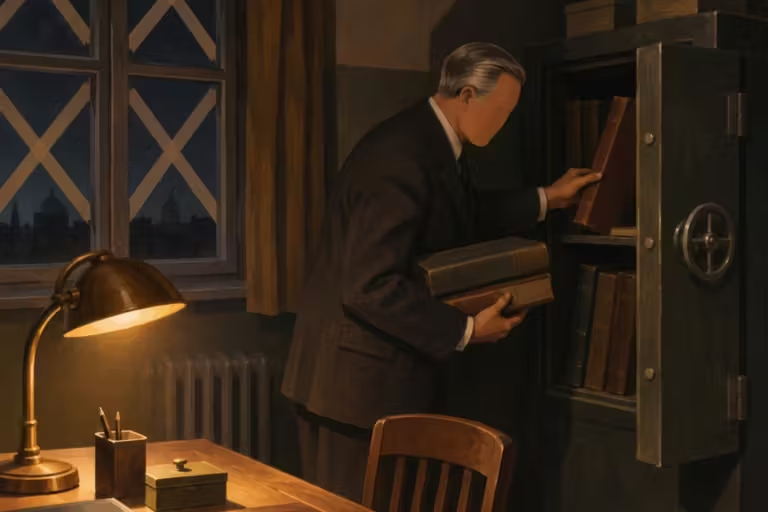
Ruprecht Schulz was a Berlin businessman when, in the middle of the war, he began seeing a ruined merchant shoot himself. In 1952 he wrote letters to find him. The city hall of Wilhelmshaven answered that a timber merchant had killed himself there.

  1. Was what the child said written down before the other family was found? Unconfirmed.
  2. Do we know when it was written? Yes.
  3. Are there documents of the other person’s death? Yes.
  4. Does an outsider confirm it? Unconfirmed.
  5. Could the child have learned it some other way? Unconfirmed.
What document would raise the score A letter from Ruprecht Schulz written before the Wilhelmshaven city hall gave him the merchant’s name. It would have to describe the most specific details of his memory, such as a safe and a dark room. The first thing he wrote about those details comes after the city hall’s reply.
Read the full story

#9: 3 stories tied with 3 out of 5

Number 9

Thusitha Silva

Sri Lanka, 1985

3 out of 5

Thusitha Silva was about three when she began to say she was from Kataragama and that a boy had pushed her into the river. A researcher wrote it down before going to look. Among the flower stalls, one family had lost a daughter in that river.

  1. Was what the child said written down before the other family was found? Yes.
  2. Do we know when it was written? Yes.
  3. Are there documents of the other person’s death? Unconfirmed.
  4. Does an outsider confirm it? Unconfirmed.
  5. Could the child have learned it some other way? No data.
Read the full story

Number 10

Swarnlata Mishra

India, 1958

3 out of 5

Swarnlata Mishra was three years old when she asked for the truck to turn toward “my house” in Katni, a city where she had never lived. Years later, a researcher wrote down how she described the house, went to Katni, and found it.

  1. Was what the child said written down before the other family was found? Yes.
  2. Do we know when it was written? Yes.
  3. Are there documents of the other person’s death? Unconfirmed.
  4. Does an outsider confirm it? Unconfirmed.
  5. Could the child have learned it some other way? No data.
Read the full story

With the same score, outside the top 10:

Which cases are included

The cases included are those in our reincarnation section that have a score. Almost all of them are about young children. One is about an adult: Ruprecht Schulz began to remember another life at age 55. Memories obtained through hypnosis or regression therapy are not included. All the cases are in Reincarnation.

How we score each case

The five questions are the same for every case. Something with published evidence that anyone can see counts as a “yes.” For the first two questions, so does a dated record made before anything was checked, that is, before the other family was found, if a named researcher says they wrote it or saw it. For example, a dated newspaper that printed what the child said, a researcher’s notes, or a death certificate. The answers for each case are on its page, with their sources. We explain it all in How we check each story.

Frequently asked questions

What is a reincarnation case?

It is when a person, almost always a young child, talks about another life. They give names, places, and details of someone who has already died, and their family does not know that person. Since the 1960s, several researchers have looked for that person and checked what matches and what doesn’t.

Why does no reincarnation case get 5 of 5 in the ranking?

Because every one of them still has something unconfirmed. The hardest thing is to fully rule out that the child heard about the other person from someone around them. It is also hard to show that what the child said was written down before anyone found the other family.

Why are there so few reincarnation cases with what the child said written down before it was checked?

Because the family almost always looks for the other person on their own, and the researchers arrive later. The University of Virginia, in the United States, has collected the cases its researchers have studied since the 1960s. In 2005, the researchers Jürgen Keil and Jim Tucker counted more than 2,500, and in only 33 was what the child said written down before anyone knew who the child had been.

Does a low score in the ranking mean the family lied?

No. A low score means the documents that would check what they say have not been published. A case can be completely sincere and still have a low score.

Does this ranking prove that reincarnation exists?

No. The ranking shows which parts of each case can be checked. It doesn’t prove that reincarnation exists, and it doesn’t prove these cases are only coincidences or misremembered accounts either.

Does the ranking change over time?

Yes. If we publish a case with a higher score, or a document turns up that raises or lowers the score of one already listed, the order changes.


Reincarnation · Free PDF

The top 5, side by side, in a free PDF

The five best-placed cases, compared with each other, with a chart for each case, to read offline.

Reincarnation: The top 5 people who remember past lives

A 32-page PDF with what each person said, what was checked and what was not. Free, in your inbox.

See what’s in the PDF

To start: