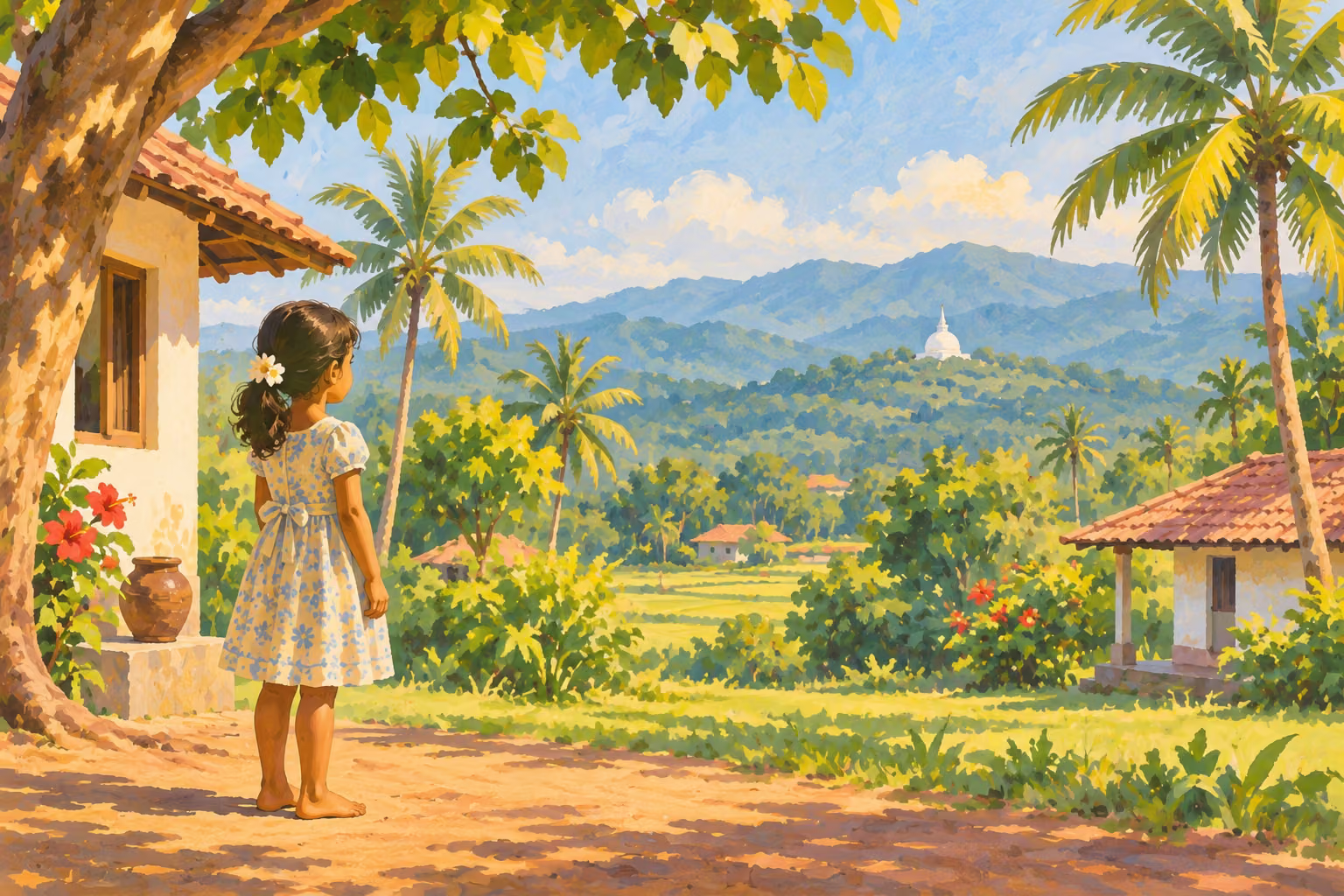
A real-life case · Sri Lanka, 1985
Thusitha Silva’s reincarnation case
Thusitha Silva was a girl from a coastal village in Sri Lanka. At about three, she began to say she was from Kataragama, a town of temples some 220 kilometers from her home. She said she lived by the river and that a boy who didn’t speak had pushed her into the water. In 1985, a researcher wrote down what she said before going to Kataragama to look for the family she talked about.
In almost every case, the child’s family finds the other family on its own. What the child said is written down afterward. In this one, psychiatrist Ian Stevenson’s team wrote down the first things Thusitha said before looking for anyone. Apart from Kataragama, the girl got no name right. Even so, in Kataragama there turned out to be a family that had lost a daughter in the river. We tell it step by step and then look at what can be checked. If you only want the evidence, skip straight to what can be checked. Did Thusitha remember that girl’s life?
Step 1
1980–1981 · Told by her father
A tailor from the coast often goes on pilgrimage to Kataragama

Gunadasa Silva was a tailor in Payagala, a village of about 6,000 people on the west coast of Sri Lanka, south of Colombo. He lived with his wife, Gunaseeli, and their children.
Kataragama is at the other end of the island, inland, some 220 kilometers away by road. It is a small town made up almost entirely of temples, and one of the country’s great places of pilgrimage. A wide river runs through it, the Manik Ganga.
In 1980 and 1981, Gunadasa went to Kataragama “very often,” as he himself said. He did what pilgrims do. He bathed in the river and bought flowers for the temple. He bought them at the stalls next to the Kiri Vehera. It is a large Buddhist stupa, a white dome-shaped monument. He didn’t remember which vendor he bought them from. His wife went with him only once, when she was two months pregnant.
That baby was born on July 29, 1981, a girl they named Thusitha. She was the sixth of seven children. By then, her father had already stopped going to Kataragama.
Three years later, the girl heard someone mention Kataragama.
Step 2
Around 1984, at about three · Told by her parents
On hearing “Kataragama,” the girl says she is from there
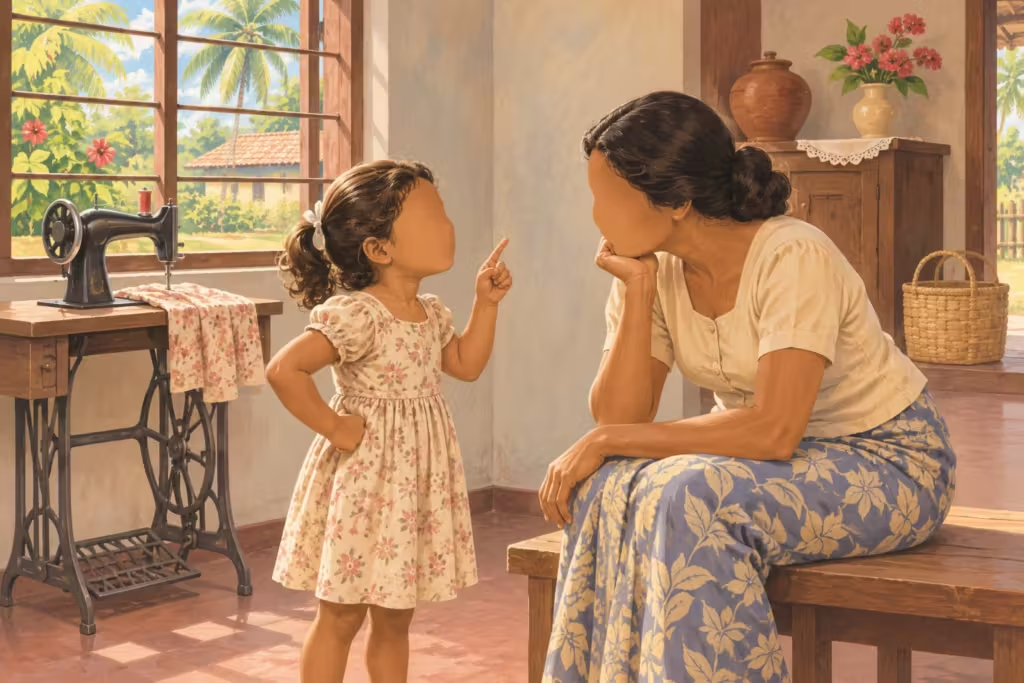
One day, someone mentioned Kataragama in front of Thusitha. The girl said she was from there. She said she lived near the river and that a boy who didn’t speak had pushed her into the water. She didn’t say she had drowned, but she implied it. Thusitha was very afraid of water.
She gave more details. Her father in that other life was a farmer and had a flower stall near the Kiri Vehera. Her house was near the main Hindu temple. That father was called Rathu Herath, he was bald, and he wore a sarong, the cloth tied at the waist like a long skirt. Thusitha’s father, by contrast, wore trousers.
She never said her own name in that other life, or any other name apart from Kataragama and Rathu Herath. Nor did she clearly say she had been a girl. She talked about dresses and didn’t want her hair cut, and her parents concluded that she was talking about a girl’s life.
She also said she had seen her present father, Gunadasa, in Kataragama. The researchers take this as a memory from before she was born.
Gunadasa, her father, says he wanted to go and check, but his work at the tailor’s shop never left him time.
Step 3
November 15, 1985 · Told by Stevenson and Samararatne
A researcher writes down what the girl says before going to look
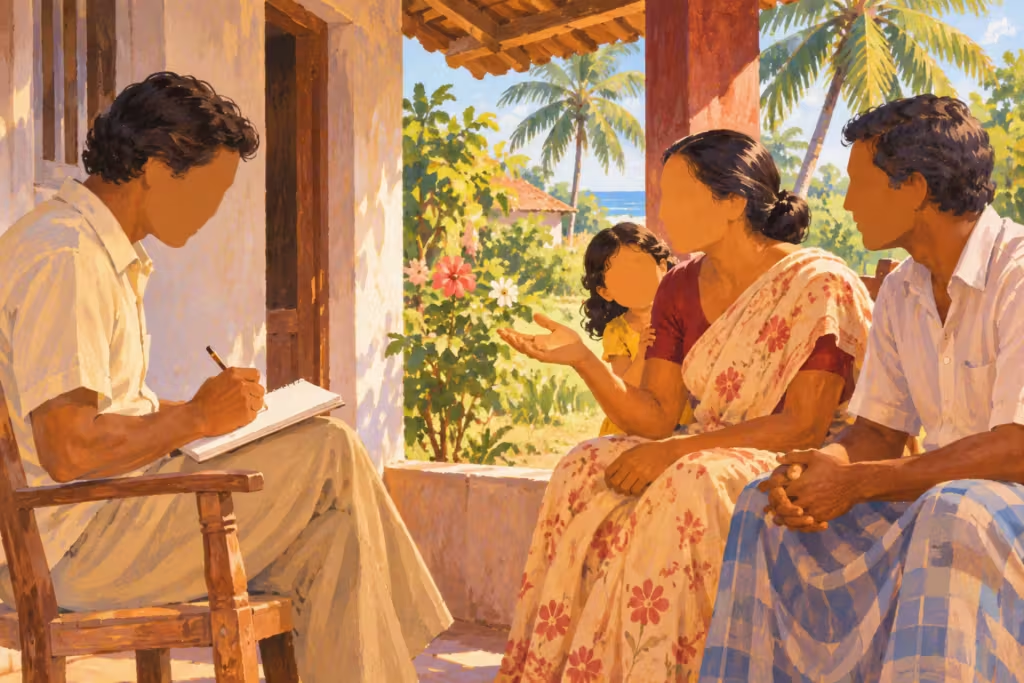
Ian Stevenson was a psychiatrist at the University of Virginia, in the United States. Since the 1960s he had been studying children who talked about another life. He almost always arrived when the two families already knew each other. In Sri Lanka he worked with two colleagues, Godwin Samararatne and Tissa Jayawardane. They looked for cases in which no one had yet found the other family.
Jayawardane heard about Thusitha in the fall of 1985. On November 15 he visited the family for the first time. He wrote down what is told in the previous step and a few more things the girl said.
Then, with his notes, he went to Kataragama.
Step 4
Late 1985 · Told by Stevenson and Samararatne
At the flower stalls, a family had lost a girl in the river
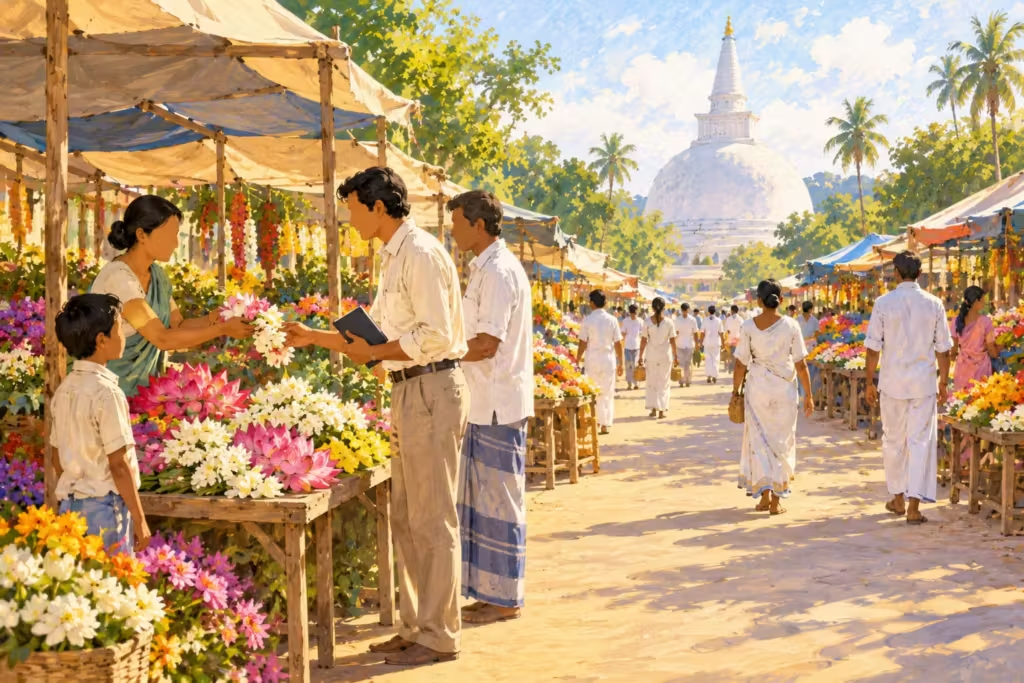
Jayawardane went first to the Kataragama police station. He asked about a family with a son who didn’t speak. They sent him to the flower stalls on both sides of the avenue that leads to the Kiri Vehera.
There he asked again, and the vendors pointed him to one particular stall. At that stall he asked whether the family had lost a girl to drowning. They told him yes, a young daughter had drowned in the river a few years earlier. And one of the girl’s brothers didn’t speak.
According to Jayawardane’s notes, Thusitha had said 13 things that could be checked. Ten fit that family and three didn’t.
The two families still didn’t know each other. It remained to be seen whether Thusitha had said anything more.
Step 5
December 1985 · Told by Stevenson and Samararatne
Thusitha had said seventeen more things, and fifteen fit
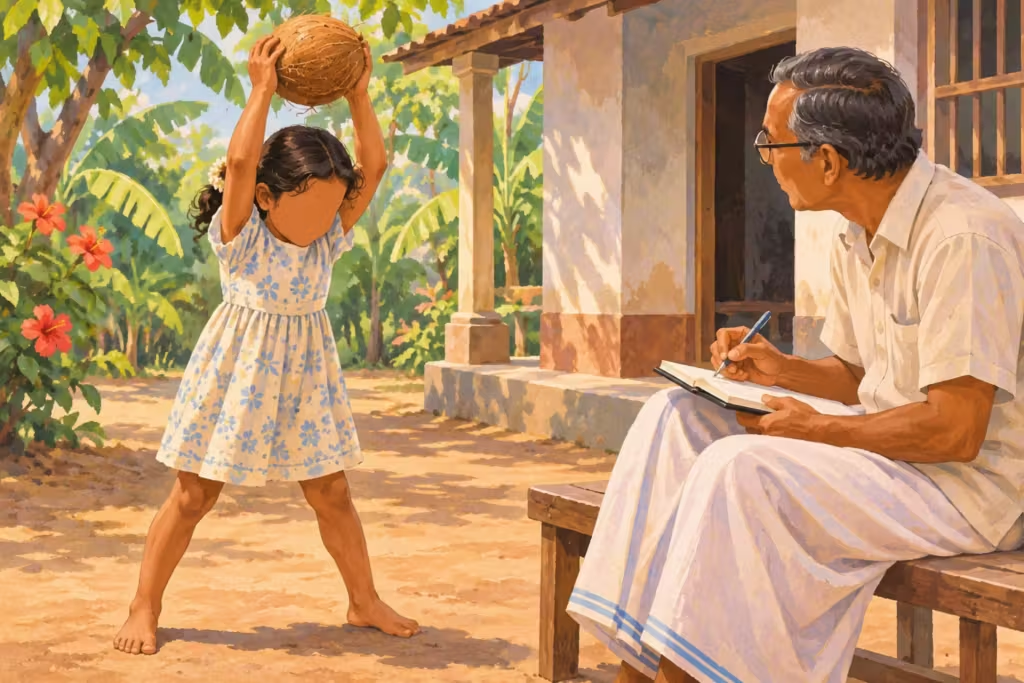
In December, Godwin Samararatne went back to Thusitha’s home and wrote down 17 more things the girl had said that Jayawardane didn’t have. The two families still hadn’t met. Of those 17, fifteen fit the family in Kataragama and two couldn’t be checked.
Some would fit almost any home, such as having a thatched roof. Others are known to anyone familiar with Kataragama, such as there being crocodiles in the river. Several, however, were unusual details:
- Her father, besides being a farmer and a flower seller, was a priest at the temple.
- The family had two houses, and one had a pane of glass in the roof.
- She said there were dogs kept tied up that were fed meat. This is rare in Sri Lanka, where there are hardly any household dogs and most Buddhists reject hunting. Next to that family’s house lived some neighbors who hunted and gave the meat to a tied-up dog.
- She said her earlier family had a better sieve for cleaning rice than the one in her present home.
- She acted out how pilgrims smash coconuts on the ground at the Kataragama temple. According to the researchers, Thusitha had never had a chance to see that ritual.
The following year, Stevenson went to both homes in person.
Step 6
November 1986 and October 1987 · Told by Stevenson and Samararatne
The drowned girl was named Nimalkanthi and was not yet two
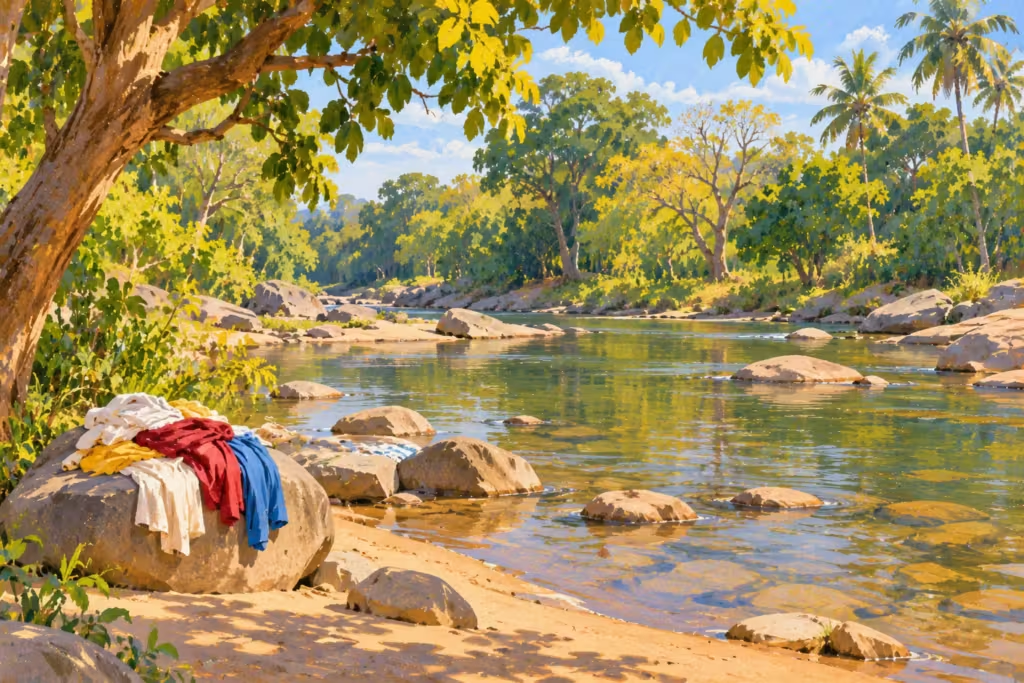
Stevenson visited the two families twice, with his two colleagues. The family in Kataragama told them the girl’s name was Nimalkanthi. She drowned around June 1974, when she was not yet two.
That day, her mother was washing clothes in the river. Nimalkanthi was playing nearby with two of her brothers, and one of them was the one who didn’t speak. The mother suddenly realized the girl was gone. The brother who could speak couldn’t say where she had gone. They searched, and pulled her body out of the river. She couldn’t swim.
For Stevenson, the most likely thing is that the girl slipped and fell into the water. No one could confirm that the mute brother pushed her, and Stevenson thinks that probably isn’t what happened. He doesn’t rule it out entirely, because the three children were playing together just before.
Three things Thusitha said didn’t fit. Nimalkanthi’s father had a good head of hair and was named Dharmadasa, not Rathu Herath. There were two bald men in the family, the girl’s grandfather and an uncle. And a cousin by marriage was named Herath. Stevenson mentions these coincidences but says he doesn’t want to make much of them. And Thusitha said she had sisters. Nimalkanthi had only one sister, and a second was born a year and a half after she died.
Stevenson asked at the 20 flower stalls on the avenue. One was empty that day. Among the rest, only Nimalkanthi’s family had a son who didn’t speak. At another stall, the family had a cousin who didn’t speak, not a son. And no other family had lost anyone to drowning.
Nimalkanthi’s family had never heard of Thusitha’s. Nimalkanthi’s father had never stopped in Payagala. He had only passed through on the way to another town.
The question from the beginning remains. Did Thusitha remember Nimalkanthi’s life?
Frequently asked questions
Who is Thusitha Silva?
Thusitha Silva was born in 1981 in Payagala, in Sri Lanka. At about three, she said she was from Kataragama and that a boy who didn’t speak had pushed her into the river. Her case was published in 1988 by the psychiatrist Ian Stevenson and his colleague Godwin Samararatne.
Has the Thusitha Silva case been proven?
No. The first things she said were written down before anyone looked, and it led to a single family in Kataragama that had lost a girl in the river. But Thusitha’s father had often gone on pilgrimage to that same place, and no documents were found on the girl’s death. Here we explain what can be checked.
Is Thusitha Silva the same case as Thusita Silva?
No. Thusita Silva, spelled without the “h,” is another case from Sri Lanka, studied by the Icelandic psychologist Erlendur Haraldsson. She talked about a life in the town of Akuressa that ended when she fell from a bridge into the river. Thusitha Silva, the girl on this page, talked about Kataragama.
Where this story comes from
The articles
- Ian Stevenson and Godwin Samararatne, “Three New Cases of the Reincarnation Type in Sri Lanka With Written Records Made Before Verifications,” Journal of Scientific Exploration, vol. 2, no. 2, 1988, pages 221 to 225. This is the report on the case
- James G. Matlock, “Reincarnation Cases with Records Made Before Verifications,” Psi Encyclopedia, Society for Psychical Research. It lists the case among those with something written down before it was checkedRead
Learn more
- Reincarnation: the cases we have studiedRead
- The ranking of the best-checked reincarnation casesRead
Our archive
- Our reading of the article by Stevenson and Samararatne and the scoring against our five criteria, as of November 16, 2026
Keep reading
India, 1958
Swarnlata Mishra
Swarnlata Mishra was three years old when she asked for the truck to turn toward “my house” in Katni, a city where she had never lived. Years later, a researcher wrote down how she described the house, went to Katni, and found it.
Sri Lanka, 1983
Subashini Gunasekera
Subashini Gunasekera was three years old when she began saying that, in another life, a hill fell on her house in Sinhapitiya. The landslide happened, in 1977. The researchers found the family of a girl who died in it.
England and Ireland, 1953-1993
Jenny Cockell
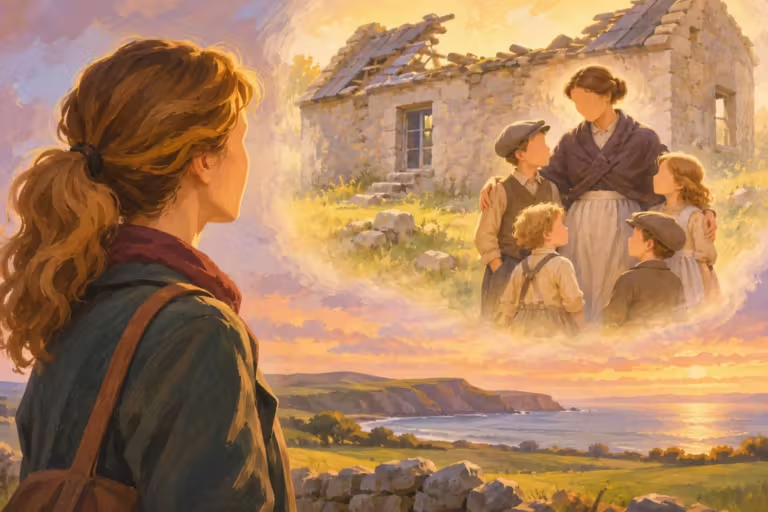
From childhood, Englishwoman Jenny Cockell said she remembered the life of Mary, an Irish mother who died young. As an adult, she looked for her, and in 1990 she found Mary Sutton and her children.
Reincarnation: The top 5 people who remember past lives
We asked them the same five questions as this story. A 32-page PDF, free in your inbox.
Check your email
We have sent you an email. Open it and press the button to confirm. If you cannot see it, check your spam folder.