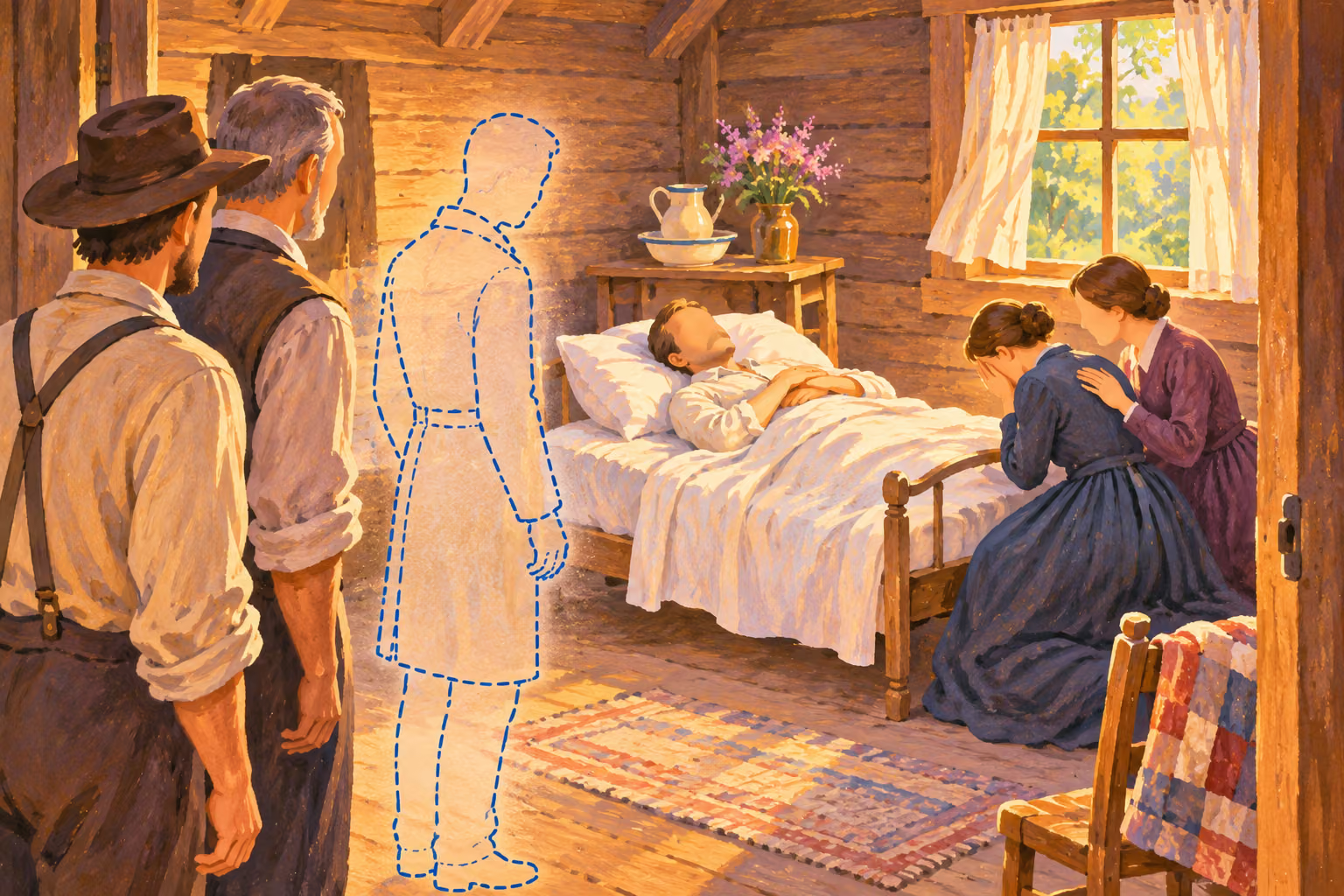
A real-life story · Tennessee, United States, 1889
Dr. Wiltse’s near-death experience
In the summer of 1889, a doctor in Tennessee was dying of typhoid fever. He went about four hours without a pulse, and for half an hour of that time he seemed completely dead. When he woke up, he began to tell people that he had left his body. He said he had seen the people in the room and had gone down to the street.
It is one of the oldest near-death experiences with witnesses. Wiltse was a doctor, and before he lost consciousness he asked everyone to watch him as he died. Two months later he told it to a meeting of doctors and published it in a medical journal. The next year, his wife and the two men who had nursed him swore before a notary to what they had seen that day. We tell it step by step and then look at what can be checked. If you only want the evidence, skip straight to what can be checked. Did he really see the people who were in the room?
Step 1
August 1889 · Tennessee, United States · As told by his sister and the men who nursed him
A doctor sick with typhoid fever asks everyone to watch him as he dies
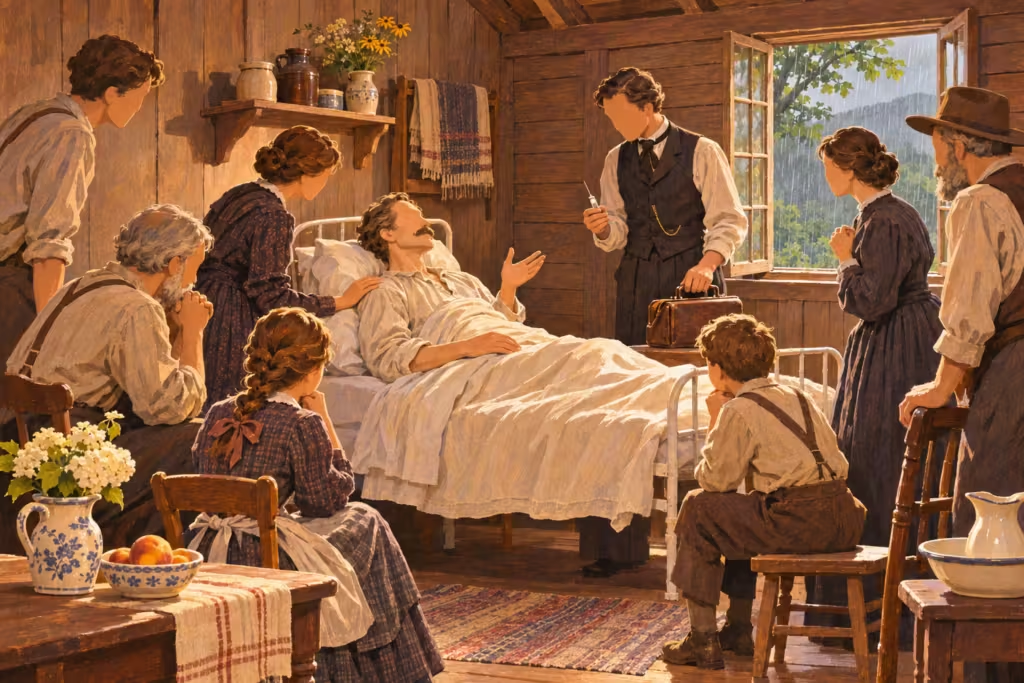
Dr. A. S. Wiltse lived in a mountain area of Tennessee, in the southern United States. He had had an unusual typhoid fever since June 22, with a temperature and a pulse lower than normal. Several doctors were treating him, and he prescribed some of his medicines himself.
According to his sister Sara, Wiltse was very drawn to the supernatural. He had visited haunted houses to investigate them. One of the men who nursed him says that, even so, he doubted there was life after death and was afraid of dying.
In August he got worse. His sister Sara arrived from Michigan on August 9, and the family sent a telegram to his brother. Wiltse had two very severe crises, one on a Sunday and the other the following Wednesday. Both times he had the village church emptied so that people would come and take turns rubbing his body. So relatives and neighbors stood around the bed. Wiltse asked the doctor whether his mind was clear. The doctor, S. H. Raynes, told him it was as clear as a healthy man’s.
Then Wiltse asked everyone to come closer and watch him carefully. He promised that if he saw anything that proved there was life after death, he would tell them, even if only in a whisper. He asked the doctor for one more thing. As soon as he died, he wanted the doctor to inject him with ether, to see whether he spoke and what he said.
He began to lose his sight.
Step 2
That day · About four hours without a pulse · As told by the doctor and the witnesses
He closes his eyes, and the doctor can no longer find his pulse
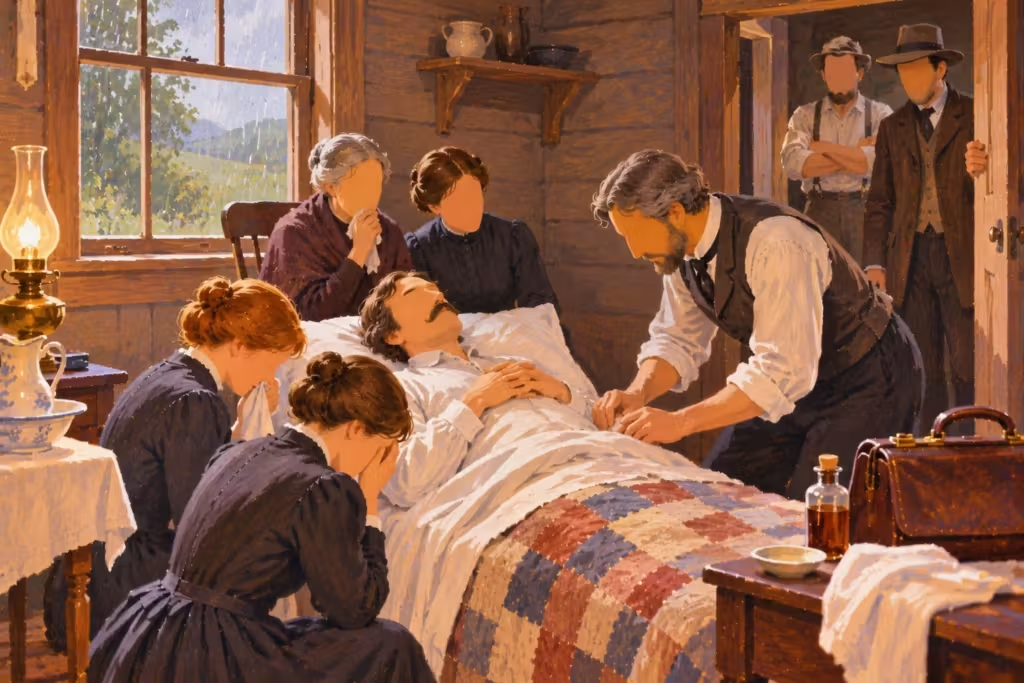
As his sight faded, Wiltse kept saying how far he could still see. He saw a light in the window, and after a while he explained that it was something natural. A neighbor was rubbing one of his feet. Wiltse told him he could see it but could no longer feel it. Wiltse asked the neighbor whether he had ever seen his mind so clear.
His sister helped him straighten his legs, which were going stiff. He folded his arms across his chest and laced his fingers together. She says she did not cry while she thought he could still see or feel her. She only cried once she was sure he could no longer see or feel anything. Then Wiltse closed his eyes.
According to Wiltse, the doctor later told him he went about four hours with no pulse or heartbeat that could be detected. Leaning in very close to his face, the doctor only noticed, now and then, a very short and faint breath. For about half an hour he seemed completely dead. The doctor pushed a needle in very deep at several points, from his feet up to his hips, and he did not react. Some people took him for dead, and the church bell in the village tolled for him.
Three years later, Dr. Raynes put it this way in a letter:
“There was no pulse and no perceptible heart-sounds. The breath was, so far as observable, absolutely suspended.”
Wiltse says that, while he was in that state, he became aware again that he existed.
Step 3
While he seemed dead, according to him · Wiltse’s account
Wiltse says he leaves his body through his head
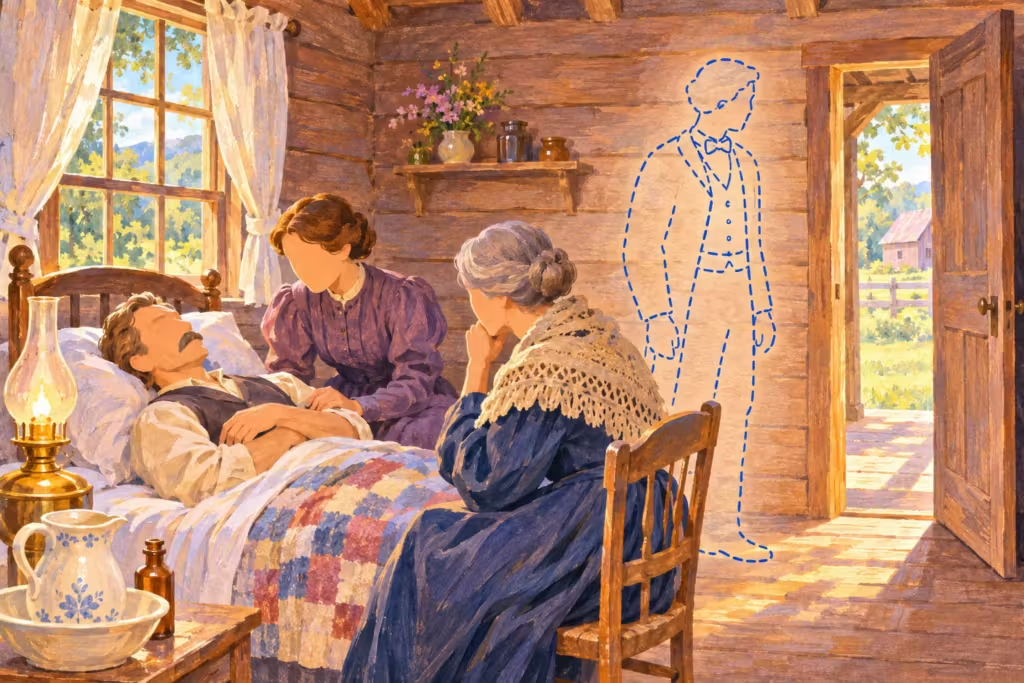
At first he was aware of nothing. Then he realized he was still inside his body, but that he no longer had anything to do with it. As a doctor, he was interested in what he was seeing. He felt something rocking him from side to side, like a baby in a cradle. In the soles of his feet he felt something like many small cords snapping.
Then he slowly drew back from his feet toward his head. He says he came out through the seams of his skull and that he looked like a jellyfish, in shape and in color. He floated like a soap bubble on the end of a pipe until he broke loose. He dropped gently to the floor. There he rose up and grew to the height of a man. He was see-through, bluish in color, and naked.
As he came out, he saw two women sitting at the head of his bed. He was very embarrassed to be naked in front of them. He went toward the door so they would not see him. When he reached the door, he found himself dressed.
Then he turned around and looked at the room.
Step 4
While he seemed dead, according to him · Wiltse’s account
He says a man’s arm passes through him and that he sees his own body on the bed
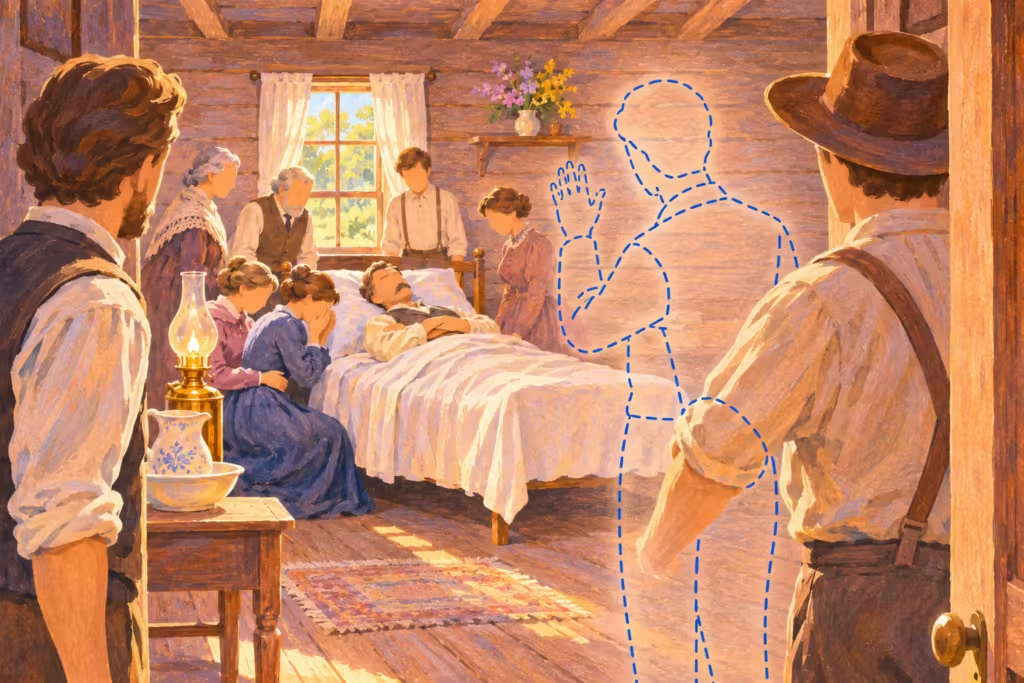
Two men were standing in the doorway. As he turned, his elbow struck the arm of one of them. He says the man’s arm passed through him without hurting him, as if it were air. The man noticed nothing. He was looking toward the bed, and Wiltse looked that way too.
He saw his own body, lying just as he had arranged it. He was surprised at how pale the face was. A lot of people were gathered around. He noticed above all two women who seemed to be kneeling to the left of his body, and he knew they were crying. Later he learned that they were his wife and his sister. At that moment he did not recognize them. He says he was not thinking about names or family ties.
He wanted to comfort everyone there. He bowed to them and waved. He walked among them, but no one paid him any attention. He found the situation so funny that he laughed out loud. No one looked up from the bed. This is how he wrote it later:
“They see only with the eyes of the body. They cannot see spirits.”
He turned around and went out through the open door.
Step 5
While he seemed dead, according to him · Wiltse’s account
He says he goes out to the street and sees the gullies left by the rain
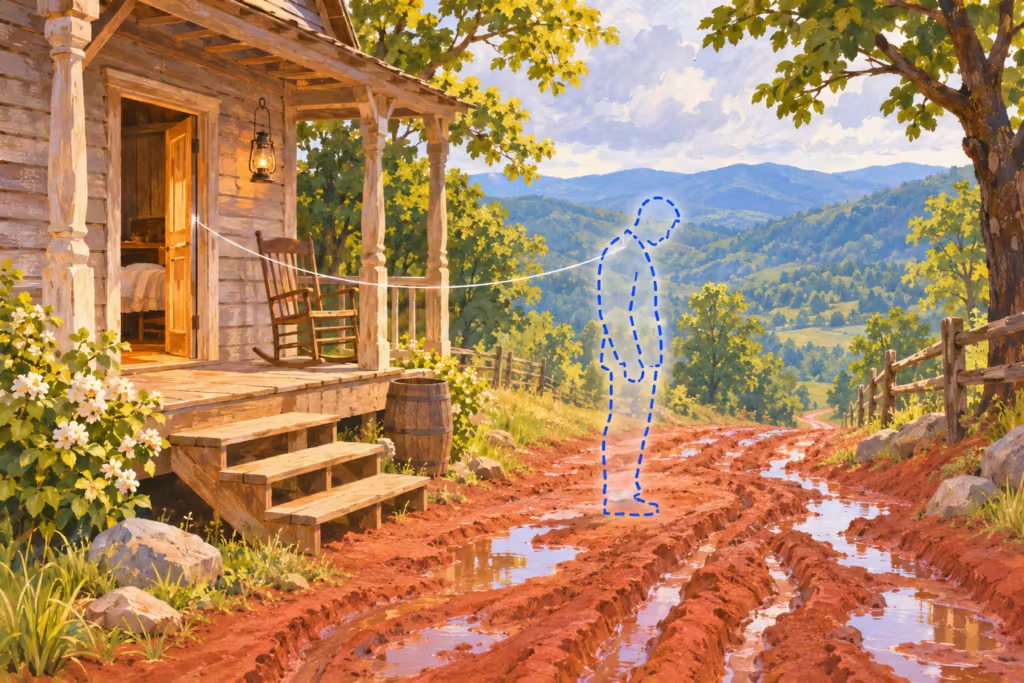
He crossed the porch, went down the steps, and reached the street. He says he had never seen it so clearly. He noticed how red the dirt was and the gullies the rain had cut into it. He looked around sadly, like someone leaving home for a long time.
He felt taller than he had been in life. He was wearing a suit he did not recognize. He felt very well, and he started dancing for joy. Suddenly he realized he could see his own back, all the way down to his heels, without turning his head. He touched his face, and his eyes were where they belonged.
From the street, through the open door, he could see the head of his body on the bed. A cord as fine as a spider’s thread ran from his shoulders. The cord went to his body and joined it at the front, at the base of the neck. He thought that, thanks to that cord, he was still using the eyes of his body.
He set off down the street and lost consciousness again.
Step 6
While he seemed dead, according to him · Wiltse’s account
He says he reaches three rocks and that a cloud tells him he can go back
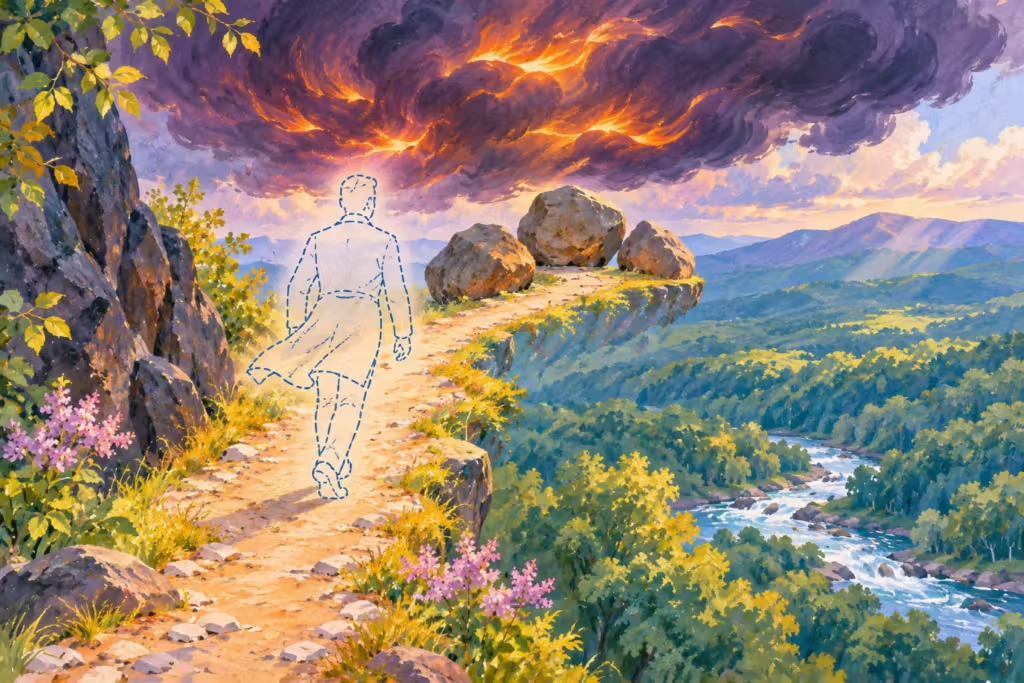
He woke up in the air. Hands were holding him by the sides and pushing him from behind. They set him down on a narrow road that climbed uphill, above a forest. The hills and the river in the landscape reminded him of those back home. He waited for someone to come, but no one came.
He became afraid that he was heading toward a terrible end. Then, he says, he saw for an instant a face full of love, and he calmed down. In a later version, the one Myers copied in 1892, he adds that before that he became aware of the thought “Fear not, you are safe,” although he heard no voice. That sentence is not in his 1889 article.
Farther on, three huge rocks blocked the road. A dark cloud full of moving streaks of fire stopped above his head. He felt a presence he could not see enter it. He says thoughts that were not his own came to him. They told him the rocks were the border between the two lives, and that if he passed them he could no longer return to his body. If his work in life was only to write down what he had learned, he had already done it and could cross. If he also had to publish it and teach it to many people, he was not finished yet, and he could go back.
He wanted to cross anyway. Pressed against one rock, he edged along it to the middle and put his left foot out on the other side. Then a small, very black cloud came up to his face. His strength left him.
He knew nothing more.
Step 7
About half an hour later · In bed · As told by Wiltse, his wife, and the men who nursed him
He opens his eyes and asks whether he has to die again
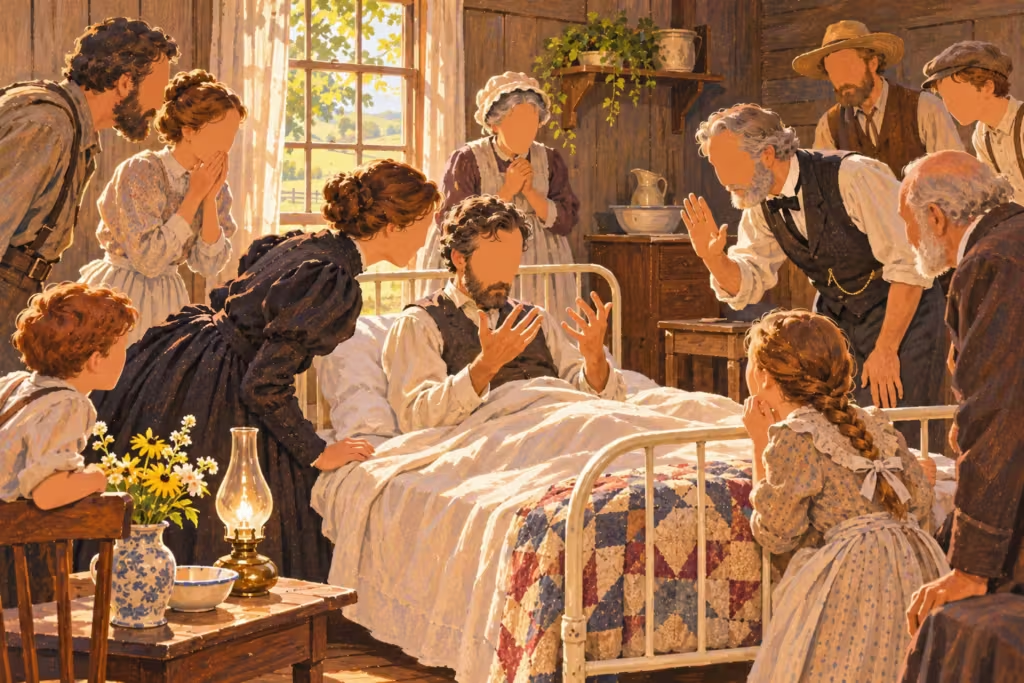
He opened his eyes all at once. He looked at his hands and at the bed, and he realized he was back in his body. The witnesses remember that he seemed very surprised. William T. Howard, one of the men who nursed him, remembers him saying:
“What in the world has happened? Is it possible that I have to die again?”
His wife told him he had not died yet. He told her he had, and he began to tell what he had seen. The doctor told him several times to be quiet. Wiltse kept starting over, so he told the story in bits and pieces. He told everyone not to be frightened anymore, that he was going to get well because his work was not finished yet.
He was still very ill. He had vomiting and hiccups he could not stop. Another doctor, who dropped by without knowing he was sick, said only a miracle could save him. But his pulse and temperature slowly rose, and he recovered.
About eight weeks after what his neighbors called “the day he died,” Wiltse finished writing down what he had been through. On October 15, 1889, he read it to a medical society of Tennessee, Alabama and Georgia, meeting in Chattanooga. A St. Louis medical journal, the St. Louis Medical and Surgical Journal, published it in two installments. The illness appeared in November 1889, and the experience in December.
Later, a researcher in Boston asked him for evidence.
Step 8
1890 to 1892 · Kansas, Michigan, and Tennessee · As told by the letters and the sworn statements
A researcher in Boston asks the witnesses to make sworn statements before a notary
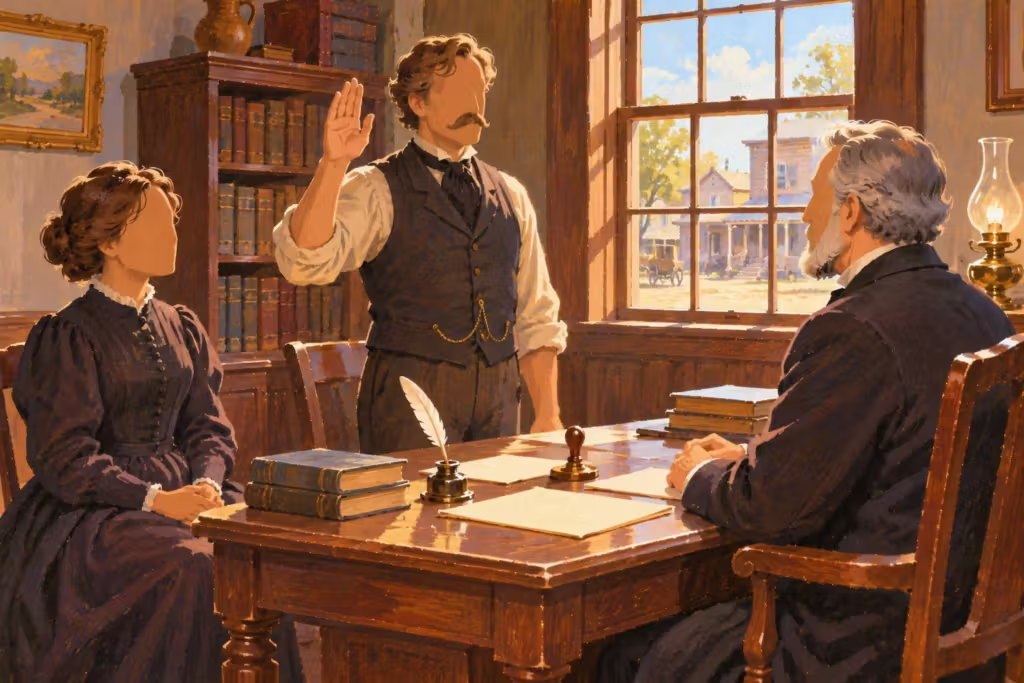
Richard Hodgson worked in Boston for a British society that studied cases like this one, the Society for Psychical Research. He wrote to Wiltse with several questions. By then, Wiltse had moved to Skiddy, a small town in Kansas, and some of the witnesses had gone with him.
In June 1890, three witnesses signed a statement before a notary in Kansas. They were his wife, Haidee, and the two men who had nursed him, A. J. Howard and William T. Howard. His sister Sara sent a long letter from Michigan. And in March 1892, Dr. Raynes wrote from Tennessee.
All three swore that Wiltse began telling it as soon as he woke up. The two men who nursed him swore that, during part of that time, two men were standing in the doorway and women were at the head of the bed. A. J. Howard thinks the men in the doorway were Wiltse’s brother and the doctor. William T. Howard does not know who they were. Both say it had rained a lot while he was ill and that the gullies in the street had grown. A. J. Howard adds that the street was very steep. William T. Howard adds that on that particular day it did not rain and that it was a clear day.
His wife did not remember those details. His sister thought Wiltse was wrong about where she had been. A married couple who were also in the room, the Carpenters, told the sister that she was the one who was wrong.
In 1892, the British researcher Frederic Myers published the whole case with the statements. He wrote that the experience was very unusual. But he said it could not be shown that Wiltse had seen the room and the street without his eyes.
The question remains: did he really see the people in the room and the rain-soaked street?
How many people have an NDE?
Dr. Wiltse is not a one-off. For more than thirty years, several teams of doctors have asked people who survive a cardiac arrest what they remember. They do it in the hospital, a few days afterward.
Picture 100 of those people:
Each dot is a person. The 18 filled-in dots are the ones who described a near-death experience. That is what the largest study found. It was done in the Netherlands in 2001, with 344 people.
The other 82 didn’t describe one. Many remember nothing of their cardiac arrest.
| Where and when | People interviewed | Described an NDE |
|---|---|---|
| England, 2001 | 63 | 6% |
| Netherlands, 2001 | 344 | 18% |
| United States, 2002 | 30 | 23% |
| United States, 2003 | 116 | 10% |
| United Kingdom, United States, and Austria, 2014 | 101 | 9% |
| Vienna, Austria, 2023 | 126 | 4% |
| United States and United Kingdom, 2023 | 28 | 21% |
What these figures don’t tell you
- Only some people are asked. In the 2014 study, 330 people survived, but only 140 could be interviewed, and 101 reached the second interview. The rest died later, were too ill, or didn’t respond.
- Most cardiac arrests are never counted. These studies run in a few hospitals for a limited time. Outside them, no one keeps track. Also, the 2003 study interviewed 1,595 cardiology patients, not just the 116 with cardiac arrest in the table, and 81 of them described an NDE from an earlier occasion. The study did not count them, because it only counted those from that hospital stay.
- Some people keep quiet. In the accounts in our archive, at least 13 people say they kept their experience to themselves for a while. They kept quiet because they weren’t believed or because they were afraid of how others would react.
- It depends on how you count. If you count any memory of the cardiac arrest, the numbers go up. If you use a strict scale, they go down. In England in 2001, 7 of 63 people remembered something. But on the scale, only the memories of 4 people qualified as an NDE.
That’s why no one knows the real figure. But every study shows that it isn’t rare. Between 4 and 23 of every 100 survivors who are asked describe an NDE. Wiltse did not have a cardiac arrest in a hospital. He had a fever that left him without a pulse at home. And he told his experience almost a century before these studies began.
Frequently asked questions
Who was Dr. Wiltse?
A. S. Wiltse was an American doctor. In August 1889, in Tennessee, he nearly died of typhoid fever. He went about four hours without a pulse and said afterward that he had left his body. Shortly after, he moved to Skiddy, a small town in Kansas. Here we tell his story.
Is Wiltse’s one of the oldest near-death experiences?
It is one of the oldest published in a medical journal. The researcher Janice Holden reviewed the cases in which someone says they saw something while outside their body. She says Wiltse’s is the oldest she found in the scientific journals. It was published in 1889, almost ninety years before the psychiatrist Raymond Moody made the term “near-death experience” famous.
Where was Dr. Wiltse’s experience published?
He published it in the St. Louis Medical and Surgical Journal, a medical journal, in two installments, in November and December 1889. Before that he had read it to a medical society in Chattanooga, on October 15, 1889. In 1892, Frederic Myers published it again, with the witnesses’ sworn statements, in the journal of the Society for Psychical Research, the Proceedings of the Society for Psychical Research, volume 8, pages 180 to 194. Here are the links.
Where this story comes from
The case documents
- Frederic Myers, “On Indications of Continued Terrene Knowledge on the Part of Phantasms of the Dead,” Proceedings of the Society for Psychical Research 8, 1892, pages 180 to 194, public domain. It reproduces Wiltse’s account, the sworn statements of his wife and of the two men who nursed him, his sister’s letter, and the doctor’s letterRead for free
- A. S. Wiltse, “A case of typhoid fever with subnormal temperature and pulse,” St. Louis Medical and Surgical Journal 57, in two installments: November 1889, pages 281 to 288, and December 1889, pages 355 to 364, public domain. The original articleRead for free
- Frederic Myers, Human Personality and Its Survival of Bodily Death, volume 2, 1903, public domain. It summarizes the caseRead for free
Learn more
- What is a near-death experience?Read
- What does science say about near-death experiences?Read
- How we check each storyRead
Our archive
- Our reading of Myers’s pages and of the original 1889 article, our search for what has been written about the case since, and the case’s score on our five criteria, as of November 20, 2026
Keep reading
Leeds, 1880
John Ogle
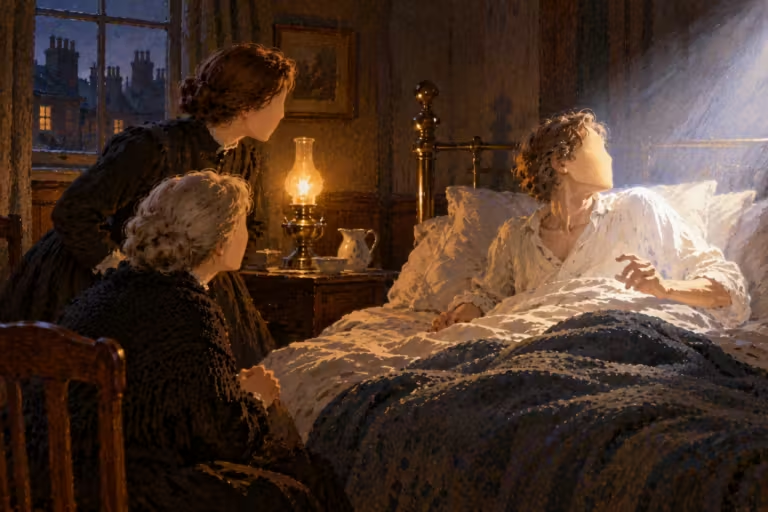
John Ogle was dying in Leeds and said George Hanley’s name in surprise. According to his mother, George Hanley had died ten days earlier, and no one had told John.
Asturias, Spain, 2005
María Teresa Álvarez Aramendía
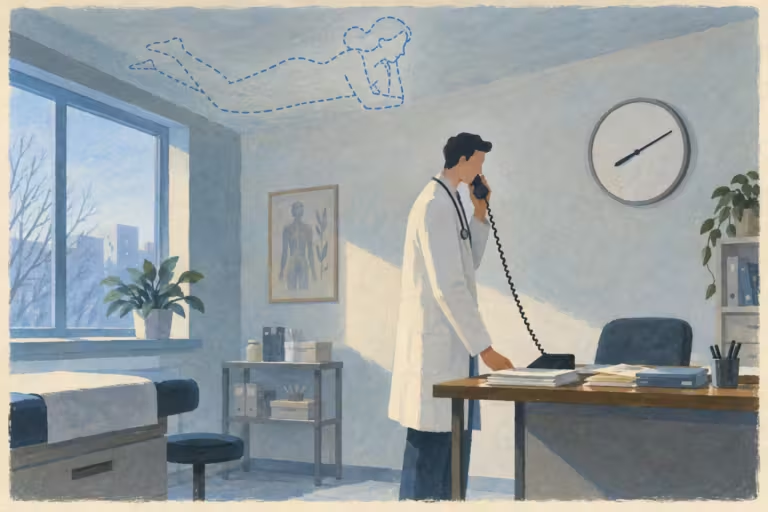
She says that while she was in a coma she saw her doctor call another doctor from the health center at 8:10. According to her, months later he told her that he had made that call.
Colombia, around 1985
Luding Coenen
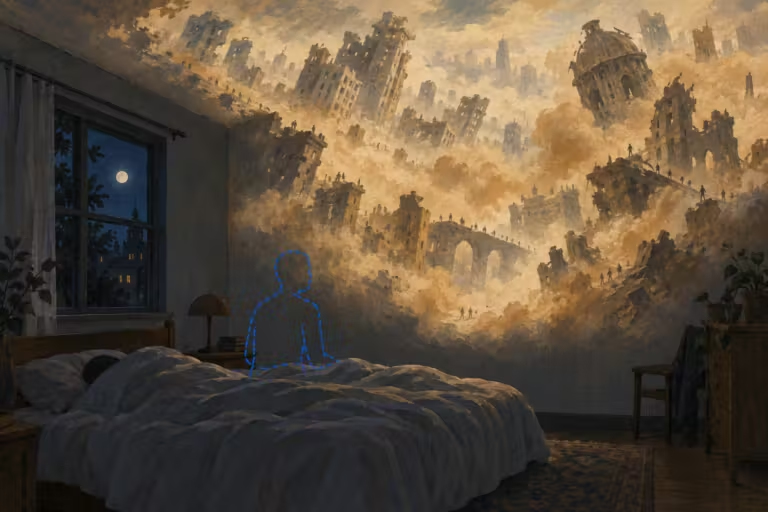
She had a hemorrhage in childbirth and says she saw her grandparents and a light. She says that years later she saw buildings falling at two in the morning. It was the time of an earthquake in Turkey.

Reincarnation: The top 5 people who remember past lives
We asked them the same five questions as this story. A 32-page PDF, free in your inbox.
Check your email
We have sent you an email. Open it and press the button to confirm. If you cannot see it, check your spam folder.