A real-life case · Sri Lanka, 1985
Iranga Jayakody’s reincarnation case
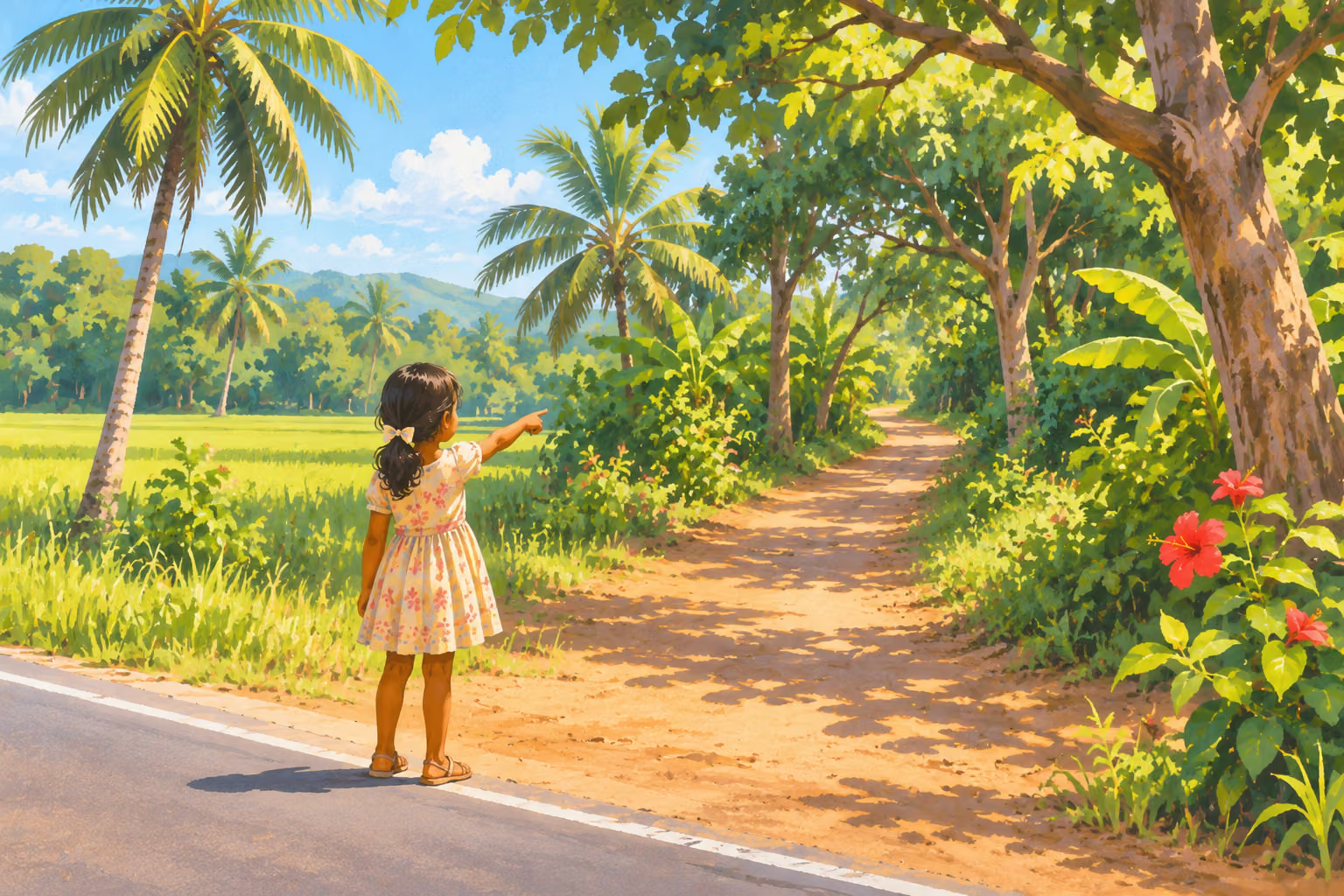
Iranga Jayakody was a girl from a village in southern Sri Lanka. At three or four, she began to talk about another life in Elpitiya, a small town about 15 kilometers away. She said her father had a shop where he sold bananas and that her mother came from another village, Matugama. In 1985, a researcher began writing down what she said before going to look for the family she talked about.
Iranga didn’t give the name of the person she said she had been. She didn’t give her family’s name either. Even so, psychiatrist Ian Stevenson’s team wrote down what she said. With those details, they found a family in Elpitiya that had lost a 13-year-old daughter in 1950. Of 43 things she said, 37 fit. We tell it step by step and then look at what can be checked. If you only want the evidence, skip straight to what can be checked. Did Iranga remember that girl’s life?
Step 1
Around 1984 or 1985, at three or four · Told by her parents
A neighbor mentions Matugama, and the girl says her mother was from there
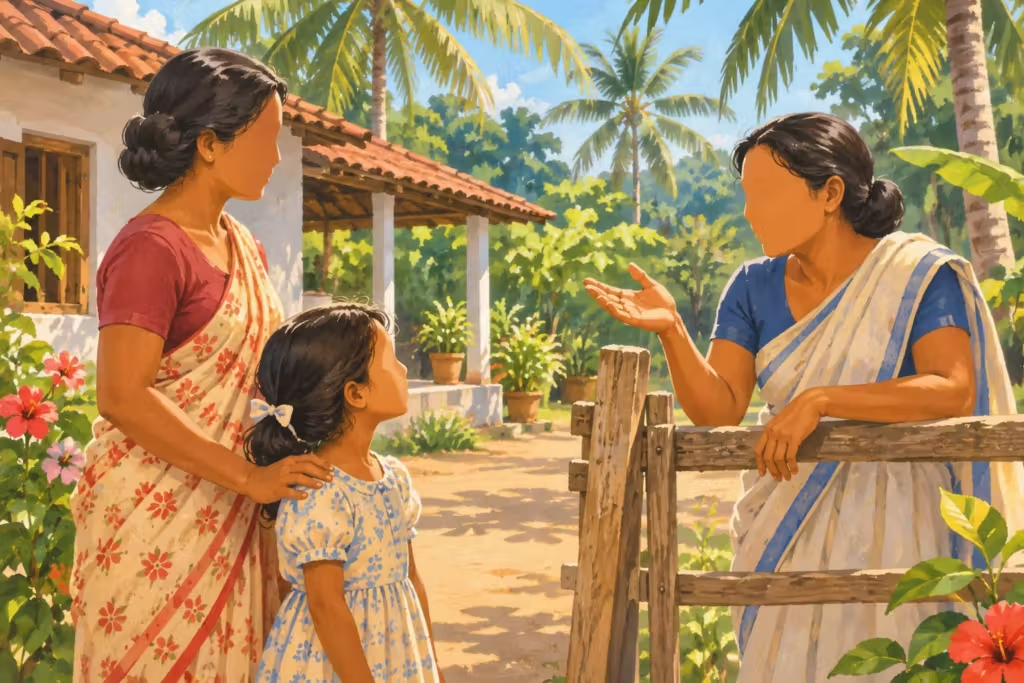
Iranga was born on June 29, 1981, in Uragasmanhandiya, a village of about 3,000 people in southern Sri Lanka. Her father was a schoolteacher and an astrologer. Iranga was the youngest of seven children and the only girl.
A neighbor of the family came from a village called Matugama. One day, Iranga heard her mention that village and said she had once had a mother who was from there. She was talking about another life.
From that day on, she told many things about that life. She had lived in Elpitiya, a small town about 15 kilometers away. Her father had a shop where he sold bananas. She had three sisters, and one of them was married. She went to a school much bigger than her present one, in a white uniform that she took off when she got home.
According to the researchers, from the age of three Iranga was extremely modest. She wouldn’t let anyone see her body, especially her chest. No one else in her family was like that. The researchers say this modesty fit the girl she talked about, or what would have been expected of her.
She didn’t say how she had died in that other life.
Step 2
December 1985 · Told by Stevenson and Samararatne
A researcher writes down 18 things before looking for anyone
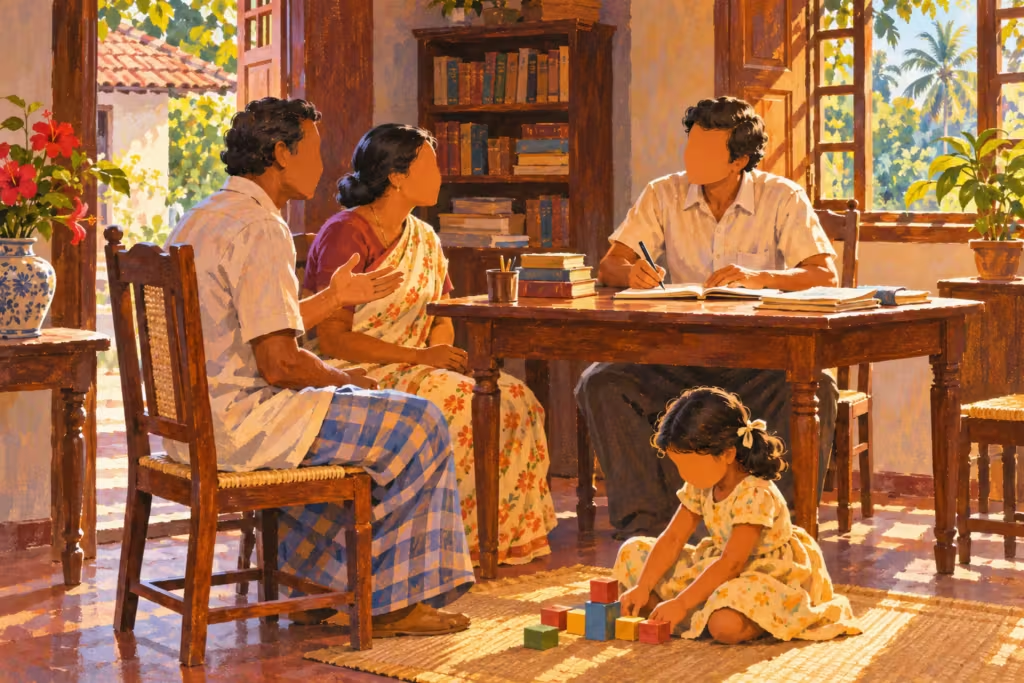
Ian Stevenson was a psychiatrist at the University of Virginia, in the United States. Since the 1960s he had been studying children who talked about another life. In Sri Lanka he worked with two colleagues, Godwin Samararatne and Tissa Jayawardane. They looked for cases in which no one had yet found the other family.
Jayawardane heard about Iranga in December 1985. That same month he visited the family. He wrote down 18 things that the parents remembered the girl saying about her other life.
Two months later, the family went to Elpitiya for another reason.
Step 3
February 1986 · Told by Stevenson and Samararatne
At a wedding in Elpitiya, the girl points out the way to “her house”
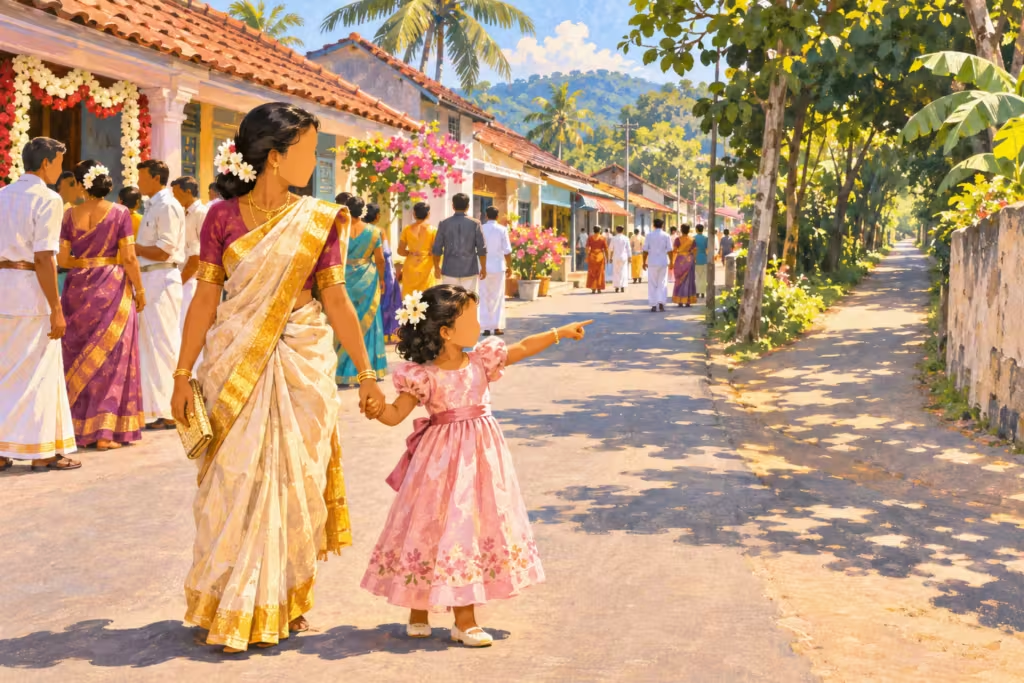
Iranga went with her family to a wedding in Elpitiya. There she pointed to a road and said it was the way to the house where she had lived.
Her parents had neither the time nor the interest to follow it up. They took her home, and the girl was somewhat disappointed.
It was the researcher who went looking.
Step 4
July 1986 · Told by Stevenson and Samararatne
Among the banana sellers, one family had lost a daughter who went to school
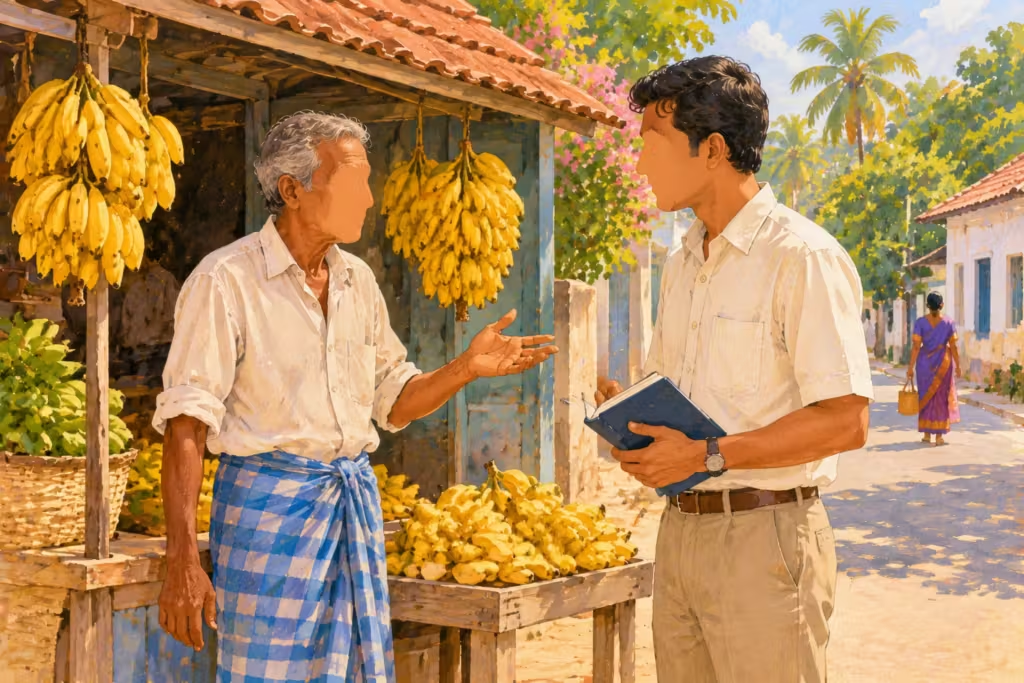
In July, Jayawardane went to Elpitiya with his list. He asked the banana sellers whether any of them had lost a daughter of school age.
Only two sellers had lost daughters. One had lost two little girls who weren’t yet going to school. The other had lost a 13-year-old daughter.
Jayawardane talked with four siblings of that girl. Her parents had already died. According to him, everything he had written down fit that family, except for two things.
The two families still didn’t know each other. Iranga still had more to tell.
Step 5
August 11 and 12, 1986 · Told by Stevenson and Samararatne
The girl was called Punchihamie, and she died in 1950, at 13
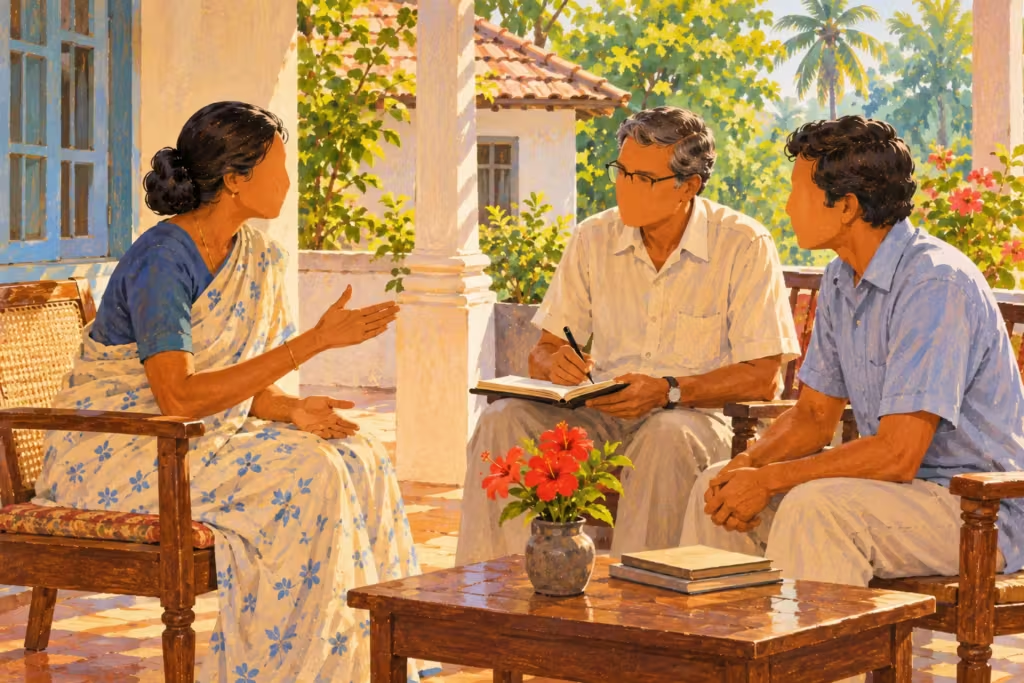
On August 11, Samararatne and Jayawardane went back to Iranga’s home. Her parents told them 25 more things the girl had said that weren’t on the first list. This time the family in Elpitiya had already been found, but the two families still hadn’t met.
Then they went to Elpitiya and talked with Podi Haminie, the girl’s younger sister. The girl who died was called Punchihamie, and she died on May 5, 1950, at the age of 13. She had been ill for more than a year, and the left side of her body was paralyzed. Doctors in Colombo found a brain tumor and suggested surgery, but she was taken home and died there. Podi Haminie confirmed almost everything Iranga had said.
The next day, the researchers took Iranga and her parents to Elpitiya. The girl seemed to recognize the old path that led from the road to Punchihamie’s house. It was hardly used anymore, because there was a wider road. At the house she recognized no one and nothing. She was calm, but she didn’t seem to know the place.
In November, Stevenson went to both homes in person.
Step 6
November 1986 and October 1987 · Told by Stevenson and Samararatne
Of 43 things she said, 37 fit Punchihamie
Stevenson visited both families with his colleagues. Before the families met, his colleagues had written down 43 things. Two didn’t fit, and three couldn’t be checked or were doubtful. One more wasn’t accurate. Iranga said her younger sister had a bicycle, and the bicycle belonged to the daughter of some neighbors. The family also called that girl “little sister.” The other 37 fit Punchihamie.
Some of them would apply to many homes in Sri Lanka, such as the jasmine and jackfruit trees next to the house. Others were more specific. In Elpitiya, out of about 100 shops, only six sold bananas, and three more had sold them in the past. Punchihamie’s father owned one of them. He had married a woman from Matugama and had four daughters. They were Punchihamie and her three sisters, as Iranga said, and one of them was married.
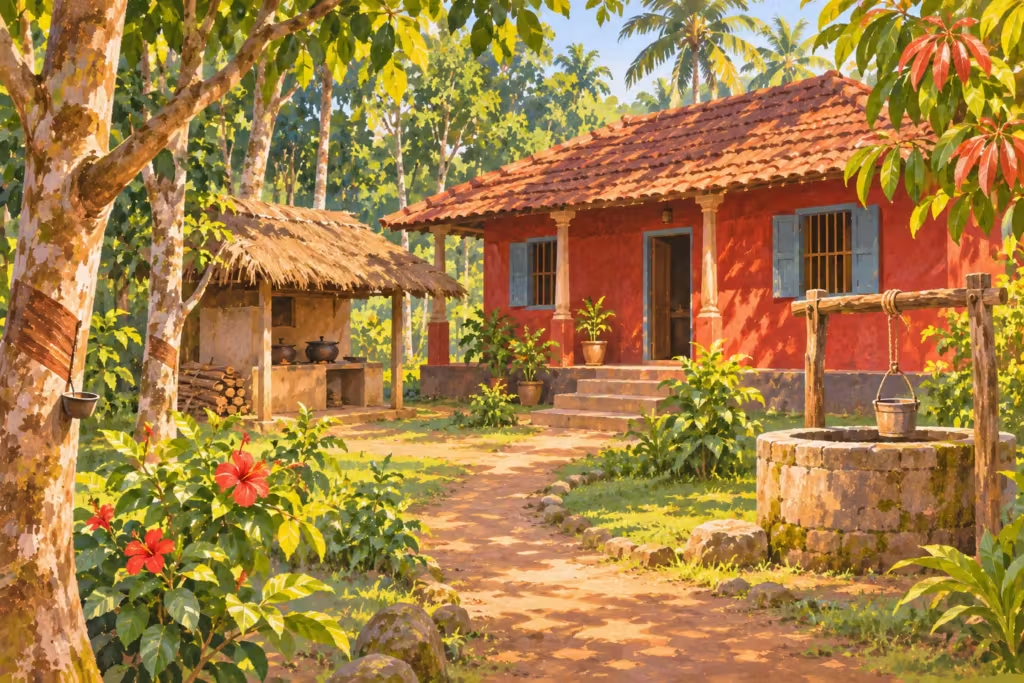
Iranga had also said that the house was reached by a path between rubber and cinnamon trees. The house was near the shop and a temple, it had red walls, and the kitchen had a thatched roof. One well had caved in during the rains, and they still had two others. It all fit. The red walls and the thatched roof were no longer like that in 1986. According to the family, the house was later painted white, and the kitchen and the shop were roofed with tiles.
The two families said they didn’t know each other. There was some contact between the two villages, though. Iranga’s father sometimes visited patients at the hospital in Elpitiya, and he stopped in Elpitiya on his way to other places. Punchihamie’s father had a relative in Iranga’s village and visited him. And a few weeks before she died, Punchihamie was taken to a monk in Iranga’s village who was known as a healer. In 1950, Iranga’s family lived far away, in the east of the island.
The question from the beginning remains. Did Iranga remember Punchihamie’s life?
Frequently asked questions
Who is Iranga Jayakody?
Iranga Jayakody was born in 1981 in Uragasmanhandiya, in southern Sri Lanka. At three or four, she talked about another life in Elpitiya and said she was the daughter of a banana seller. Her case was published in 1988 by the psychiatrist Ian Stevenson and his colleague Godwin Samararatne.
Has the Iranga Jayakody case been proven?
No. What she said began to be written down before anyone looked, and it led to just one family in Elpitiya. But more than half of it was written down after that family had been found, and there was contact between the two villages. Here we explain what can be checked.
Where this story comes from
The articles
- Ian Stevenson and Godwin Samararatne, “Three New Cases of the Reincarnation Type in Sri Lanka With Written Records Made Before Verifications,” Journal of Scientific Exploration, vol. 2, no. 2, 1988, pages 225 to 229. This is the report on the case
- James G. Matlock, “Reincarnation Cases with Records Made Before Verifications,” Psi Encyclopedia, Society for Psychical Research. It lists the case among those with something written down before it was checkedRead
Learn more
- Reincarnation: the cases we have studiedRead
- The ranking of the best-checked reincarnation casesRead
- Another case from the same article: Thusitha Silva, the girl who said she was from KataragamaRead
Our archive
- Our reading of the article by Stevenson and Samararatne and the scoring against our five criteria, as of November 16, 2026
Keep reading

Louisiana, United States, 2000
James Leininger
James Leininger was two years old when he began screaming in his sleep that a plane was going down in flames. His parents say he talked about a ship called “Natoma” and a pilot named Jack Larsen. In 2002 his father found a pilot who fit, James Huston, who died in 1945.
Sri Lanka, 1992
Chatura Karunaratne
Chatura Karunaratne was three years old when he began saying that in another life he was a soldier who was attacked in a truck. A national newspaper published what he said in June 1992. Then the father of a soldier who died in 1986 read the article and recognized his son.
Sri Lanka, 1972
Sujith Jayaratne
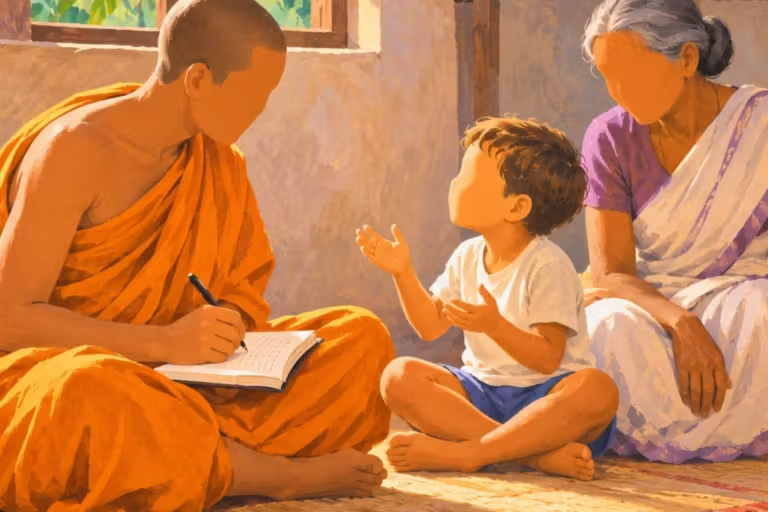
Sujith Jayaratne was about two years old when he began saying that he was called “Gorakana Sammy” and that a lorry had run him over. A Buddhist monk wrote down what he said before checking it. In Gorakana he found the family of Sammy Fernando, who died that way in 1969.
Reincarnation: The top 5 people who remember past lives
We asked them the same five questions as this story. A 32-page PDF, free in your inbox.
Check your email
We have sent you an email. Open it and press the button to confirm. If you cannot see it, check your spam folder.