
An analysis by portalecm, directed by Miguel Parada · interviews published between 2015 and 2026
Does the story of an NDE change over the years? We compare 13 accounts, first version against last
Many people tell the story of their near-death experience again and again, over years. We listened to 13 of them and compared two of their interviews, detail by detail. We also gathered what they themselves say about how they tell it. What they lived through inside is what repeats most. And several explain, in their own words, why they now tell things they used to keep quiet about.
When someone adds a detail to their story years later, is it an embellishment or something they had not told before? The numbers do not say. The people themselves do say something, and they do not all say the same. If you want, go straight to the results.
Step 1
Before we start · We tell it
The doubt anyone has when listening to these accounts

A near-death experience (NDE) is told many times. The person who lived it repeats it in interviews, in talks and sometimes in a book. Over the years, details appear that were not there at the start, and others stop being told.
There are two ways to explain the new details:
- One says that memory gradually adjusts to what the person learned later.
- The other says these are things the person did not tell before, because they did not seem important or because they were hard to tell.
Comparing interviews does not let us choose between the two. It lets us see which kinds of details change most, and hear how the people who tell them explain it.
Step 2
From 2001 to 2020 · Three studies tell it
What had already been measured

The psychiatrist Bruce Greyson, of the University of Virginia, published a study on this in 2007. A group of 72 people answered the same questionnaire twice, about 19 years apart. The average score was similar. Greyson concluded that the accounts had not been embellished in that time. He himself pointed out a limit. Almost 18 years had passed on average since the experience when the study began, so the account could have changed before then.
That questionnaire measures whether each of 16 features was present, such as light or peace, and how intense it was. It does not follow each detail of the account.
The cardiologist Pim van Lommel interviewed resuscitated patients in the Netherlands, and did so again two and eight years later. That follow-up looked at how their lives had changed, not at the details of what they told.
In 2020, a team at the University of Liège counted the details in the memories of 25 people. On average, they gave 53 details of the event itself when talking about their experience. They gave 16 when remembering how they heard some important news. That work compares how rich each memory is, not whether it changes over the years.
We have not found a study on near-death experiences that follows each detail of one person’s account at two points in time. Our search was short, so one may exist.
Step 3
October and November 2026 · We tell it
Thirteen people, and two interviews that tell the whole story
We started with 13 people in our archive who had at least two transcribed interviews. For each one, we wanted two interviews a year or more apart: the oldest and the most recent.
To choose them, we wrote a rule. An interview counts if the person tells the whole story in it, in their own voice: what happened to them, the experience and the return. A fragment does not count. Neither does an interview given to present a book that barely tells the experience.
Nine people have two interviews like that. We make the main count with them. Between one interview and the other, the gap ran from a little over a year to, in one case, about ten.
Three others have one interview in which some part is told only halfway. We made a second count that includes them, with 12 people, to see whether the result depended on leaving them out. The person who is missing has an old interview given to present her book and two recent ones from the same month.
We did not choose them at random. These are people who tell their experience in public, and almost all of them were in the archive because their story contains something that could be checked. Their interviews do not represent everyone who has had an experience like this.
Each interview is split into details. A detail is a person, a sentence, an object, a place, a time or a sensation. Each detail is one of two kinds:
- Checkable. It belongs to this world, and another person or a document could confirm or refute it. For example, who was in the room or how many days she was in hospital. Checkable does not mean checked.
- Not checkable. It is what the person lived through inside. For example, the light, a dead relative or what they felt.
The details were counted twice, separately and with the same instructions, to see whether the same thing came out. That is why you will see two very similar figures in some results.
Then we read 31 interviews of the 13 people in full, to collect only one thing. We wanted to know what they say about their own account and their own memory. More than a thousand sentences came out.
Step 4
October and November 2026 · We tell it and they tell it
What they lived through inside is what repeats most

We looked at which details of the old interview show up again in the recent one.
Nine people, two interviews each. The second figure changes a little depending on the count.
What they lived through inside is told again more than what could be checked. This happens for six or seven of the nine people. With the count of 12 people, the result is almost the same.
They put it in their own way. Scott Drummond is an American who has been telling his near-death experience for six years. In 2026 he says: “my story never changes […] It has been the same story from the very beginning.” In that same interview he says that some things he did not tell until later. For him there is no contradiction. What he lived does not change, and what changes is how much he tells. His numbers say something similar. Of what he said in 2020 that he lived through inside, about 90 in every 100 details are still in an interview recorded almost five years later. Of the checkable details, between 71 and 75 are.
Pablo Lull is a diver from Valencia. In 2024 he says he remembers that moment “far more vivid” than any other moment of his life (translated from Spanish). Almost all of them also say they have no words to tell it.
A detail that does not show up again is not necessarily forgotten. In February 2024, Lull spoke about other lives and a meadow with a wolf, a bear and an eagle. In May 2025, in an hour-long interview, he told none of that. In November 2025, he spoke again about other lives and the meadow with animals, without naming which ones. He himself had warned about it in 2024: “When people ask me about the journey, I don’t usually talk much about the journey.”
Step 5
October and November 2026 · We tell it
What is added looks like what was already there

The recent interviews contain many details that were not in the old ones. There are about 470 among the nine people.
We wanted to know whether what is new is mostly what could be checked, or mostly what they lived through inside.
Nine people, two interviews each. The second figure changes a little depending on the count.
The two figures are very similar. What is new is not mostly checkable, and it is not less checkable than what was already there either.
The small rise comes almost entirely from one person. In 2025, Ana Cecilia González gives many more facts about her hospital admission than in the old talk. Without her, the two figures come out equal.
The people do not all behave the same way. For four of the nine, what is new has more checkable part than the old interview. For the other five, it has less.
With the count of 12 people, what is new is also somewhat more checkable. The figures are in the table below.
Step 6
From 2015 to 2026 · They tell it, in their interviews
How they explain why their account changes

For this part we have all 13 people. They talk about this without anyone asking them in an organized way. They say four different things.
One person can say more than one thing.
They say they now tell what they used to keep quiet about. Six of the 13 say so. Pablo Lull, in 2025: “I keep holding many things back and telling them very much drop by drop.” That day he tells three questions that he says God asked him, and adds: “It is the first time I have done it. You are the second person I have told.” Tessa Romero, a Spanish journalist, stops herself in 2025: “Gosh, I haven’t told that in any interview.” Several say that at first they kept completely silent. María Jesús Araujo remembers what she thought in the hospital: “What do I do with all this? Well, I keep quiet.”
They say that over the years they remember or understand more. Ken Leth, an American, says that as a young man he did not remember his childhood experience. He says that in his twenties he had a very intense dream and that then it all came back. Arantza Alcívar says: “It took me 30 years to become aware of what I had lived.”
They say they have tried to remember. Five of the 13 talk about regressions, meditation or dreams. Lull says he has been remembering through regression therapy. The neurosurgeon Eben Alexander says that meditation helps him recover memories of his experience. For them, it is a memory coming back. People who study memory see in these the situations where it is hardest to tell what was remembered from what was imagined. With interviews, there is no way to know which of the two is happening.
They tell of something that reached them from outside. They say so themselves. Scott Drummond believed for years that the trees he saw were sequoias. In 2026 he says he found out which trees they were because someone wrote it in the comments of a video. Tessa Romero used to say she had not seen any tunnel. In 2025 she says a doctor told her that the elevator she saw was the tunnel. And she adds: “Maybe the chronology is not exact.” They do not live it as a change in the memory, but as understanding better what they saw.
Not all of them tell it this way. In 2026, María Jesús Araujo is asked whether she remembered little by little. She answers no: “I woke up there alone and I was aware of everything that had happened to me.”
What they say counts as what they say. A person who gives many interviews also learns how to explain their account.
Step 7
From 2006 to 2026 · They tell it, in their interviews and books
Three accounts up close
The first two examples are from the 13 people. The third comes from comparing a text, a book and an interview.
Scott Drummond told his experience in public in May 2020. He described how he saw the operation on his thumb from above. He did not say that anyone tried to resuscitate him. In September of that year, in another interview, the host read him doubts from the audience. Several nurses said that in a cardiac arrest like that, they would have tried to bring him back. He answered that there was no doubt people had been trying. He did not say he saw it. In November 2021 he says he could see the people trying to resuscitate him. In 2026 he describes it in detail. He says they cut his clothes, put the paddles on him and he saw the flat line on the monitor. He also keeps telling the operation. With that sequence, we cannot know whether the comments changed his memory or made him tell something he had not told before.
María Jesús Araujo told her experience in July 2024. She remembered little of the doctors’ movements, although she spoke of the commotion and of being rushed along. In June 2026 she describes the scene from above and counts four health workers, two women and two men. The July 2024 talk that we compared at the start lasted a quarter of an hour, and the 2026 interview lasted almost an hour. She says she knew everything from the moment she woke up.
Anita Moorjani wrote her near-death experience in 2006. A copy of that text was saved in October 2006, eight months later. Already in it she says she saw and heard a conversation between her husband and the doctors, “about 40 feet away down a hallway.” In that text she also says she had not yet spoken about her experience with her doctors. In her 2012 book she adds that on waking she recognized Dr. Chan, and that he asked her how she had recognized him. In a 2023 interview she says he asked her how she knew his name. We tell it in full in Anita Moorjani’s story.
Step 8
October 2026 · We tell it
Sometimes the detail was already there

The opposite also happens. In another search, we looked at old interviews of 14 people. In several, what could be checked was already in the oldest interview we found. In others, it appeared later.
Elizabeth Krohn is one of the first. What she says was announced to her during her experience is already in the oldest interview we have found, from 2019. We tell it in Elizabeth Krohn’s story.
The oldest interview does not prove by itself that the person told it before they could know it. For that we need something written or recorded with an earlier date.
The main count: nine people
These are the nine people who have two interviews with the whole story. Each interview was counted twice, separately.
| What | First count | Second count |
|---|---|---|
| Details in the old interview | 830 | 853 |
| Checkable | 354 | 369 |
| Not checkable | 460 | 462 |
| Doubtful | 16 | 22 |
| Checkable details that show up again | 62 in every 100 | 65 in every 100 |
| Not checkable details that show up again | 73 in every 100 | 73 in every 100 |
| New details in the recent interview | 464 | 474 |
| Checkable | 218 | 228 |
| Not checkable | 235 | 230 |
| Doubtful | 11 | 16 |
| Checkable in the old interview | 44 in every 100 | 44 in every 100 |
| Checkable among the new details | 48 in every 100 | 50 in every 100 |
The check: twelve people
Here we also include three people with some part of their account told only halfway. It serves to see whether the result changes.
| What | First count | Second count |
|---|---|---|
| Details in the old interview | 1,155 | 1,204 |
| Checkable | 425 | 430 |
| Not checkable | 713 | 750 |
| Doubtful | 17 | 24 |
| Checkable details that show up again | 62 in every 100 | 65 in every 100 |
| Not checkable details that show up again | 74 in every 100 | 73 in every 100 |
| New details in the recent interview | 758 | 775 |
| Checkable | 340 | 332 |
| Not checkable | 404 | 423 |
| Doubtful | 14 | 20 |
| Checkable in the old interview | 37 in every 100 | 36 in every 100 |
| Checkable among the new details | 46 in every 100 | 44 in every 100 |
What these figures don’t tell
- A detail counts the same whether it is important or not.
- The time of an operation and the color of a wall count one each.
- The percentages are calculated without the doubtful details.
- The figures add up details, so a person who talks a lot weighs more than one who talks little.
- We chose the interviews with a rule that we wrote after seeing some first results.
Frequently asked questions
Do people who have had a near-death experience change their account over the years?
Yes, in part. In our analysis, most of the details show up again years later. Many new ones also appear, and others stop being told. The details of what was lived through inside repeat more than the ones that could be checked.
Why does someone tell new things about their experience years later?
The people themselves give several reasons. Some say they kept quiet at first and are telling it little by little. Others say that over the years they remember or understand more. And some say that someone later explained something they had seen.
Are near-death experience accounts embellished over time?
In 2007, Bruce Greyson did not find that 72 people scored their experience higher almost twenty years later. Our analysis cannot say whether a new detail is an embellishment or something that was not told before.
Why does it matter when a detail was first told?
Because to know whether someone perceived something they could not have known, we have to check that they told it before finding out some other way. If they tell it afterwards, it may be true, but that account can no longer show how they came to know it.
Who made this analysis and with what data?
It was made by portalecm, directed by Miguel Parada, with interviews published between 2015 and 2026.
Where this page comes from
Other studies
- Bruce Greyson, “Consistency of near-death experience accounts over two decades: Are reports embellished over time?”, Resuscitation (2007), in EnglishRead our page
- Pim van Lommel and others, “Near-death experience in survivors of cardiac arrest,” The Lancet (2001), in EnglishRead our page
- Helena Cassol and others, University of Liège, Frontiers in Psychology (2020), in English
The stories
Our archive
- The compared interviews, the rule for choosing them, the lists of details from the two counts and the sentences from the 13 people about their own account
More studies
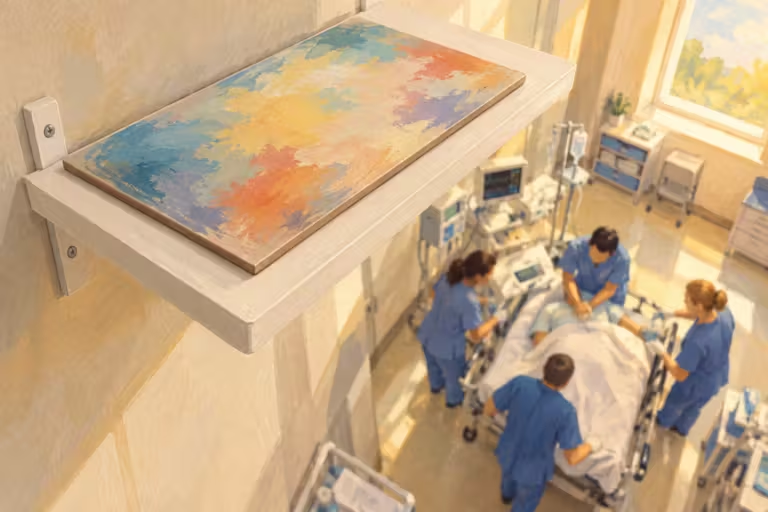
AWARE: the pictures hidden on the shelves
Fifteen hospitals put up pictures that could only be seen from the ceiling, to check whether anyone saw them during a cardiac arrest.
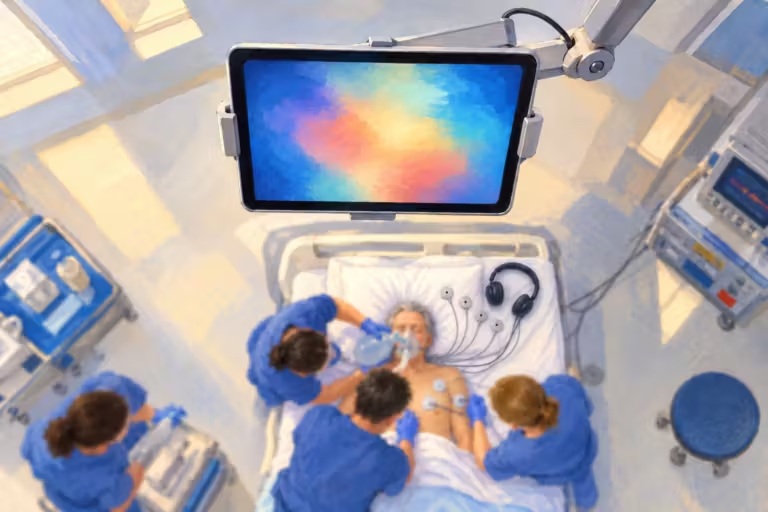
AWARE II: a random picture and the brain on the screen
Above the patient was a tablet with a random picture. Headphones said the names of three fruits. And the doctors measured the brain during resuscitation.

Van Lommel: 344 cardiac arrest survivors in ten hospitals
Ten hospitals asked every cardiac arrest survivor what they remembered. They saw them again after 2 and 8 years.