A study and a book · Seattle (United States), published 1985 to 1990
“Closer to the Light”: a pediatrician asks children who nearly died what they remember
In 1982, the pediatrician Melvin Morse resuscitated a girl who had nearly drowned. When she woke up, the girl told him she had made a journey through a tunnel. Morse wanted to know whether the same thing happened to other children. He compared children who nearly died with very sick children who did not nearly die. He published what he found in two articles and in a book that sold enormously well.
The question of the study is: do you need to be close to death to have an NDE, or is it enough to be very sick and on medication? We tell it step by step, with what Morse published in the journals, what changed in the book and what other researchers said. If you only want to know what he found, go straight to the results.
Step 1
1982 · Pocatello, Idaho · Told by Melvin Morse
A young doctor resuscitates a 7-year-old girl who has nearly drowned
Melvin Morse was a young doctor finishing his training as a pediatrician. In 1982 he was working for a few months at a hospital in Pocatello, Idaho. One day Kristle Merzlock, a 7-year-old girl who had nearly drowned in a swimming pool, was brought to the emergency room.
A doctor who was at the pool had pulled her out of the water, put a breathing tube in and started resuscitating her. In the emergency room, Morse took over the resuscitation. Kristle spent three days in a coma at another hospital, in Salt Lake City, and she recovered.
Three weeks later, Kristle told Morse that she had gone through a dark tunnel. She told him that a woman had taken her to heaven and that there she had seen her dead grandparents. Morse published it in 1983 in a pediatrics journal. It was one of the first NDE cases in a child to be published in a medical journal. Her full story is in Kristle Merzlock’s near-death experience.
Morse wondered whether the same thing happened to other children.
Step 2
From 1983 · Seattle · Told by the articles
He searches a children’s hospital for children who nearly died

Morse was training at the children’s hospital in Seattle, Children’s Orthopedic Hospital. Morse and other doctors went through the medical records of the children’s intensive care unit from 1978 onward. They separated the children into two groups:
- Children who nearly died. They had had a cardiac arrest or a deep coma. With those problems, more than 10 in every 100 children die.
- Very sick children who did not nearly die. They had been in the same unit, with a breathing tube and with strong medicines for pain and for sleep.
The idea was simple. If NDEs are caused by the medicines or by the fear of being in the unit, both groups would tell them equally. If you need to be close to death, mainly the children in the first group would tell them.
To compare the two groups, every child had to be asked in the same way.
Step 3
1985 · The first article
4 of 7 children who nearly died remember something, and none of 6 very sick children do
In the first article, from 1985, Morse and two colleagues interviewed 13 children. The interviews were at least two months after the children left the hospital, sometimes years later. The parents were present.
First they asked in general terms: “What do you remember about the time you were unconscious?”, “Did you have any dreams?”. Young children were given paper and pencils to draw. Only at the end did they ask yes-or-no questions, such as “Did you see a tunnel?”.
- Of the 7 who nearly died, 4 remembered something. When he woke up, one boy told his parents that he had climbed a dark staircase. Another child said he had left his body and gone through a tunnel of colored lights, “like airplane landing lights”.
- Of the 6 very sick children, none remembered anything from the time they were unconscious.
These were very few children. Morse kept looking.
Step 4
1986 · The second article
With more children, the same result: 7 of 11 against none of 29
In 1986, Morse and four other doctors published the study with more children. They reviewed 202 medical records from 1978 to 1984. That left 40 children aged 3 to 16 who had fully recovered and agreed to talk.
- 11 had nearly died. 7 of them told something from the time they were unconscious.
- 29 had been very sick, with a breathing tube and strong medicines. Three remembered moments of their operation. Another child heard the nurses ask for a medicine. None told anything else.
In this study, any memory of the time unconscious counted as an NDE. But the memories of those four children in the comparison group were not counted as NDEs, and the article does not explain why.
After each interview, the doctor who had done it dictated a summary. A person who did not know the details of the study read those summaries and compiled the data. But the doctors of the study did the interviews. They were the same doctors who had chosen the children for each group from the medical records. So they knew which group each child was in when they asked their questions.
The difference between the two groups was very large. What did those 7 children tell?
Step 5
1986 · What the children told · Told by the second article
Leaving the body, a tunnel, and a class singing beside the bed
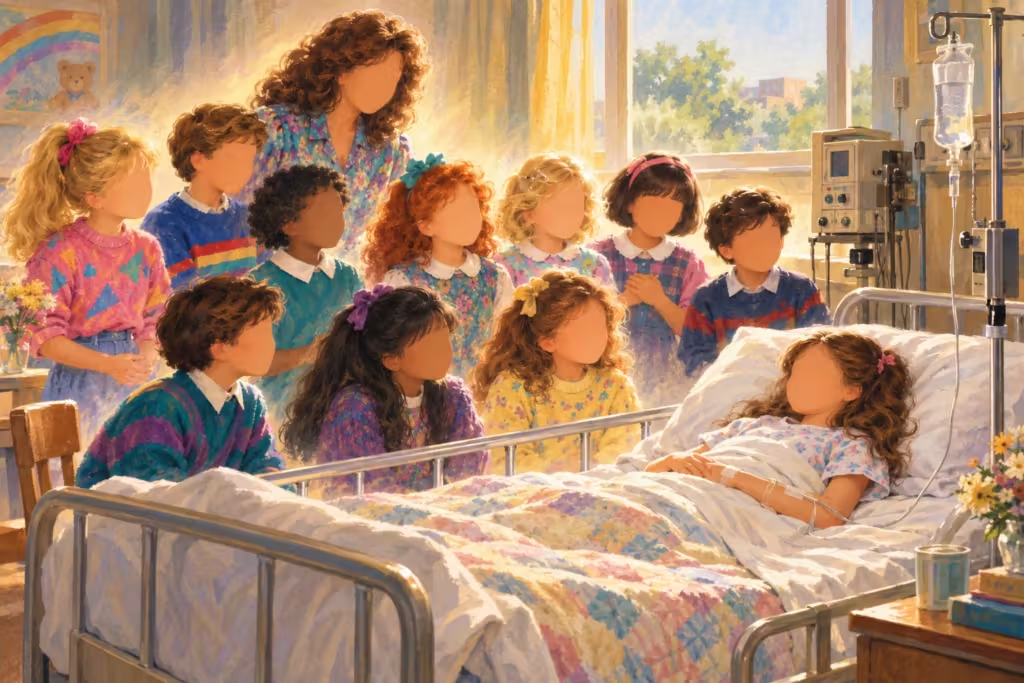
This is what the 7 children who remembered something told:
- 6 left their body and saw it from above.
- 5 went into darkness and 4 went through a tunnel.
- 3 saw people dressed in white, and 3 decided to go back to their body.
- 2 saw their teacher and their classmates, who are alive. One girl heard them sing her a song beside the bed.
- 1 saw a dead relative.
Not all of it was pleasant. Three children told something that frightened them, and one girl saw her mother as a monster. No child said they saw their life pass before them. Many adults do tell this. The children’s accounts were shorter than adults’, like pieces of memory.
One of the 7 children told something more. He told what he saw of his resuscitation.
Step 6
Seattle · The boy in the lobby · Told by the 1986 article and the book
An 11-year-old boy says he heard a nurse: “I wish we didn’t have to do this”
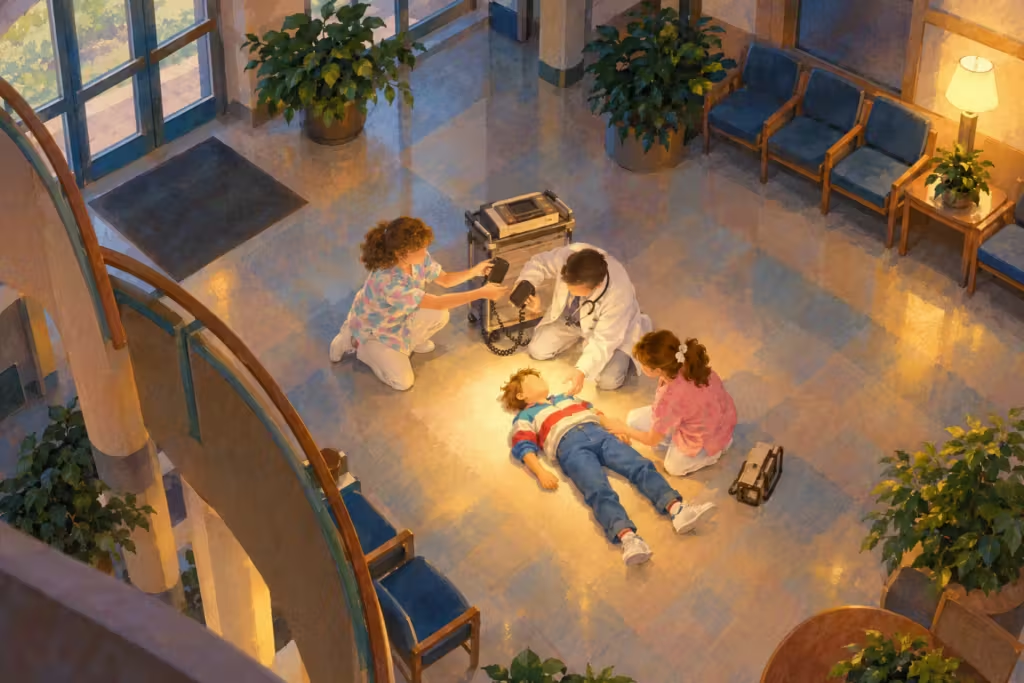
An 11-year-old boy had a cardiac arrest in the lobby of Children’s Orthopedic Hospital in Seattle. He said he heard a whooshing sound. Then he was floating on the ceiling and saw his body below.
He said he heard a nurse say “I wish we didn’t have to do this”. He also said he saw the nurse put some grease on his chest and hand the defibrillator paddles to the doctor. When the doctor pressed the button, he felt a very strong pain and was back in his body.
According to the 1986 article, the nurses who were there say the boy spoke when he opened his eyes. He said this: “That was really weird. I was floating above my body”. He did not remember saying it.
According to the book, one of the nurses remembers saying “I wish we didn’t have to do this”. The book does not say when or to whom the nurse told this memory. Morse spoke with the boy seven years after the cardiac arrest. In that conversation, the boy told him what he remembered.
In 1990, Morse told all of this in a book.
Step 7
1990 · The book · Told by Melvin Morse
Morse writes a book for parents and it becomes a best seller
Morse wrote Closer to the Light with the journalist Paul Perry. He wanted the parents of very sick children to know what some children tell when they are about to die. The book spent three months on The New York Times best-seller list.
The study is bigger in the book than in the articles:
- 12 children who nearly died, and 8 with an experience. In the 1986 article, they were 11 and 7.
- 121 very sick children in the comparison group. Morse also interviewed another 37 children who were not in that group. Those children had taken almost every kind of mind-altering medicine.
Morse writes that the study proved something “as no other study before”. According to Morse, it proved that you have to be on the brink of death to have an NDE. And he writes that his results ruled out medicines as the cause of NDEs.
At the start, the book warns that names, ages and some details of the cases were changed, to protect the children.
When you read the book next to the articles, a difference appears.
Step 8
1985, 1986 and 1990 · We compared them at portalecm
The account of the girl with the red button changes between the articles and the book
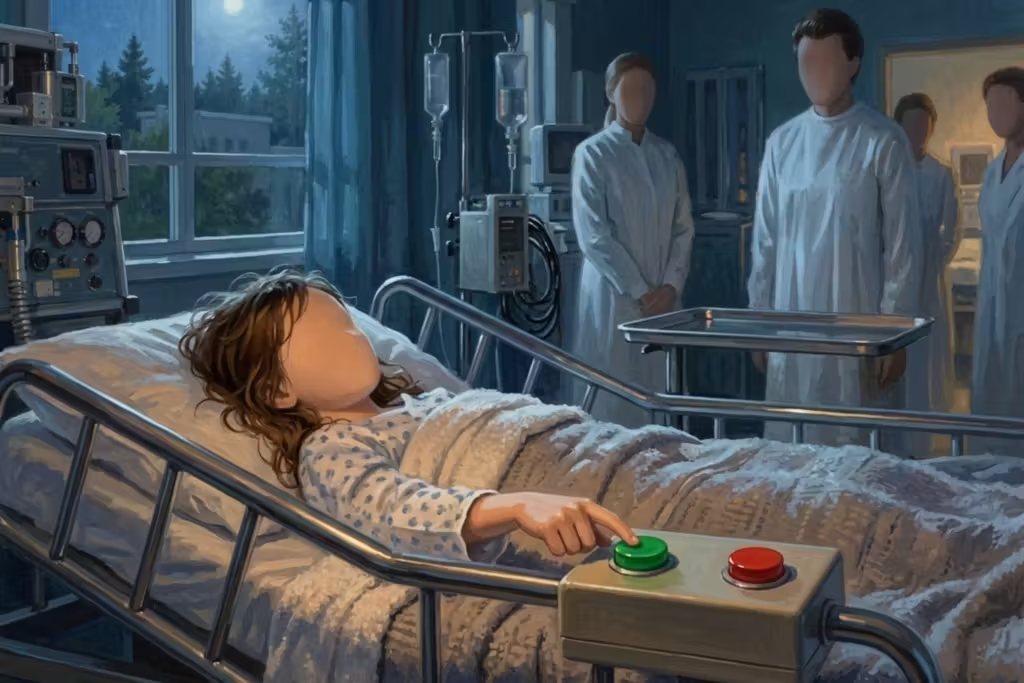
An 8-year-old girl went into a coma because her blood sugar rose very sharply. She later said that some men dressed in white told her to press a red button. She pressed a green one and woke up.
At portalecm we have compared the 1985 and 1986 articles with the 1990 book. The accounts appear to describe the same girl: the age, the diabetic coma and the scene with the two buttons all match.
- In 1985, the girl says she floats above her body, on an examination table, and sees two male doctors. The article says she could give no further details of that scene.
- In 1986, she sees “two doctors” and draws them with green masks.
- In the 1990 book, they are two women doctors pushing her stretcher. Morse adds that the girl was right about where the instruments were and how many people were in the room, but he does not explain how he checked those details.
The articles do not say she got those details right. The book adds that. The book warns that it changed some details to protect the children, and it is not known whether that explains these differences. That is why we keep what the articles report apart from what the book adds.
The size of the comparison group also changes from one text to another.
Step 9
From 1985 to 1994 · Morse’s texts
Morse’s texts give different sizes for the comparison group

The comparison group is the very sick children who did not nearly die. It is the most important part of the study. Its size changes depending on the text:
- 6 children in the 1985 article.
- 29 children in the 1986 article.
- 121 children in the 1990 book.
- 176 children in his second book, Transformed by the Light, from 1992.
- 121 children in a review Morse published in 1994.
In the 1994 review, Morse says he expanded the study with children interviewed between 1985 and 1992. Of 26 children who nearly died, 22 remembered something. The comparison group had 121 children. The 1985 article includes a table for each child. The 1986 and 1994 texts describe the groups and several cases, but they do not give the full list of children.
We have not found an explanation of why the 1992 book gives 176 children and the 1994 review goes back to 121.
Step 10
From 1990 to 1994 · What Melvin Morse proposes
Morse believes a part of the brain lets us see the beyond

In the book, Morse proposes that there is an area of the brain prepared for this experience. It is on the right side, above the ear. He calls it “the seat of the soul”. Morse did no experiment to test it. He relies on what patients undergoing brain surgery said in the 1950s.
In 1994, Morse explained to a Seattle Times journalist how he sees it. For Morse, that area does not create the experience. It serves to perceive something that comes from outside the body.
In 1993, the researcher Robert Kastenbaum criticized his second book. Morse replied in a letter. In it, Morse wrote that his own work was “speculative and inspirational”. And he wrote that it served to raise questions, not to settle them. In the same letter he wrote that, for him, the evidence points to something of the person surviving death.
Other researchers reviewed his study.
Step 11
From 1990 to 2001 · What came next
Two criticisms and a study with adults that agrees with Morse

- The psychologist Susan Blackmore, in 1993, explained NDEs with the brain. She said Morse’s comparison does not rule out lack of oxygen. The children in the comparison group did not have a cardiac arrest or a coma. For Blackmore, they may not have seen tunnels because their brains did not lack oxygen. She also said the comparison does not rule out endorphins. These are substances the brain itself makes at times of stress, and they resemble morphine.
- Justine Owens, Emily Cook and Ian Stevenson, in 1990, studied at the University of Virginia whether something of the person survives death. They reviewed the medical records of 58 people who described an NDE. More than half had not been close to death. That was 30 of the 58. That does not fit Morse’s idea that you need to be on the brink of death.
- Pim van Lommel, in 2001, asked 344 adults resuscitated in ten hospitals in the Netherlands. Medicines did not explain who had an NDE. It is the same thing Morse saw in children.
Let’s see what can be said with what Morse published.
The two articles of the Seattle study
These are the figures published in a pediatrics journal. The 1985 article includes a table for each child. The 1986 article describes the groups and several cases.
In both, no account from a child in the comparison group was counted as an NDE.
| Group | 1985 | 1986 |
|---|---|---|
| Nearly died | 4 of 7 | 7 of 11 |
| Very sick, without nearly dying | 0 of 6 | 0 of 29 |
The comparison group in each text
In order of date. We have not found an explanation of the changes.
| Text | Children |
|---|---|
| 1985 article | 6 |
| 1986 article | 29 |
| 1990 book | 121 |
| 1992 book | 176 |
| 1994 review | 121 |
What these figures don’t tell
- With so few children, a big difference can turn out smaller in a larger study. 7 of 11 is 64 in every 100, but with 11 children that figure can change a lot.
- In 1986, any memory of the time unconscious counted as an NDE. A single image counted the same as a full experience. But three children in the comparison group remembered moments of their operation, and one heard the nurses. Those memories were not counted as NDEs. The article does not explain why.
- In other hospitals NDEs are less frequent. The figures are in How many people have an NDE? The explanations are in What does science say about these experiences?
Where this page comes from
The book
- Melvin Morse and Paul Perry, Closer to the Light: Learning from the Near-Death Experiences of Children (Villard, 1990). The link goes to the 1991 paperback reissueBuy the book
- The same book, to borrowBorrow it on archive.org
The articles
- Melvin Morse, “A Near-Death Experience in a 7-Year-Old Child”, American Journal of Diseases of Children, 1983 (paywalled)View in the journal (paywalled)
- Melvin Morse, Doug Conner and Donald Tyler, “Near-Death Experiences in a Pediatric Population”, American Journal of Diseases of Children, 1985 (paywalled)See the abstract
- Melvin Morse and four other doctors, “Childhood Near-Death Experiences”, American Journal of Diseases of Children, 1986 (paywalled)See the abstract
- Melvin Morse, “Near death experiences and death-related visions in children”, Current Problems in Pediatrics, 1994 (paywalled)View in the journal (paywalled)
- Melvin Morse, letter on the review of Transformed by the Light, Journal of Near-Death Studies, 1993Read for free
Assessments and criticism
- Susan Blackmore, Dying to Live (1993)Read our page
- Justine Owens, Emily Cook and Ian Stevenson, “Features of ‘near-death experience’ in relation to whether or not patients were near death”, The Lancet, 1990 (paywalled)View in the journal (paywalled)
- Pim van Lommel and others, the study in ten hospitals in the Netherlands (2001)Read our page
To understand more
Our archive
- The full reading of Morse’s book and of his 1983, 1985 and 1986 articles, as of 21 October 2026
More studies
AWARE: the pictures hidden on the shelves
Fifteen hospitals put up pictures that could only be seen from the ceiling, to check whether anyone saw them during a cardiac arrest.
AWARE II: a random picture and the brain on the screen
Above the patient was a tablet with a random picture. Headphones said the names of three fruits. And the doctors measured the brain during resuscitation.
Van Lommel: 344 cardiac arrest survivors in ten hospitals
Ten hospitals asked every cardiac arrest survivor what they remembered. They saw them again after 2 and 8 years.