
Six studies · from 1992 to 2023
Distressing NDEs in six studies: how common they are and what is known about them
A near-death experience, or NDE, is a very intense experience that some people have when they are about to die. Most people describe peace and light, but some describe fear, an endless void, or scenes that look like hell. Researchers call these distressing NDEs. Six studies published between 1992 and 2023 have tried to describe them and count them. Their figures range from 11 to 23 out of 100 NDEs, and on this page we explain why they vary so much. We also cover what the studies have found about who has them, how they are remembered, and what might play a part.
The question on this page is: how many NDEs are distressing, and what do we really know about them? We go through the studies in order, from the oldest to the most recent. If you only want to know what is known, skip straight to the results.
Step 1
Before 1992 · The question
For years, hardly anyone asked about frightening NDEs

The first books on NDEs, in the 1970s, talked almost only about peace, light, and kind beings. In 1984, the psychologist Kenneth Ring wrote that unpleasant NDEs were at most one in a hundred. A Gallup poll in the United States gave a similar figure.
Other researchers found many more. In 1979, the psychologist Charles Garfield interviewed 36 people a few days after they had come close to death. Eight described nightmarish visions. In 1981, a study in the northwestern United States found 11 partly negative experiences out of 55.
The figures did not match, and nobody was quite sure what to count as a distressing NDE.
Two researchers decided to start by describing them.
Step 2
1992 · Greyson and Bush · As the study tells it
From 50 accounts, Greyson and Bush describe three types of distressing NDE
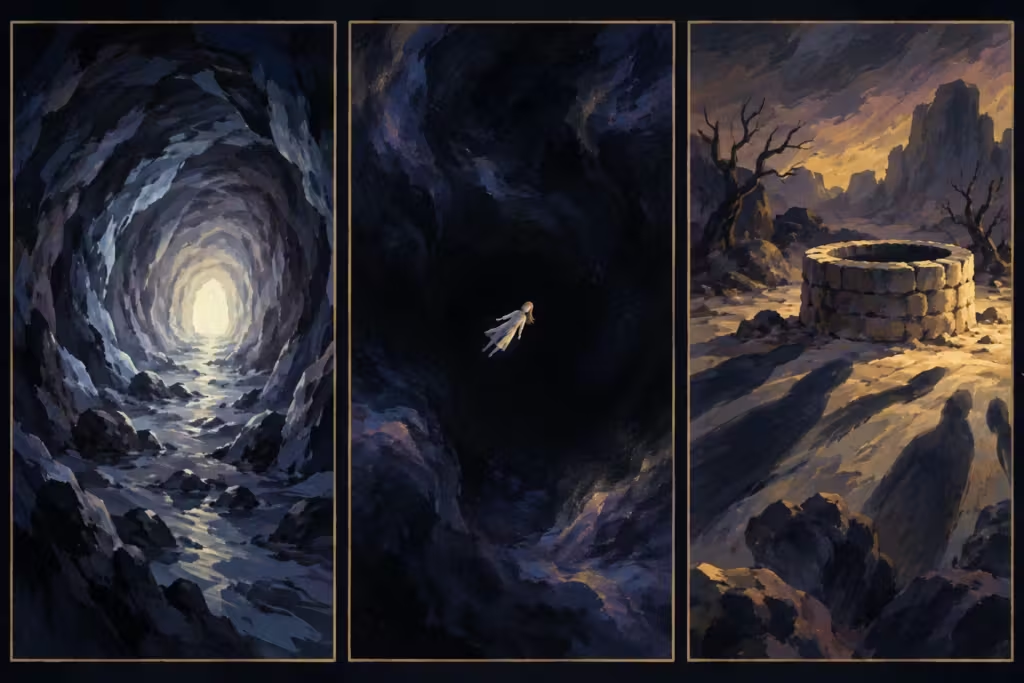
The psychiatrist Bruce Greyson had created the scale used to measure NDEs. In 1992, he and the researcher Nancy Evans Bush published the first study devoted to these experiences. Over ten years, about 30 people had written to them on their own to tell them about a terrifying NDE. The two then placed a notice in the newsletter of the International Association for Near-Death Studies. In all, they gathered 50 accounts.
From these accounts they described three types:
- The inverse NDE. It has the same features as a pleasant NDE, such as leaving the body, a tunnel, or a light, but the person goes through it in terror. Often what frightens them is losing control. Some become calm when the person stops resisting.
- The void. The person feels they are ceasing to exist, or that they are alone forever in an endless nothingness. Sometimes they feel they are being told that their life was never real. According to the authors, most of these happened to women giving birth under anesthesia.
- The hellish NDE. The person sees dark landscapes and frightening beings, or falls down a pit. According to the authors, these were the least common among their accounts.
This study gives no percentage. The 50 accounts were gathered precisely because they were distressing, so they cannot show how many NDEs are distressing. Nor do they say how many accounts there are of each type.
That same year, another researcher gave a figure based on her interviews.
Step 3
1992 · Atwater · As she tells it
Atwater counts 105 distressing cases among more than 700 people she interviewed

Phyllis Atwater is an American researcher who had been interviewing people with an NDE since 1978. She had had three herself, all three pleasant. In 1992, she wrote an opinion piece in the journal of NDE studies.
In it she says that, among more than 700 people she had asked, 105 had a distressing experience. That is about 15 out of 100. She does not explain how she chose these people or what she counted as distressing, because it is not a study with a method.
Atwater noticed other things. None of the children she interviewed described anything terrifying. Nobody described fire to her. They described cold. And the same scene could be joyful for one person and horrible for another. She also suggested that hellish NDEs happen mostly to people who carry guilt or expect punishment. She gave no data to back this up.
Seventeen years later, Nancy Evans Bush brought together all the published figures.
Step 4
2009 · Bush · As her review tells it
Bush adds up thirty years of studies and concludes they may be between 15 and 19 out of 100

In 2009, Nancy Evans Bush wrote the chapter on distressing NDEs in the standard reference book on NDEs, the Handbook of Near-Death Experiences. She went over the studies published since 1975.
She found 9 studies, with 459 people, in which nobody described a distressing NDE. And another 12 studies, with 1,369 people, in which 315 did. In those 12 studies, that is 23 out of 100. She does not say which studies they are, or how many cases each one contributes.
These studies were done in very different ways. Some asked all the patients in a hospital, and others collected accounts from people who wrote in on their own. Some were looking specifically for distressing experiences.
Her final conclusion is more cautious than that 23 out of 100. She writes that distressing NDEs are more common than was believed, and that they may be in the “mid- to high teens” out of 100. That means between 15 and 19. In the Psi Encyclopedia, an online encyclopedia, she does the calculation with all 21 studies together. These are the 9 with no distressing NDEs and the 12 with some, and she gets 17 out of 100. She also writes that there is no evidence that they are a punishment for having done something wrong.
The studies that followed looked at more specific groups of people.
Step 5
2015 · Liège · As the study tells it
With an injury at the base of the brain, NDEs bring much less peace

Locked-in syndrome is when a person is conscious but cannot move or speak. They can only move their eyes. It is caused by an injury to the brainstem, the lower part of the brain that connects it to the spinal cord.
In 2015, the neuropsychologist Vanessa Charland-Verville and her team at the University of Liège, in Belgium, looked for people with this syndrome. They asked 14 who remembered something from their coma. Eight described an NDE. The team compared them with 23 people who had an NDE after a coma caused by an injury to another part of the brain.
Peace was felt by 3 of the 8 people with locked-in syndrome, and by 22 of the 23 in the other group. It was the only clear difference. On average, they described their NDE about 19 years after having it.
The authors give two possible explanations and do not choose between them. One is that the injury changes how the brain areas that control emotions work. The other is that waking up trapped in a body that does not move would take the peace away from anyone.
This study did not measure fear. The scale they used only asks about pleasant features, so it shows less peace, not more distress.
Four years later, the same Liège group compared how distressing NDEs are remembered.
Step 6
2019 · Liège · As the study tells it
Among 123 people who had been in a coma, 17 describe a distressing NDE

In 2019, the neuropsychologist Helena Cassol and the Liège group reviewed the accounts they had received since 2010. They used only those from people who had been in a coma for more than an hour and admitted to the ICU. Their experience also had to reach the minimum score on Greyson’s scale to count as an NDE. In all, 123 people met these conditions.
To find out whether an NDE was distressing, they asked how the person’s emotions felt at the time, from very negative to very positive. They were negative in 17 of the 123. That is about 14 out of 100. Eight were inverse NDEs, 8 were hellish, and only 1 was a void. Unlike in Greyson and Bush’s accounts, the rarest type was the void.
People remembered distressing NDEs with the same detail and the same clarity as pleasant ones. Distressing and pleasant NDEs had almost the same features, except for peace and joy.
There was one more difference. Four of the 17 people with a distressing NDE had it after a suicide attempt. Among the 106 with a pleasant NDE, only one did. The authors suggest that what the person was feeling beforehand might influence how they experience it.
The authors warn that these people came forward on their own, so the figure may not apply to everyone.
The largest study was published by Bruce Greyson in 2023.
Step 7
2023 · Virginia · As the study tells it
In 546 Virginia accounts, 58 are distressing, and the only thing that stands out is resisting

In 2023, Bruce Greyson published an overview of distressing NDEs with new data from the University of Virginia’s collection. It holds 546 accounts that people sent in on their own. Of these, 437 were pleasant, 51 neutral, and 58 distressing. That is about 11 out of 100.
Greyson looked at whether distressing NDEs were linked to sex, age, childhood, or cause. He also looked at religion, mood, and suicide attempts. He found no clear link with any of these.
The only thing that stood out was the person’s attitude just before the experience. Among those who wanted to let go, 6 out of 100 were distressing. Among those who were fighting to stay in control, 17 out of 100 were.
Greyson also points out that the scales for measuring NDEs were designed with pleasant ones in mind. As a result, some distressing NDEs do not score high enough to count as NDEs.
That leaves the question we started with: how many NDEs are distressing? Let’s look at what is known and what isn’t.
The figures from each study and where they come from
How many distressing NDEs each study found, and how it gathered the people.
| Study | How the people were gathered | Distressing |
|---|---|---|
| Greyson and Bush, 1992 | 50 accounts sent in by people who chose to, looking for distressing ones | No figure given |
| Atwater, 1992 | Interviews with more than 700 people, with no published method | 105, about 15 out of 100 |
| Bush, 2009 | Total of 21 studies done in different ways | About 17 out of 100. In 12 of those studies, 23 |
| Charland-Verville, 2015 | 8 patients with locked-in syndrome | Does not measure distress. Peace in 3 of 8 |
| Cassol, 2019 | 123 accounts from people who had been in a coma, sent in by people who chose to | 17, about 14 out of 100 |
| Greyson, 2023 | 546 accounts from the Virginia collection, sent in by people who chose to | 58, about 11 out of 100 |
What these figures don’t tell you
- Each study calls something different “distressing.” The Liège study uses a single question about emotions, the Virginia study looks at the tone of the account, and Atwater does not explain.
- They are not figures for the whole population. None of them asked everyone who had come close to death.
Frequently asked questions
How many near-death experiences are distressing?
Nobody knows exactly. The studies give between 11 and 23 out of 100. The most recent studies, with the most people, give between 11 and 17. In the University of Virginia’s collection, 58 of 546 accounts were distressing. Almost all the accounts were sent in by people who chose to, and many people keep a distressing experience to themselves.
Is it true that one in five near-death experiences is distressing?
Not exactly. That figure comes from a 2009 review by Nancy Evans Bush, who found 23 out of 100 in 12 studies. But Bush herself concludes that they may be between 15 and 19 out of 100. When the studies with no distressing NDEs are also included, it comes to about 17 out of 100.
Why do some people have a distressing NDE and others don’t?
Nobody knows. In the University of Virginia’s collection, the only thing that stood out was the attitude just before. NDEs were distressing almost three times as often among those fighting to stay in control as among those who let go. In another study, from Liège in 2019, they were more common after a suicide attempt, which the Virginia study did not find.
Are distressing NDEs remembered the same way as pleasant ones?
Yes, according to a 2019 study from the University of Liège with 123 people. Distressing NDEs were remembered with the same detail and the same clarity as pleasant ones. And they had almost the same features, except for peace and joy.
Where this page comes from
The studies
- Bruce Greyson and Nancy Evans Bush, “Distressing near-death experiences,” Psychiatry 55(1):95-110 (1992)View in the journal (paywalled)
- Phyllis Atwater, “Is there a hell? Surprising observations about the near-death experience,” Journal of Near-Death Studies 10(3):149-160 (1992)Read for free
- Nancy Evans Bush, “Distressing Western near-death experiences: finding a way through the abyss,” in The Handbook of Near-Death Experiences, Praeger, pp. 63-86 (2009)View at the publisher (paywalled)
- Vanessa Charland-Verville and others, “Near-death experiences in patients with locked-in syndrome: not always a blissful journey,” Consciousness and Cognition 34:28-32 (2015)View in the journal (paywalled)
- Helena Cassol and others, “A systematic analysis of distressing near-death experience accounts,” Memory 27(8) (2019)Read for free
- Bruce Greyson, “The darker side of near-death experiences,” Journal of Scientific Exploration 37(4):683-698 (2023)Read for free
To understand more
- Nancy Evans Bush and Bruce Greyson, “Distressing near-death experiences: the basics,” Missouri Medicine 111(6):486-490 (2014)Read for free
- Nancy Evans Bush, “Distressing near-death experience,” Psi EncyclopediaRead for free
- What happens when a near-death experience is frightening?Read
- The Kondziella survey, in which 36 of 77 NDEs were unpleasantRead
- Howard Storm’s storyRead
Our archive
- A full reading of the six studies, checked page by page, as of October 30, 2026
More studies

AWARE: the pictures hidden on the shelves
Fifteen hospitals put up pictures that could only be seen from the ceiling, to check whether anyone saw them during a cardiac arrest.
AWARE II: a random picture and the brain on the screen
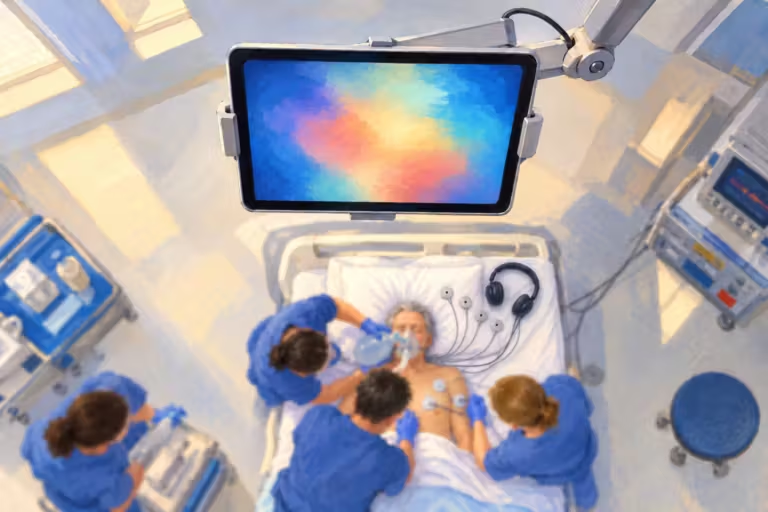
Above the patient was a tablet with a random picture. Headphones said the names of three fruits. And the doctors measured the brain during resuscitation.

Van Lommel: 344 cardiac arrest survivors in ten hospitals
Ten hospitals asked every cardiac arrest survivor what they remembered. They saw them again after 2 and 8 years.